Pro-Tip: Viewing on a phone? Select desktop mode or rotate to landscape for the best reading experience!
Estimated Read Time: 9 Minutes
Rabbit Recovery Food: A Practical Feeding Guide
Written by Cookie Yiyi, founder of Oishi Bunnies
Drawing on nine years of rabbit care and hands-on experience rescuing, fostering and rehabilitating 18 rabbits, Cookie Yiyi brings a practical carer’s perspective to this rabbit recovery food guide. Product details are checked against manufacturer instructions, with feeding principles informed by veterinary and rabbit-welfare sources listed below. This guide supports an individual veterinary feeding plan.
When a rabbit eats less, the questions pile up fast. Which rabbit recovery food should you use? How should you prepare it? How much has bunny actually eaten—and what happens when the syringe gets a firm nose of disapproval?
A rabbit recovery diet provides nutritional support while the reason for poor eating is investigated and treated. Choosing a formula is one part of the plan; preparation, feeding technique and recording what your rabbit accepts matter too.
If you’re comparing Critical Care for rabbits with other recovery formulas, this guide explains their ingredients, nutritional roles and preparation instructions. It also covers syringe feeding rabbits, voluntary bowl and spoon feeding, storage, and practical ways to help a reluctant bunny accept the food prescribed.
Whether you’re reading about rabbit GI stasis, post-operative care or an ongoing feeding difficulty, use this guide alongside your rabbit’s veterinary plan. The aim is to understand the instructions, make feeding more manageable and give the clinic a clear picture of progress.
Bunnini: “Understand the food. Follow the plan. Record the mouthfuls.”
Pee-Casso: “And no wrestling matches at dinner. Noted.”
Quick Answer

Oxbow Critical Care Herbivore, EmerAid Sustain Herbivore, EmerAid Intensive Care Herbivore, Supreme Science Selective RecoveryPlus and Sherwood Rabbit Recovery Food
all offer nutritional support for rabbits that can’t meet their needs through normal eating.
Their formulations and intended uses differ. The right choice depends on your rabbit’s condition, feeding tolerance and veterinary plan, not on which packet shows the highest fibre percentage.
If your rabbit stops eating, passes markedly fewer droppings, or develops abdominal pain or swelling, contact a rabbit-savvy vet promptly.
Stasis and intestinal obstruction need different care, and owners can’t reliably tell them apart at home.
Recovery Formulas: Label Figures, Fibre Sources & Storage
Use clean equipment, keep dry powder dry and follow each manufacturer’s directions. Never return a wet or saliva-contaminated scoop to the bag.
On smaller screens, scroll the table sideways to see all columns, including storage and hygiene.
| Checked formula | Crude protein | Crude fat | Crude fibre | Calculated energy per gram of dry powder | Selected fibre ingredients & their roles | Storage & hygiene |
|---|---|---|---|---|---|---|
| Oxbow Critical Care Herbivore Anise | Minimum 17% | Minimum 5% | Minimum 21%; maximum 26% | 2.66 kcal | Timothy grass meal, soybean hulls and inulin. Timothy and hulls supply plant fibre; some components contribute energy through fermentation. Inulin provides fermentable fibre with a prebiotic role. |
Opened powder: Oxbow’s official pages conflict. Its help centre states 90 days in a tightly sealed container in a cool, dry place; its Tips and Tricks blog states 30 days. Follow the current packet, and ask Oxbow if it’s unclear. Prepared food: The help centre directs refrigeration in a clean, airtight container, use within 24 hours and bringing it to room temperature before feeding. Discard contaminated leftovers. |
| EmerAid Sustain Herbivore Mint | Minimum 14.5% | Minimum 9.9% | Maximum 26% | 3.04 kcal | Timothy, soybean hulls, beet pulp and inulin. These contribute a mixture of dietary fibres. Inulin supplies fermentable fibre with a prebiotic role. |
Opened powder: EmerAid advises refrigerating opened herbivore powder and using it within six months, subject to the best-before date. Prepared food: Sustain instructions specify fresh preparation for each feeding. |
| EmerAid IC Herbivore | Minimum 18.1% | Minimum 9% | Maximum 35.7% | 2.95 kcal | Cellulose and inulin. Cellulose provides mainly structural, relatively poorly fermentable fibre. Inulin contributes fermentable fibre with a prebiotic role. |
Opened powder: EmerAid advises refrigerating opened herbivore powder and using it within six months, subject to the best-before date. Prepared food: Follow the IC packet and the treating clinic’s preparation and handling instructions. |
| Supreme Science Selective RecoveryPlus | Listed 18.5% | Listed 5% | Listed 25% | Not included in this comparison | Timothy, cellulose, beet pulp and fructo-oligosaccharides (FOS). These supply a mixture of plant and structural fibres. FOS provides a prebiotic carbohydrate that supports microbial fermentation. |
Opened powder: Follow the packet for handling and storage. Prepared food: RecoveryPlus specifies using the prepared mixture within 12 hours. Follow its packet for handling and storage conditions. |
| Sherwood Rabbit Recovery Food | — | — | — | — | Timothy hay. Supplies plant fibre; some components contribute energy through microbial fermentation. |
Powder and prepared food: Follow the directions on the exact packet or bulk product. Don’t apply another brand’s opened-powder or prepared-food storage limits. |
These are intended-use distinctions, not a ranking of effectiveness. Manufacturer information doesn’t establish that one brand produces better recovery outcomes than another.
These are manufacturer-listed figures. Minimum and maximum guarantees aren’t exact measured concentrations, and Supreme’s analytical declarations use a different presentation.
Sustain’s apple-and-banana label additionally lists a 21% fibre minimum. Check the actual packet for flavour and regional differences. Comparable Sherwood figures weren’t available in the checked product-page text. [1,3,9,25,26]
Fibre ingredients shown are selected examples, not complete ingredient lists. Prebiotics such as inulin and FOS provide substrates for microbes; they don’t supply live microorganisms. [1,3,9,19,20,25,26]
Supreme Science Selective RecoveryPlus
RecoveryPlus is a nutritionally complete, rehydratable diet for sick or convalescing rabbits and other small herbivores.
Its ingredients include timothy, alfalfa, cellulose, soya protein, FOS, linseed oil, beet pulp, echinacea and chamomile, with added probiotic yeast.
The herbs and vitamin C are formulation features; their inclusion doesn’t establish special calming or immune benefits in a sick rabbit.
Checked preparation instructions
- Mix one 20 g sachet with 90 mL warm water.
- Offer by an appropriate oral-feeding syringe or from a bowl.
- Use within 12 hours, following packet handling instructions.
- Have the feeding amount and frequency determined for the patient.
Sherwood Rabbit Recovery Food
Listed ingredients include timothy hay, safflower meal, whole flaxseed, banana, vitamins, minerals and botanicals.
The checked ingredient list contains no soy or grain ingredients. This describes the formulation rather than demonstrating superior recovery outcomes. Ginger and other botanicals shouldn’t be presented as proven rabbit gut-motility treatments.
Recovery Food versus Appetite Restore
These are separate products. Appetite Restore contains glucose, banana, potassium chloride, vitamin C and B vitamins. It isn’t an interchangeable complete recovery meal.
For the checked bulk Recovery Food, mix one tablespoon of powder with three tablespoons of water. Individual packets have separate instructions. Follow your exact product and the clinic’s feeding plan.
Oxbow Critical Care Herbivore
A complete recovery diet containing essential nutrients and high-fibre timothy hay.
The powder can be prepared for voluntary eating or assisted feeding.
The table uses the checked Anise formula. Confirm the details on your own packet.
EmerAid Sustain Herbivore
Designed for recovery after illness or surgery and ongoing nutritional support, including chronic dental problems and weight loss.
Available in mint and apple-and-banana varieties; the table uses the mint formula.
For older rabbits, supplementation should address an identified nutritional need rather than age alone.
EmerAid IC Herbivore
IC means Intensive Care. This therapeutic formula requires veterinary or licensed wildlife-rehabilitator supervision.
Its semi-elemental design supplies some nutrients in more broken-down forms, including hydrolysed protein and individual amino acids.
A severely ill rabbit may need stabilisation before feeding. IC isn’t the automatic choice for every rabbit that refuses food.
A Note for Singapore Carers
Check the exact product, expiry and current stock with your clinic or supplier before an emergency. A retailer listing doesn’t guarantee availability.
Keeping a vet-approved backup can be useful, especially for a rabbit with flavour preferences. Get new preparation instructions when you switch brands.
Write the opening date on every bag. In Singapore’s humidity, keeping powder dry deserves particular attention.
Mixing ratios, scoops and storage limits differ between products. Follow the current packet and your rabbit’s veterinary feeding plan.
Inside the Bag: What the Ingredients Contribute
A recovery formula combines fibre, protein, energy and micronutrients. The benefits come from meeting the patient’s nutritional needs through the complete formulation.
Prebiotics and probiotics are different.
Prebiotics provide substrates that microbes can use. Probiotics supply live microorganisms. RecoveryPlus lists Saccharomyces cerevisiae, which is a yeast, not a bacterium.
Why Fibre Percentage Doesn’t Crown a Winner
IC and Sustain use different fibre designs for different clinical purposes. A higher crude-fibre number alone doesn’t tell us which formula is appropriate.
Physical particle size matters too. Milled timothy supplies fibre, but a syringeable powder doesn’t reproduce intact hay’s structure or chewing time. Keep offering appropriate normal foods as the treatment plan allows.
Protein and Amino Acids
Soybean meal supplies plant protein for tissue and muscle maintenance. Hydrolysed soy protein, present in both EmerAid formulas, has been broken into smaller components, which reduces the breakdown needed before absorption.
EmerAid describes glutamine, arginine and dietary nucleotides in its intensive-care nutrition. Amino acids contribute to protein metabolism, and nucleotides provide building blocks for DNA and RNA.
These explain the nutritional rationale. The manufacturer’s overview doesn’t establish that the formula speeds up intestinal repair or boosts immunity in rabbits with stasis.
Carbohydrates and Fats
Oats, rice and wheat ingredients contribute nutrients within the formulas that contain them. EmerAid’s ingredient lists also include glucose syrup solids, and IC includes sucrose. These provide energy within a formulated ration.
Plant oils supply concentrated energy and fatty acids. Canola oil, for example, contributes omega-3 and omega-6 fatty acids. The practical question is how much energy your rabbit needs and tolerates, so don’t add extra oil without guidance. [23]
Vitamins, Minerals and Texture
Recovery diets include vitamin and mineral fortification. Vitamin C is particularly relevant to products also intended for guinea pigs, whose dietary requirements differ from rabbits’.
Ingredients such as xanthan gum help maintain the mixture’s texture, and flavourings can improve acceptance. That matters when a meal must flow through a syringe and persuade a reluctant diner.
Papaya, Pineapple and Mint
The checked Oxbow Anise ingredient list includes papaya and pineapple. Their presence doesn’t establish active papain or bromelain concentrations, or show that the prepared diet dissolves stomach hair mats. Recovery food shouldn’t be presented as a hair-blockage remedy.
The checked mint Sustain formula contains spearmint leaves, rather than peppermint. An appealing aroma may help acceptance, but the product information doesn’t demonstrate that it relieves gas or treats stasis.
Before Syringe Feeding Rabbits: Veterinary Assessment First
Bunnini: “Before the first assisted feed, we need the vet’s plan.”
Pee-Casso: “Even when you’re desperate to do something. I know. It’s hard.”
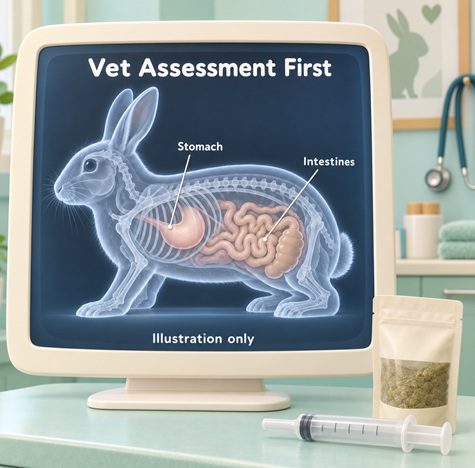
See the Vet Before Starting Rabbit Recovery Food
If your rabbit stops eating, get a veterinary assessment before you start syringe-feeding recovery food. Your vet needs to check for intestinal obstruction and decide whether assisted feeding is appropriate at all. Don’t assume every episode of food refusal is uncomplicated rabbit GI stasis.
A rabbit recovery diet can form part of the treatment plan for GI stasis, but obstruction changes that plan completely. An acutely painful rabbit with a distended stomach may need stabilisation, imaging and decompression.
Why Feeding an Obstructed Rabbit Is Dangerous
With an obstruction, fluid and gas can accumulate upstream and severely distend the stomach. Gastric rupture is a possible, life-threatening complication.
Adding rabbit recovery food to an obstructed, distended stomach may make the distension worse. Whether you have Critical Care for rabbits or another recovery formula, don’t syringe-feed unless the treating vet advises it.
What X-rays Can and Can’t Tell Us
Abdominal X-rays are an important part of assessing suspected obstruction. They aren’t a standalone guarantee that no blockage exists. Your vet reads the images alongside the physical examination and other findings, and repeat imaging or further investigation may be necessary.
The decision to begin syringe feeding rabbits depends on that clinical assessment. Feeding starts when the vet determines it’s appropriate.
Signs That Need Urgent Help
Seek urgent help for sudden food refusal with significant pain, abdominal swelling, profound weakness or collapse.
A cold, collapsed or severely dehydrated rabbit may need warming, fluids and other stabilisation before feeding. Choosing an intensive-care rabbit recovery food doesn’t make immediate home feeding safe. EmerAid’s intensive-care guidance places stabilisation before feeding decisions. [11]
A rabbit that can’t swallow normally or is having trouble breathing needs immediate professional assessment. Feeding tubes require veterinary placement and a prescribed formula, volume and method.
If a Rabbit Recovery Diet Is Already Prescribed
If your vet has already prescribed assisted feeding and your rabbit develops new swelling, severe pain or difficulty swallowing, stop the feed and contact the clinic urgently.
How to Prepare Rabbit Recovery Food Correctly
Start with the exact rabbit recovery food prescribed or approved by your vet. Check the product name, variety and current preparation instructions. Even formulas from the same brand can use different powder-to-water ratios.
If you’re preparing Critical Care for rabbits, check whether you have the standard Herbivore formula or Fine Grind. The table below compares starting preparations for these and other products used in a rabbit recovery diet.
| Product | Manufacturer’s starting preparation |
|---|---|
| Oxbow Critical Care Herbivore Anise | 1 part powder to 2 parts warm water |
| Oxbow Critical Care Herbivore Fine Grind Papaya | 1 part powder to 3 parts warm water |
| EmerAid Sustain Herbivore, syringe preparation | 1 scoop powder to 1 scoop water |
| EmerAid IC Herbivore, rabbit preparation | 1 part powder to 1 part water |
| Supreme Science Selective RecoveryPlus | One 20 g sachet with 90 mL warm water |
| Sherwood bulk Rabbit Recovery Food | 1 tablespoon powder with 3 tablespoons water |
These are preparation instructions, not feeding doses. Use matching measures where ratios are specified, and follow the current packet. An equal volume of powder and water doesn’t have an equal weight. [1,9,11,14,25,26]
Check the Mixture Before Syringe Feeding Rabbits
Mix the rabbit recovery food thoroughly in a clean bowl. Test a suitable blunt oral-feeding syringe away from bunny first.
If the mixture clogs or needs heavy pressure, correct the texture or the equipment before feeding. Ask the clinic which syringe and nozzle suit the formula. Cutting off a syringe tip can allow the plunger bung to enter the rabbit’s mouth. [27]
Follow the packet’s water-temperature instruction for preparation, then bring the food to a comfortable feeding temperature. Never feed hot slurry.
If you need more water for consistency, remember that dilution changes calories per millilitre. Keep the prescribed dry ration in view when preparing your rabbit’s recovery diet.
Avoid mixing medication into an entire meal without your vet’s agreement. If some food remains, you won’t know how much medicine was swallowed.
If Commercial Rabbit Recovery Food Is Unavailable
A veterinary clinical chapter describes soaked, blended rabbit pellets as an alternative. Ask the clinic whether your rabbit’s usual pellets make a suitable short bridge, and how much to feed. This isn’t automatically equivalent to a clinical recovery formula. [28]
Choose food intended for herbivores rather than a carnivore or dog-and-cat recovery diet.
Measuring a Rabbit Recovery Diet: Powder, Volume and Calories
When measuring rabbit recovery food, there are three quantities to keep separate. They’re easy to muddle, particularly when you’re tired and keeping track of several feeds:
- Grams of dry powder: how much formula you use.
- Millilitres of prepared food: the volume after adding water.
- Calories: the energy the powder supplies.
Adding water increases volume without adding calories.
For illustration, 10 g of powder labelled 3 kcal/g supplies approximately 30 kcal, however much you dilute it. That’s arithmetic, not a recommended serving.
Whether the feeding plan supports recovery from rabbit GI stasis, surgery or another condition, ask your vet to specify the daily dry amount, preparation method, volume per feed, frequency and adjustment for voluntary eating.
“Give 20 mL” needs an agreed concentration to mean anything. A clear rabbit recovery diet plan should tell you both how to mix the food and how much of that prepared mixture to offer.
Rabbit Recovery Food Feeding Schedules: A Clear Daily Plan
A rabbit recovery diet plan should explain how much food to prepare, how much to offer at each feed and when to offer it. Whether your rabbit is recovering from rabbit GI stasis, surgery or another condition, use the schedule prescribed for that patient.
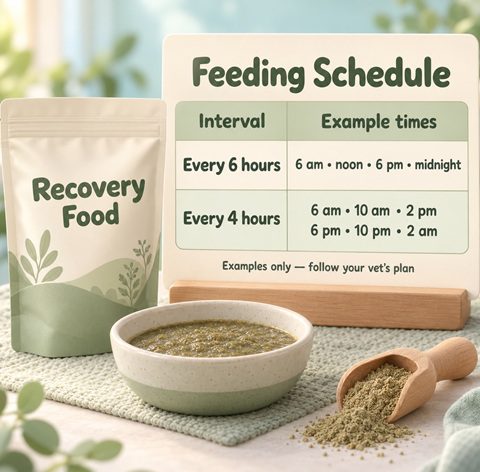
When using Oxbow Critical Care for rabbits, its label recommends dividing the daily amount into four to six feeds unless the vet specifies otherwise. EmerAid’s guides list three to four daily feeds for small mammals.
These are starting guidelines, not interchangeable prescriptions. Supreme and Sherwood also require a schedule suited to the patient. The brand of rabbit recovery food alone doesn’t determine the feeding timetable. [1,9,11,25,26]
Once your vet specifies an interval, these examples show how feeds can be spaced:
| Prescribed interval | Example times |
|---|---|
| Every 6 hours | 6 am, noon, 6 pm, midnight |
| Every 4 hours | 6 am, 10 am, 2 pm, 6 pm, 10 pm, 2 am |
This illustrates spacing only. It doesn’t prescribe a volume of rabbit recovery food, and it doesn’t determine whether your rabbit needs overnight feeding.
Planning Overnight Feeds and Missed Meals
When arranging a schedule for syringe feeding rabbits, ask about overnight coverage, voluntary intake and what to do if a feed is missed. “Four feeds during the day” and “every six hours around the clock” are different instructions.
If the prescribed schedule is hard to manage, tell the clinic early. Don’t squeeze missed meals into one large feed.
Before each feed, check comfort and what bunny has eaten independently. Record the time and amount actually accepted so your vet can review how the rabbit recovery diet is working in practice. Food on the towel hasn’t reached the rabbit.
How to Syringe-feed More Gently
Ask the veterinary team to demonstrate the technique before you leave.
A syringe that holds a whole meal still delivers that meal a little at a time. [16]
- Prepare everything first. Have the food, syringes, towel and cleaning materials ready.
- Support the body. Use a stable surface with traction, and support the feet and hindquarters.
- Keep a natural position. Don’t tip bunny onto their back or lift the head sharply.
- Use a gentle towel wrap if needed. Avoid compressing the chest.
- Approach from the side. Place the syringe gently into the toothless gap behind the incisors, the diastema, and direct food into the mouth, away from the throat. [29]
- Give a very small mouthful. Remove the syringe and wait for swallowing. RWAF advises a maximum of 1 mL per mouthful. That’s a ceiling, not a target, and some rabbits need much less. [27]
- Clear blockages away from the mouth. Never push harder while a blocked syringe is inside. [8,16]
Stop immediately if swallowing ceases, food comes from the nose, or breathing changes. Seek urgent veterinary advice.
Gently wipe food from the chin and keep the nostrils clear. If every feed becomes a long struggle, tell your vet. Technique, pain control or the feeding route may need reassessment.
Looking for Feeding Syringes?
Browse the two syringe listings below. Ask your veterinary team which size and tip suit your rabbit’s recovery food and feeding plan.
Bunnini: “A small mouthful, then time to swallow.”
Pee-Casso: “Understood. Dinner is not a speed-eating event.”
Rabbit Recovery Food Refusal: How to Outsmart a Reluctant Bunny
When bunny refuses rabbit recovery food, start by asking what they’re objecting to. Taste, texture and handling are different problems, and pain or worsening illness can look like refusal too.
Whether your rabbit recovery diet is prescribed for rabbit GI stasis, post-operative support or another condition, the feeding plan still needs to deliver the intended nutrition. If that isn’t happening, contact the clinic rather than spending hours inventing increasingly elaborate recipes.
| What you notice | A practical next step |
|---|---|
| Eats from a dish but fights the syringe | Use voluntary eating where the vet agrees; measure intake |
| Sniffs and walks away | Offer a small fresh portion; discuss another flavour |
| Syringe repeatedly clogs | Check preparation and equipment; ask whether a finer formula suits the plan |
| Accepts only tiny mouthfuls | Slow down and allow swallowing pauses; report inadequate intake |
| Repeatedly spits out food | Have the clinic reassess technique, pain and swallowing |
| Suddenly refuses previously accepted food | Update the vet about the change |
Change one thing at a time, so you can tell what helped. When syringe feeding rabbits becomes a struggle, note whether the difficulty starts with the food, the syringe or the handling.

Bowl Service: Let Bunny Eat Voluntarily
Offer a small, fresh portion of rabbit recovery food in a shallow, stable dish near the usual eating spot.
Measure what’s eaten. Approaching the bowl, giving it one suspicious lick and leaving isn’t a completed feed.

The “Silver Spoon” Approach
Hold a small, smooth spoon at mouth level and let bunny lick voluntarily. An ordinary clean teaspoon works.
Don’t push it into the mouth or scrape food onto the nose.

A Familiar Scent
Offer a familiar, tolerated leafy herb beside the food.
If your vet approves adding a little to the slurry, blend it finely enough to avoid clogging the syringe. The purpose is familiarity and acceptance, not turning the mixture into a herbal treatment.

A Tiny Approved Puree
RWAF recognises plain fruit or vegetable puree as a possible palatability aid.
Ask whether a small amount of unsweetened apple, banana or suitable vegetable puree fits your rabbit’s condition. Check the ingredients and keep the recipe consistent.
The puree shouldn’t replace the prescribed rabbit recovery food. Count the recovery powder actually consumed. [27]

A Measured Topper: Critical Care for Rabbits
Oxbow describes two related ways to use Critical Care Herbivore with a pet’s usual food. One is sprinkling the dry powder over their usual food as a top dressing. The other is mixing the powder with water and stirring the prepared product into their usual food. Oxbow suggests the papaya flavour if your vet recommends it for palatability. [8]
Oxbow’s page doesn’t specify vegetables, damp greens or an amount for either method, so ask your vet what your rabbit’s usual food should be and how much powder to use. These methods suit a rabbit that’s still eating voluntarily, after your vet has assessed the cause of the poor appetite.
Whatever you try, measure it, offer it separately from the main food supply, and record what was actually consumed.

A Flavour or Texture Change
Oxbow offers different flavours and a Fine Grind papaya formula. Sustain has mint and apple-and-banana varieties.
Discuss changes to your rabbit recovery diet with the clinic, especially when the formula’s concentration or feeding purpose changes. [2,14]
Manufacturer-Directed Bites
Sustain provides a separate preparation for bites. Follow that recipe where suitable.
A homemade dough ball with extra ingredients shouldn’t be assumed to deliver the same nutrition as the prescribed slurry. [9]
Pro-Tip 1: Introduce Rabbit Recovery Food Before Illness

Teach “the syringe brings a tiny taste” while bunny feels well.
Rabbit welfare guidance supports cooperative oral-administration training. Applying that principle to recovery-food familiarisation is a practical suggestion, not a product-tested guarantee of easier feeding during illness. [18]
For a healthy adult, agree a suitable formula with your vet. Use a tiny voluntary taste of an appropriate rabbit recovery food, and reserve IC for its supervised clinical purpose. Keep normal hay and food available.
Try This Gradual Sequence
- Offer a small taste from a spoon or dish.
- On another occasion, present a blunt syringe tip with a little prepared food on it.
- Let bunny approach and lick voluntarily, with feet supported.
- Progress to brief, comfortable contact at the side of the mouth only while relaxed.
Keep practice brief and occasional. Stop when bunny moves away.
The aim is familiarity, not an extra meal or a forced-feeding rehearsal. Practising beforehand doesn’t establish that syringe feeding rabbits will be safe during illness; swallowing and feeding tolerance still need assessment.

The Tiny Square Introduction
A familiar cookie could help introduce an unfamiliar taste. Our Tiny Square cookies measure approximately 1 cm across and 2 mm thick—a miniature starting point.
For a healthy adult bunny who already tolerates these cookies, ask your vet whether this approach fits their diet: put a tiny dab of freshly prepared recovery food on one square, or spread a thin smear between two squares to make a little “CC sandwich.” Prepare the recovery food separately according to its instructions; add it after baking, without reheating.
Offer it immediately and let bunny choose. Count both squares towards the usual treat allowance, keep hay and normal food available, and discard uneaten prepared portions rather than storing them with dry cookies.
A taste introduction, not a recovery ration. This is an occasional familiarisation idea, not a tested feeding method or a substitute for prescribed nutrition. A sick rabbit refusing recovery food needs the clinic’s advice.
Pro-Tip 2: Keep a Rabbit Recovery Food and Care Record

A notebook makes the next veterinary conversation much clearer. Record the rabbit recovery food actually accepted alongside independent eating, droppings, weight and comfort. These details help the clinic review the feeding plan.
| Record | What to write |
|---|---|
| Feeding | Product, dry amount prepared, volume accepted, date and time |
| Independent eating | Foods eaten willingly, especially usual foods |
| Droppings | Approximate output and noticeable changes |
| Weight | Measurements under consistent conditions, as advised |
| Comfort | Activity, posture and changes in feeding tolerance |
| Treatment | Medication times and missed feeds or doses |
Keep your bunny’s care notes together with our free, two-page printable. Includes pet name, date and time columns, feeding and treatment logs, observations, and the next veterinary review.
Download the Bunny Recovery Record (PDF)
A4 printable · Opens in a new tab · Print a fresh copy as needed
EmerAid’s clinical guidance includes next-day weighing and reassessment. A trend helps your vet interpret progress better than one reassuring number. [11]
Before going home, ask what should improve, by when, and which changes require an immediate call.
Should recovery diets be baked into rabbit cookies?
Oishi Bunnies doesn’t bake with Oxbow Critical Care or EmerAid recovery formulas. We keep nutritional recovery support separate from our everyday baked treats.
Oxbow specifically advises avoiding baking Critical Care, because heat may reduce nutrient content. It does describe small no-bake treats from leftovers once the vet approves stopping assisted feeding. EmerAid also provides instructions for Sustain bites.
These preparations differ from using recovery powder in baked commercial cookies.
A cookie containing recovery powder shouldn’t be assumed to provide the original formula’s complete nutritional balance or a prescribed recovery ration. Adding ingredients changes the recipe and the amount of formula consumed.
Why we keep recovery formulas out of the oven
Read our companion article
Conclusion: Caring for the rabbit behind the feeding chart
Returning to normal food
As the patient stabilises, the vet may gradually move from IC towards Sustain or the normal diet. EmerAid also describes combining IC and Sustain during this progression. [4,10]
One enthusiastic nibble doesn’t necessarily mean supplementary feeding is finished. Independent intake, droppings, weight and the underlying condition should guide each reduction.
Some rabbits need an ongoing adapted diet, particularly when dental disease or another chronic problem limits normal eating. The goal is a feeding arrangement that meets their needs comfortably.
Recovery feeding asks a lot of both rabbit and carer. There are bowls to wash, mouths to wipe and uncertain moments between feeds.
A clear plan makes that work more manageable: an appropriate formula, a tolerable feeding method and timely reassessment.
The goal is to meet your rabbit’s nutritional needs while treating the reason those needs aren’t being met, and to help bunny return to comfortable, voluntary eating wherever possible.
Living Content Notice
The Modern Art of Rabbit Care grows alongside our learning. We may update this article as new research, manufacturer guidance or practical insights become available. We welcome thoughtful corrections and useful references that help keep our rabbit-care content accurate and clear.
Medical Disclaimer
Cookie Yiyi is a rabbit rescuer and independent researcher, not a licensed veterinarian. This article draws on published information and practical experience for educational purposes. It does not replace individual veterinary advice, diagnosis or treatment. Please consult a rabbit-savvy vet about your rabbit’s health and nutritional needs.
A Note on Recovery Diets and Our Baking
This article explains our baking policy and provides general information about rabbit recovery diets. Use recovery formulas according to the manufacturer’s instructions and your rabbit-savvy vet’s feeding plan.
Our cookies and cakes are occasional treats. They aren’t formulated to replace a complete recovery diet or prescribed nutritional support.
Our decision to keep recovery formulas out of our baking is specific to our recipes and product claims; it isn’t an assessment of another bakery’s products.
Help Us Keep Learning
Have a useful study, a correction or an idea for collaboration? We’d love to hear from people who care about rabbit welfare, research and thoughtful education.
Oishi Bunnies · Singapore