
1. Why Every Rabbit Needs a Bonded Companion
Why Rabbits Were Never Meant to Live Alone
One of the most common misunderstandings about rabbits is the belief that they are independent pets that are content living by themselves. The truth is quite the opposite: rabbits are among the most social mammals kept as companion animals.
In the wild, European rabbits (Oryctolagus cuniculus)—the ancestors of all domestic rabbits—live in complex social colonies called warrens. These underground networks can house dozens of individuals, all participating in a sophisticated social structure built upon cooperation, communication, hierarchy, and companionship. For a rabbit, social interaction is not a luxury; it is a fundamental biological need.
While humans often compare rabbits to cats because of their quiet nature, their social behavior is actually closer to that of horses, guinea pigs, elephants, and primates. Their emotional well-being depends heavily upon having meaningful social relationships.
 Key Insight
“A rabbit living alone may survive. A rabbit living with a bonded companion often thrives.”
The Hidden Cost of Loneliness
Because rabbits are prey animals, they have evolved to conceal weakness and distress. A lonely rabbit rarely cries, a lonely rabbit rarely complains, and a lonely rabbit often suffers silently. Owners may assume their rabbit is happy simply because it eats, sleeps, and behaves normally. However, many solitary rabbits exhibit subtle signs of social deprivation:
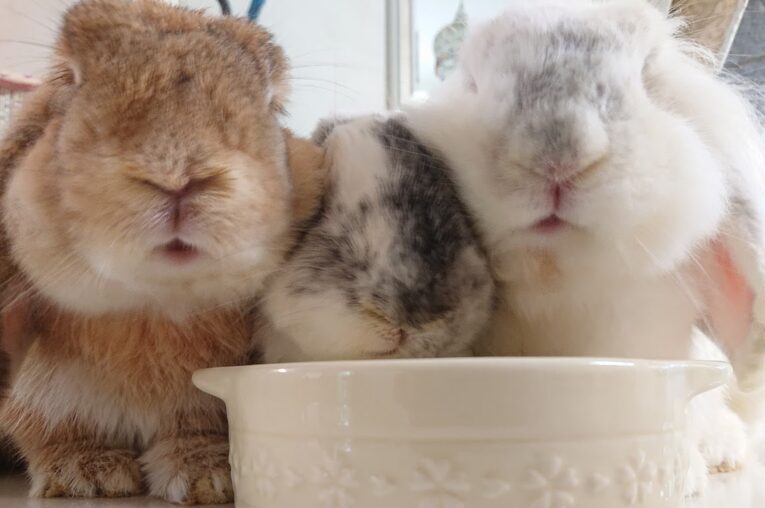
Barley, Bubble & Missy
- Excessive Sleeping & Lethargy: Spending large portions of the day withdrawn or unresponsive.
- Reduced Curiosity & Lower Activity Levels: Showing little interest in exploring new toys or shifting environments.
- Destructive Chewing: Directing pent-up frustration and boredom into chewing furniture, baseboards, or carpets.
- Increased Anxiety & Attention-Seeking: Demanding continuous physical human contact or overreacting to sudden movements and noises.
- Depression-Like Symptoms: Sitting hunched or motionless in a corner for hours on end.
- Excessive Grooming & Fur Pulling: Over-grooming out of stress, which can lead to raw patches or hairballs.
- Poor Appetite During Absences: Refusing food or hay specifically during periods of owner absence.
Many owners only realize how lonely their rabbit was after introducing a bonded companion and witnessing a dramatic transformation in confidence, activity levels, and overall happiness. The rabbit that once sat quietly in a corner suddenly begins exploring, binkying, grooming, and engaging dynamically with its environment. The difference can be profound.
Understanding Rabbit Love
Humans often view companionship through a human lens, but rabbits experience it differently. A bonded rabbit pair shares a relationship built upon security, trust, and constant communication.
Snuggle pressed tightly against each other
Hours spent cleaning hard-to-reach ears
Foraging together from a single hay pile
One stands guard while the other flops
To us, these behaviors may appear simple. To rabbits, they are expressions of safety and belonging. In the wild, isolation often means danger, while companionship means survival. That instinct remains deeply embedded within every domestic rabbit, even after thousands of years of domestication.
The Emotional Architecture of Rabbit Relationships
Rabbits maintain surprisingly sophisticated social relationships, and within bonded pairs, each rabbit naturally develops a distinct role:
- The Alpha Dynamic: One rabbit may be more confident, more adventurous, more dominant, or more protective.
- The Companion Dynamic: The other may be more cautious, more submissive, more affectionate, or more dependent.

Smooch & Potato. A healthy bond eliminates round-the-clock stress, replacing hyper-vigilance with deep emotional safety.
These roles are fluid and can change over time. What matters is not dominance itself, but stability. A healthy bond creates predictability. Each rabbit understands its relationship with the other, which actively reduces stress and creates long-term emotional security.
Much like humans, rabbits develop deep attachments; they grieve losses, they miss companions, and they actively seek comfort from trusted individuals. Owners frequently report profound behavioral changes after the death of a bonded partner, including a reduced appetite, depression, lethargy, and social withdrawal. These heartbreaking observations remind us that rabbit companionship is not merely practical—it is deeply emotional.
Why Humans Cannot Fully Replace Another Rabbit
Many loving owners spend hours interacting with their rabbits every day. While this enriches a rabbit’s life tremendously, humans cannot fully replicate rabbit companionship.
Humans cannot groom a rabbit continuously for hours, sleep beside them on the floor all day, communicate fluidly through rabbit body language, provide round-the-clock social interaction, or offer the instinctive comfort that another rabbit provides. Even the most dedicated owner must eventually leave for work, school, errands, holidays, or sleep. A bonded rabbit never leaves. Their companion is present every hour of every day, fulfilling needs that human interaction simply cannot replicate.
2. Can Rabbits Be Bonded? Understanding Rabbit Relationships
Overcoming Territorial Instincts
The short answer is yes: most rabbits can be successfully bonded. However, not every rabbit will instantly become friends. Rabbit bonding is a carefully managed process that allows two unfamiliar rabbits to establish trust and negotiate their social relationship safely. Successful bonding is not determined by luck; it is determined by preparation, patience, and proper pairing.
Rabbits are social, but they are also deeply territorial. This combination often confuses new owners. People assume that social animals naturally enjoy meeting strangers, but in reality, social animals frequently maintain strict social boundaries. Wild rabbits protect territories, establish hierarchies, and recognize familiar colony members with aggressive intensity.
When two unfamiliar rabbits meet, they often perceive each other as territorial intruders rather than potential friends. This is entirely normal. Structured bonding allows rabbits to gradually transition from stranger to companion without triggering their baseline survival defenses.

Initial meetings should always happen in neutral territory to bypass hardwired territorial defenses.
Signs of a Growing Bond
As bonding sessions progress, owners can track their progress by observing three distinct phases of behavioral milestones:
| 1. Early Positive Signs | 2. Intermediate Signs | 3. Strong Bond Indicators |
|---|---|---|
| • Ignoring peacefully • Eating hay nearby • Relaxed posture • Less chasing • Curiosity | • Resting nearby • Joint exploring • Mirror behavior • Seeking proximity | • Mutual grooming • Snuggling close • Shared bowl • Following • Calm separation |

Mutual grooming is the ultimate sign of acceptance, shifting their dynamic from roommates to family.
Common Bonding Mistakes
Many bonding failures occur because owners try to force the relationship. Avoid these critical mistakes:
- Rushing Introductions: Friendship cannot be forced. Some rabbits bond within days, while others require weeks or months. Moving too fast breaks fragile trust.
- Using Established Territory: Introducing rabbits in an area that a resident rabbit already considers “home base” will trigger fierce defensive behaviors. Neutral spaces are absolutely essential.
- Separating After Minor Disagreements: Small disagreements, minor chasing, and brief mounting are normal parts of establishing a dominance hierarchy. Constantly interrupting minor scuffles prevents rabbits from learning conflict resolution.
- Ignoring Body Language: Failing to read subtle warning signs can allow normal dominance behavior to escalate into a full-scale fight.
3. Why Rabbits Must Be Spayed or Neutered Before Bonding
The Single Most Important Rule
Do not attempt bonding until both rabbits are spayed or neutered.
This dramatically increases the likelihood of a successful bond and significantly reduces the risk of serious injury.
Unaltered rabbits operate under powerful reproductive instincts. These surging hormones influence a variety of volatile behavioral traits:
- Violent territorial behavior
- Severe aggression
- Relentless mounting and chasing
- Urine spraying and marking
- Unpredictable fighting
- Resource guarding
Even rabbits that appear perfectly calm individually can become intensely aggressive when introduced to another rabbit while intact. This behavior is not personal; it is purely hormonal.

Surging reproductive hormones make rational, peaceful rabbit introductions nearly impossible.
The Dangerous Myth of “Baby Bunny Friendships”
Many young rabbits appear to bond effortlessly. Owners often watch two babies snuggle and believe they have found a perfect match. Unfortunately, these “baby bonds” are false friendships that frequently collapse during puberty.
As hormones develop around 3 to 6 months of age, chasing increases, mounting becomes relentless, territorial behavior emerges, and severe fighting can begin suddenly without warning. What once appeared to be lifelong friendship can rapidly turn into dangerous hostility. This is why experienced rescuers and bonding specialists typically wait until rabbits have been sterilized and their hormones have completely subsided before beginning formal bonding.
Health Benefits Beyond Bonding
Spaying and neutering provide substantial medical benefits that extend far beyond social dynamics:
- Uterine Cancer Prevention (Females): For females, spaying dramatically reduces the risk of reproductive cancers. Clinical data indicates that 65% to 85% of unspayed female rabbits develop uterine adenocarcinoma (uterine cancer) by the time they reach 3 years of age. Spaying removes the uterus and ovaries, completely eliminating this alarmingly common, fatal cancer risk.
- Behavioral De-escalation (Males): For males, neutering eliminates the risk of testicular cancer and reduces territorial aggression, urine spraying, hormone-driven stress, and frustration-related behaviors.
Healthier, calmer rabbits generally make far better bonding candidates because they are capable of rational social choices rather than being driven by hormonal impulses.

Sterilization paves the way for a true, lifelong partnership built on safety and deep companionship.
The Ultimate Goal: One Bonded Partnership
The goal of this process is not simply to have two rabbits sharing a room. There is a profound difference:
“Two rabbits sharing a room are merely roommates.
Two bonded rabbits become family.”
Bonded pairs provide comfort during stressful events, companionship during quiet moments, and constant emotional support throughout their lives. For rabbits, companionship is not an optional enrichment item; it is woven directly into their evolutionary history, social instincts, and emotional well-being. When we provide rabbits with a carefully chosen bonded companion, we are not giving them something extra—we are giving them something they were designed to have from the very beginning.
Ready to open your heart to a second rabbit? 

Sterilization is step one. Here is how you can prepare for step two:

Ready to Adopt a Buddy for Your Rabbit?
Check out our gorgeous Angora fosters! Giving a rescue rabbit a second chance at a loving home is one of the most rewarding parts of the bonding journey. Explore our adoptable companions today.

Stock Up on Bonding Treats
While you wait out the post-surgery hormone window, prep your neutral territory. Secure our premium organic forage mixes and healthy munchies—the ultimate high-value peace offerings for a first date.