
 Pro-Tip: Viewing on a phone? Select desktop mode or rotate to landscape for the best reading experience!
 Estimated Read Time: 4 Mins

The Pros of DIY Rabbit Bonding
 You Know Your Rabbits Best

As your rabbits’ primary caregiver, you’re uniquely familiar with their personalities, routines, and subtle behavioural cues. You may already recognize:
- Signs of nervousness before they escalate
- Preferred coping behaviours
- Confidence levels
- Each rabbit’s individual comfort level and response to unfamiliar situations
This knowledge allows you to adjust the pace of bonding according to each rabbit’s specific emotional needs.
You Can Control the Environment

One of the biggest advantages of DIY rabbit bonding is complete control over the setup. You can carefully prepare a truly neutral area such as:
- A clean bathroom
- Laundry room
- Exercise pen
- Hallway
- Another space neither rabbit considers territory
Because you’re in charge, you can also adjust the environment between sessions as your rabbits become more comfortable with one another.
Immediate Supervision

You’re present throughout every interaction. If body language begins escalating from curiosity to genuine aggression, you can intervene before injuries occur.
Having tools such as a towel, dustpan, or sturdy barrier nearby allows you to separate fighting rabbits safely without placing your hands directly between them.
You Learn Rabbit Behaviour

Bonding teaches owners to interpret rabbit body language with much greater confidence. You’ll gradually learn the difference between:
- Normal dominance behaviours
- Brief chasing
- Investigative behaviour
- Mild tension
- Interactions that require prompt intervention
These valuable skills continue benefiting your rabbits long after the bonding process is fully complete.
Cost-Effective

Professional bonding services can be extremely valuable, particularly for complex cases, but they often come with additional costs. DIY rabbit bonding primarily requires:
- Time and consistency
- Patience through setbacks
- Suitable setup equipment
- A willingness to learn and adapt
For many families, this makes rabbit companionship more accessible while allowing them to build immense confidence as primary caregivers.

The Challenges of DIY Rabbit Bonding
Injury Risk if Sessions Are Poorly Managed
Rabbit disagreements can escalate within seconds. If introductions are poorly managed, rabbits may lock together and bite repeatedly, leading to serious injuries such as:
- Deep bite wounds
- Torn ears
- Corneal (eye) injuries
- Abscesses
- In severe cases, fractures or spinal injuries
Learning when—and how—to intervene safely is one of the most critical aspects of managing DIY rabbit bonding.
Emotional Stress

Watching your rabbits disagree can be surprisingly stressful for human guardians. Many first-time owners become anxious after witnessing:
- A sudden chase
- Mounting
- Fur pulling
- A brief disagreement
In reality, mild social negotiation while rabbits establish their relationship is often a normal part of bonding. Understanding expected behaviour helps reduce unnecessary worry and prevents ending sessions too soon.
Scent Management Matters

Rabbits rely heavily on scent to define territory. Introducing rabbits into an area carrying the familiar scent of just one rabbit can spike territorial aggression.
Successful DIY rabbit bonding depends entirely on preparing a genuinely neutral environment by thoroughly cleaning the area and neutralizing familiar scent cues before each session.
Reading Rabbit Body Language Takes Practice

Perhaps the greatest challenge isn’t separating fighting rabbits—it’s correctly interpreting what their body language is communicating. New owners sometimes mistake:
- Mounting for fatal aggression
- Ignoring each other as a complete failure
- Brief chasing as a vicious fight
- Overlooking subtle warning signs like prolonged freezing, intense staring, tail elevation, or a tense body posture
Learning to recognize these subtle signals helps you respond appropriately while allowing healthy social communication to unfold.
It Requires Patience

Bonding rarely follows a predictable timeline. Some rabbits become close companions within days, while others require several weeks—or occasionally months—to establish deep trust.
Progress is rarely linear. Expect calm sessions followed by occasional setbacks and gradual improvement. Trying to rush the process usually creates setbacks rather than speeding it up—consistency always produces better results than haste.
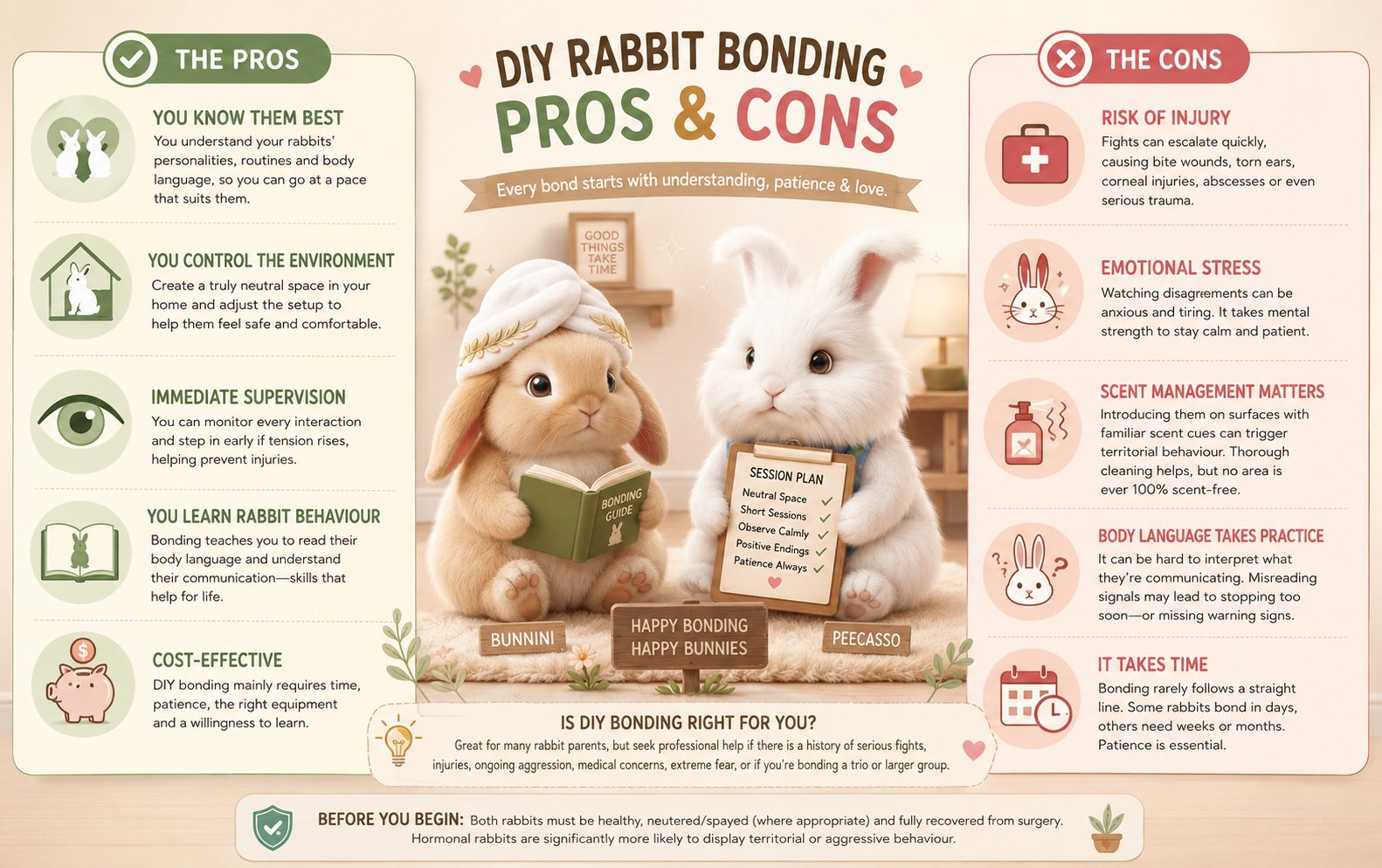

Is DIY Rabbit Bonding Right for You?
DIY rabbit bonding can be incredibly rewarding for owners who are willing to invest time in learning rabbit behaviour and progressing at the rabbits’ pace.
When to Consider Professional Assistance
Professional assistance may be worth considering if:
- Your rabbits have previously inflicted serious injuries on each other
- Repeated aggressive fights occur
- Either rabbit has significant medical conditions
- One rabbit shows persistent fear or panic
- You’re attempting to bond a trio or larger group
- You don’t feel confident managing potentially dangerous interactions
There’s no shame in seeking experienced help. Choosing professional support when needed is simply another way of prioritizing your rabbits’ welfare.

Scientific Transparency & Care Disclaimer
Educative Intent: The data provided within The Modern Art of Rabbit Care masterclass and the Oishi Bunnies platform is grounded in extensive rescue, rehabilitation, and behavioral observation. While we prioritize strict medical, physiological, and scientific accuracy regarding rabbit social dynamics, this content is engineered for educational purposes only and does not constitute official veterinary advice, clinical diagnosis, or prescribed medical treatment.
Sanctuary Safety & Socializing: Companion bonding guidelines—including neutral territory staging, chronic stress metrics, and hierarchy introductions—are highly dependent on your specific household environment and the individual profiles, histories, and medical temperaments of your animals. Always monitor your rabbit’s clinical and behavioral responses closely during any integration or transition phase.
Anatomy-Aware Handling & Ethics: Always consult an experienced, rabbit-savvy veterinary professional before modifying current care protocols, validating recovery behaviors post-surgery, or executing dynamic environmental shifts. Oishi Bunnies advocates for transparency and empirical knowledge; however, we cannot assume liability for actions executed without professional veterinary oversight.