
The Complete Gentle Rabbit Bonding & Troubleshooting Guide
Bonding two rabbits isn’t about tossing them into a playpen and hoping for the best. It is a delicate process—informed by rabbit behaviour, physiology, and welfare principles—of helping two unfamiliar rabbits become comfortable with each other’s scent, presence, and social boundaries through preparation, gradual exposure, neutral territory, and careful observation.
While clinical studies give us clear ground rules on health, stress responses, and reproductive physiology, the practical mechanics of bonding—such as session length, scent swapping, and reading subtle interactions—rely on years of experienced, hands-on rabbit welfare practice.

The Foundations of Gentle Rabbit Bonding
Rabbits are deeply social animals, but they are also territorial prey animals with complex social behaviours and hierarchies. They rely heavily on scent, body language, and environmental familiarity when assessing other rabbits.
The Gentle Rabbit Bonding Method prioritises minimal unnecessary stress, safety, and positive associations. Rather than deliberately creating fear or forcing rabbits into stressful situations, this approach focuses on building familiarity, reducing territorial pressure, using neutral territory, and allowing the rabbits to communicate at their own pace.

Preparation & Pre-Bonding Setup
Before asking your rabbits to interact physically, complete the foundational groundwork.
Step 1
Health, Neutering & Housing
Health Check
Ensure both rabbits are healthy and free from obvious pain or illness before starting. Pain and illness can significantly affect behaviour and may make a normally tolerant rabbit more defensive or irritable. If either rabbit is unwell, address the medical issue first.
Spay / Neuter
Both rabbits should be appropriately neutered before attempting a permanent bond. Allow adequate surgical recovery time and follow your veterinarian’s advice about when it is safe to begin introductions.
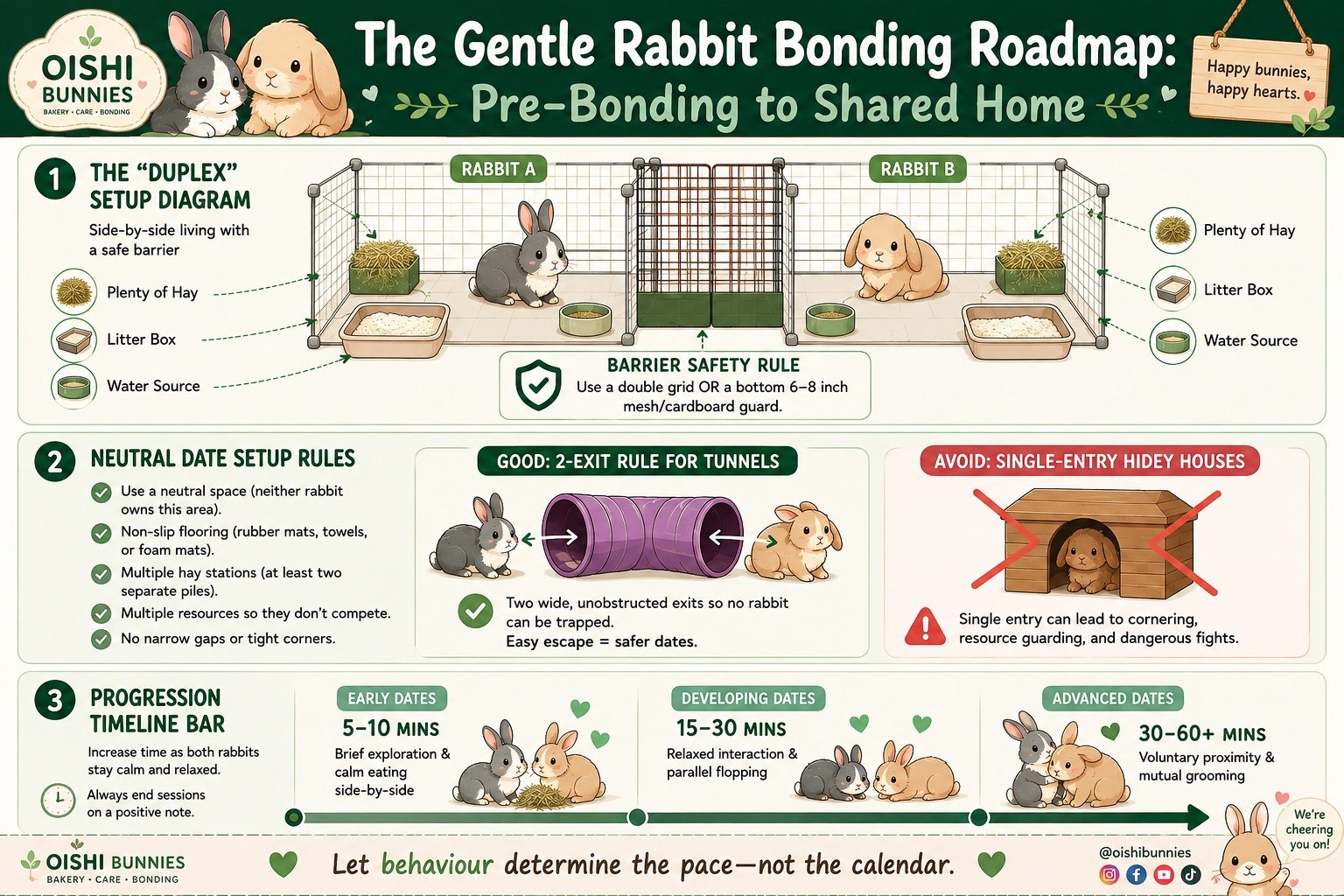
Side-by-Side Housing
Set up two secure living areas where they can:
 See each other
- Hear each other
- Smell each other
 See each other
 Hear each other
 Smell each other
Essential Equipment Check
Thick gloves may be useful as part of your safety equipment, but never rely on gloves to physically grab fighting rabbits.
Step 2
Scent Swapping
Before face-to-face contact, introduce each rabbit to the other’s scent. Swap suitable items regularly such as blankets, bedding, towels, toys, litter trays, or other safe scent-carrying items.
There is no requirement to change everything every 24 hours. The goal is gradual familiarity, not overwhelming exposure.
Scent is a key part of how rabbits identify their territory and each other. By using the gentle rabbit bonding method, you can help them shift from “who is this stranger?” to “I recognize this smell” before they ever meet face-to-face.
This process builds a valuable foundation of familiarity, reducing initial defensiveness rely heavily on scent when recognising their environment and other animals.
Step 3
Barrier Familiarity
Allow the rabbits to spend time near each other through a secure divider. You may see them sitting near the barrier, eating beside each other, resting nearby, grooming themselves, approaching the divider, or completely ignoring one another.
✔ Curious investigation | ✔ Choosing to remain nearby
Neutral Territory & Space Preparation
First impressions matter. A neutral environment can reduce territorial pressure and give both rabbits a more equal starting point.
Step 4
Choose Neutral Territory
Choose a space neither rabbit has claimed as its own. Possible locations include:
 Bathroom
 Hallway
 Unused room
 Neutral pen
Step 5
Prepare the Bonding Setup & Environment
Secure Footing
 Secure Footing
Lay down a secure non-slip surface if the floor is slippery. Rabbits need stable footing to move confidently.
Adequate Space
 Adequate Space
Provide enough room for both rabbits to move away from one another while remaining manageable for you to supervise effectively.
Multiple Resources
Provide multiple hay piles or other appropriate distractions. Having more than one resource reduces unnecessary competition and gives both rabbits something natural to focus on.
Hidey Houses & Tunnel Rules in Neutral Territory
Managing hiding structures during early bonding is important because enclosed spaces can create opportunities for cornering or resource guarding.
- Avoid Single-Entry Houses: Traditional boxes create cornering hazards. If a fight begins inside, safe human intervention is difficult.
- The Two-Exit Rule: Use tunnels or covered structures with at least two wide, unobstructed openings so an entering rabbit always has a way out.
- Choose Easy-to-Remove Materials: Use lightweight fabric tunnels, cardboard arches, or modified cardboard boxes without bottoms. Avoid heavy structures.
- Watch the Structure: If a rabbit guards, blocks, or possessively chases inside the tunnel, remove it immediately.
Step 6
The First Meeting
Place both rabbits into the neutral area and observe calmly. You may see a mix of normal behaviours:
Approaching
Moving away
Brief chasing
Mounting
Eating
Grooming
Resting
Sitting apart
Ignoring one another
Step 7
Let Them Communicate
Rabbits need opportunities to communicate their boundaries. If one rabbit walks away, don’t automatically bring them back together. If they choose to sit apart, let them. If they calmly investigate each other, observe rather than immediately intervening.
Deciphering Interactions & Knowing When to Intervene
Step 8
Normal Social Negotiation
Some behaviours can occur during introductions and do not automatically mean the bonding process has failed.
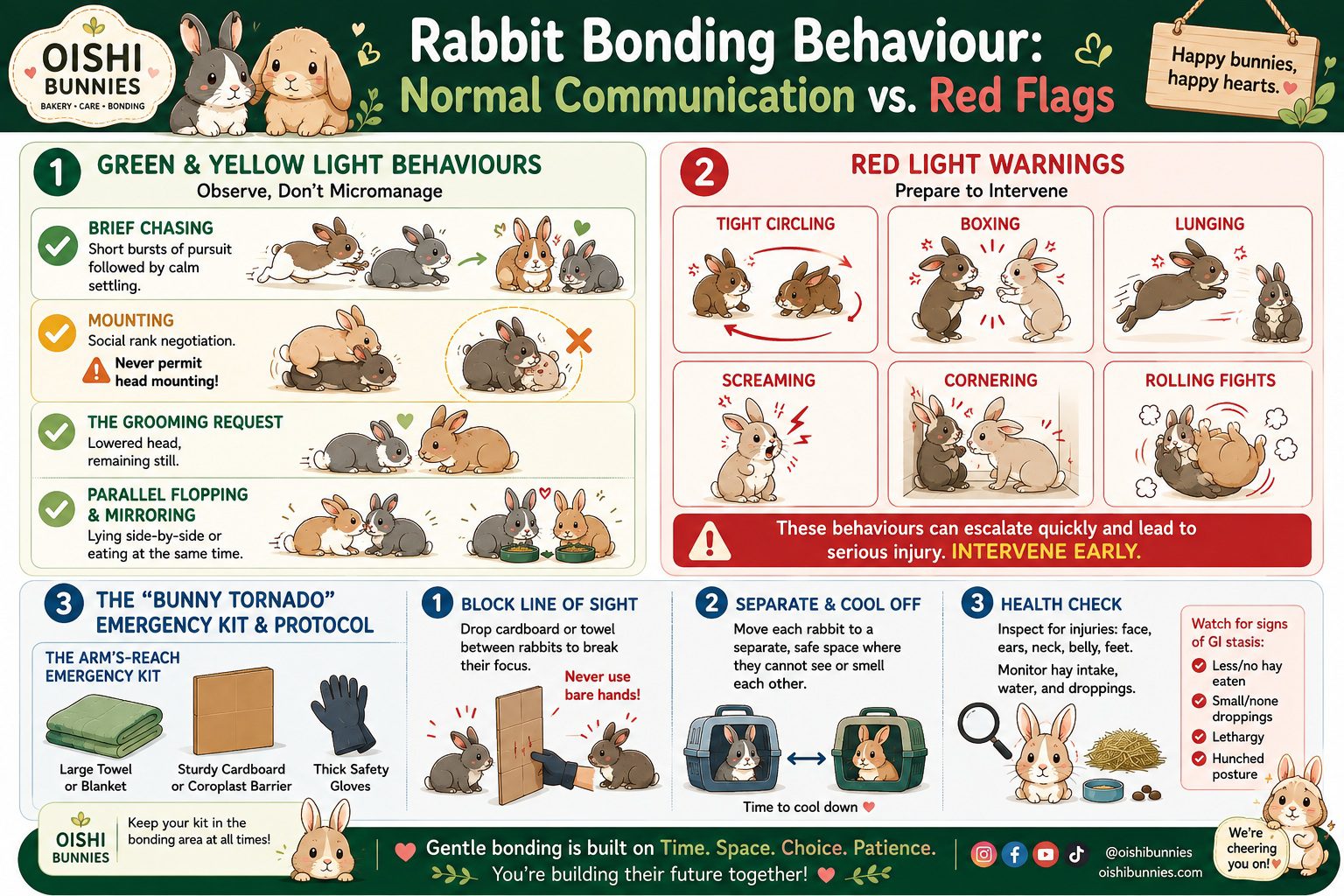
Short bursts of chasing can occur during early social negotiation. What matters is the context. Brief chasing followed by calm behaviour is very different from relentless pursuit.
Mounting can occur even between neutered rabbits and may have social as well as sexual components. Never allow one rabbit to mount the other’s head—a rabbit underneath can be seriously injured.
A brief nip can occur during social communication. Repeated hard biting is a different matter.
Sniffing and investigating one another are normal parts of becoming familiar.
Walking away is not necessarily rejection. It can simply mean “I need some space.” Allowing a rabbit to create distance can help prevent unnecessary escalation.
Step 9
Recognising Danger
Intervene when behaviour becomes persistent, intense or unsafe. Warning signs include:
⚠ Tight circling
⚠ Boxing
⚠ Lunging
⚠ Repeated hard biting
⚠ Fur pulling
⚠ Screaming
⚠ Cornering
⚠ Panic or frantic escape attempts
⚠ Rolling fights
⚠ Persistent attacking
Step 10
Safe Intervention
Never put bare hands between fighting rabbits. A frightened rabbit can bite or scratch reflexively.
The Bonding Emergency Kit
 The Bonding Emergency Kit
Before starting any bonding session, place an Emergency Kit directly beside the bonding area within arm’s reach so you aren’t scrambling when a fight breaks out:
 A large towel or blanket
 A sturdy sheet of coroplast, cardboard, or a lightweight pen divider
 Thick safety gloves (for handling rabbits after line-of-sight is blocked)
Use the cardboard or coroplast barrier to block their line of sight and separate them safely. If a serious fight has occurred, do not immediately put the rabbits back together. Allow both rabbits to settle before deciding what to do next.
Managing Session Length & Building Trust
Session Duration & Progression
Quality always beats duration. There is no universal bonding timetable that every rabbit must follow. For some rabbits, an early session may only need to last a few minutes. Others may comfortably manage longer sessions. Start at a level both rabbits can handle.
| Stage | Typical Starting Range | Focus & Goals |
|---|---|---|
| Early Sessions | 5–10 minutes | Brief introductions, calm exploration, eating near each other |
| Developing Sessions | 15–30 minutes | Extended peaceful coexistence, relaxed interaction |
| Advanced Sessions | 30–60+ minutes | Sustained calm behaviour, voluntary proximity, grooming and shared resting |
*These are guidelines, not deadlines.
Short sessions are perfectly acceptable. Stop while the rabbits are still coping well rather than waiting for tension to escalate.
When both rabbits remain relaxed, gradually extend the sessions. You do not need to increase the duration every time.
Bonding rarely progresses in a perfectly straight line. If interactions become tense: shorten the session or step back to barrier work or an earlier stage.
Step 11
Positive Associations
Pair their meetings with positive and natural experiences such as:
 Eating hay
 Exploring
 Resting
 Grooming
 Calmly sharing space
You do not need to manufacture constant interaction. Sometimes simply being able to relax in the same space is progress. The goal is not to manufacture constant interaction. In fact, sometimes simply being able to relax in the same space without conflict is significant progress when applying the gentle rabbit bonding method.
Step 12
Signs of Voluntary Connection
As the relationship develops, you may notice encouraging signs during the bonding process:
✔ Eating together
✔ Following one another
✔ Calmly approaching each other
✔ Mutual grooming
✔ Seeking each other out
✔ Relaxed body language
A rabbit may lower its head and remain still in front of another rabbit as a request for grooming. However, body language should always be interpreted in context.
Two rabbits voluntarily choosing to rest near each other is encouraging. Over time, they may begin lying side-by-side or relaxing in close proximity.
Rabbits may sometimes eat, groom or rest around the same time. This can be lovely to observe, but simultaneous behaviour alone does not prove that a bond is established. The more meaningful sign is that both rabbits are comfortable enough to perform normal behaviours in each other’s presence.
Transitioning to a Permanent Shared Space
Step 13
Look for Consistency
Do not rush after just one good session. One beautiful interaction does not necessarily mean the rabbits are bonded. Look for a stable pattern of calm interactions, relaxed eating, relaxed resting, voluntary proximity, positive social behaviour, and reduced conflict. Focus on the trend, not one isolated moment.
Step 14
Expand Space Gradually
Increase their shared area incrementally as their relationship becomes more stable. Do not move directly into one rabbit’s established home territory. If the permanent area previously belonged to one rabbit, clean and rearrange it appropriately before introducing the pair.
Step 15
Prepare the Shared Home
Equip the final enclosure with sufficient resources for both rabbits. Duplicate or distributed resources reduce unnecessary competition.
Multiple hay stations Multiple water sources
 Multiple litter areas Several resting options
 Enrichment
 Adequate exercise space
Step 16
Build Unsupervised Time
Do not rush overnight stays. Never go directly from “They had a great one-hour session!” to “Let’s leave them together overnight.”
Gradually increase the amount of time they spend together while continuing to observe their relationship. Pay attention to how they behave during eating, resting, exploration, normal movement, minor disagreements, and changes in activity. Only consider unsupervised time once you are confident that the rabbits have developed a stable relationship and can safely share space without constant human intervention.
Step 17
Essential Travel Rule — Vet Visits Together
 Always Travel as a Pair
Once your rabbits are bonded, always send them to veterinary appointments together in the same carrier. Separating them during medical trips can cause scent alienation—where the returning rabbit smells strongly of the clinic, antiseptics, or stress—which can confuse the partner and trigger sudden, severe bond breakdowns. Traveling together provides vital emotional comfort and preserves their shared scent profile.
Step 18
Know When the Bond Is Stable
There is no single behaviour that officially declares a pair “bonded.” Instead, look for sustained stability. A well-established pair should be able to:
✔ Rest together
✔ Explore together
✔ Interact positively
✔ Share environment safely
✔ Access resources without persistent conflict
✔ Move away when desired
✔ Return voluntarily
✔ Recover from minor disagreements
Troubleshooting Sudden Fights & Bond Breakdowns
Even established rabbit pairs can experience sudden conflict. A previously peaceful pair that suddenly fights should not simply be told to “work it out”. A sudden change in behaviour deserves investigation.
Step 19
“Bunny Tornado” Emergency Protocol
If a sudden violent fight occurs:
Block Line of SightInstantly place a sturdy piece of cardboard, towel or coroplast barrier from your Emergency Kit between them.
 Separate Safely
Move the rabbits into separate secure spaces. Do not attempt to grab fighting rabbits with your bare hands.
Physical CheckInspect both rabbits carefully for hidden injuries. Check ears, face, neck, belly, legs, and feet. Look for bite punctures, blood, scratches, swelling, or pain. Seek veterinary attention if injuries are found or suspected.
 Monitor Eating & Droppings
Stress and pain can cause rabbits to reduce or stop eating. Monitor food intake, water intake, faecal output, activity, and behaviour. A significant reduction in eating or faecal output requires prompt veterinary attention because rabbits are at risk of gastrointestinal complications when they stop eating.
Step 20
Primary Causes of Sudden Fighting
A sudden fight can have many possible triggers:
 Medical Pain or Illness: Dental problems, musculoskeletal pain, gastrointestinal discomfort and other medical conditions can alter behaviour. A rabbit that suddenly becomes aggressive may be experiencing pain rather than simply becoming “dominant” or “difficult.”
 Fear or Startle: A loud noise, frightening event or unfamiliar stimulus can trigger a strong reaction.
 Separation or Changed Scent: A rabbit returning alone from a veterinary visit may smell different from normal. Temporary separation can disrupt an established relationship. Hormonal Factors: If either rabbit is not appropriately neutered, reproductive and territorial behaviours can complicate the relationship. Territorial Changes: Moving house, changing the enclosure layout or introducing unfamiliar animals can alter territorial dynamics. Resource Competition: Check whether one rabbit has started guarding food, litter trays, resting areas, favourite spaces, or toys.
Step 21
Veterinary Examination
If a previously bonded pair suddenly becomes aggressive, consider having both rabbits assessed by a rabbit-savvy veterinarian—particularly if the change is unexplained or accompanied by other behavioural changes. Pain can be subtle in rabbits. A sudden behavioural change can sometimes be the first visible sign that something is wrong.
Step 22
Cooling Off & Resetting
After a serious rabbit fight, do not immediately put the rabbits back together. Give both rabbits time to settle and assess what happened. There is no universal cooling-off period that applies to every pair.
The appropriate approach depends on the severity of the fight, whether injuries occurred, whether a medical problem was identified, whether there was an obvious environmental trigger, and how the rabbits behave after separation.
Step 23
Restart the Bonding Process
Treat the process as a reset, not a punishment. A key strength of the gentle rabbit bonding method is its flexibility; stepping back to a stage where both rabbits were consistently comfortable preserves their stable relationship and trust while they recover from sudden fights or breakdowns. If it is safe to resume bonding, do not assume the rabbits can immediately return to where they left off. Return to the last stage where both rabbits were consistently comfortable. That may mean:
➔
Scent Familiarity
➔
Neutral Territory
➔
Short Supervised Sessions
The Gentle Rabbit Bonding Philosophy
You are not trying to make two rabbits fall in love. You are creating the conditions in which they can discover whether they can live comfortably together.
What Progress Looks Like

“That quiet moment can be just as meaningful as the dramatic ones.”
Give Them
 Time Space Safety
 Choice
 Patience
— and let the relationship develop at their pace.
Downloadable Gentle Rabbit Bonding Guides & Infographics
Save these quick-reference PDF guides to keep near your rabbit bonding area.
1. The Gentle Bonding Roadmap & Bonding Setup
Complete guide for pre-bonding setup and preparation, neutral area rules, and pen layout.
 Download PDF
2. Decoding Behaviour & Emergency Action Plan
Visual reference sheet for rabbit body language, red flags, and fight protocols.
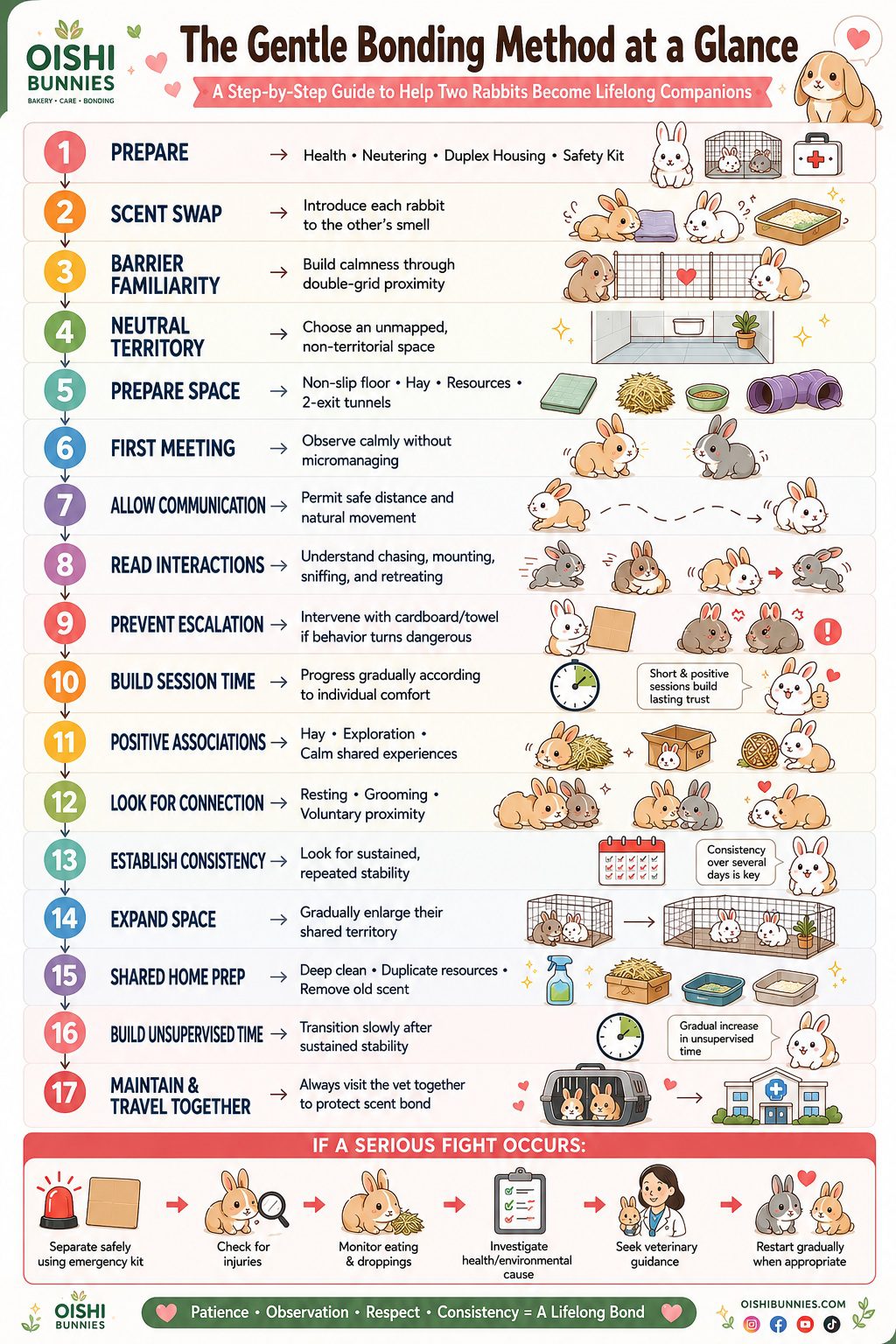
3. Gentle Rabbit Bonding at A Glance (Bonding Steps and Bonding Process)
The quick 14-step summary checklist from pre-bonding to permanent home.