
What Does the Evidence Actually Tell Us?
There is currently limited scientific research specifically evaluating stress bonding as a method for establishing rabbit-to-rabbit bonds.
Much of the discussion surrounding techniques such as short car rides, confinement, or other environmental stressors comes from the experiences of individual owners, rescuers and bonders rather than controlled scientific studies.
This means reported success should not automatically be interpreted as proof that stress itself caused the bond to develop.
For this reason, Oishi Bunnies distinguishes between:
What experienced bonders report ➔ What we can observe ➔ What scientific evidence has established
This article recognises the real-world experiences of experienced rabbit owners while being transparent about the current limitations of the evidence.
1. UNDERSTANDING THE SPECTRUM OF STRESS
Rabbit stress bonding involves introducing a temporary, unfamiliar, or challenging situation while two rabbits are together.
These bonding techniques carry different levels of impact and should never be treated as interchangeable:
Simultaneous head petting (“Bunny Magic”) or gentle hands-on supervision.
Short carrier sessions, controlled transport, or temporary changes in surroundings.
High-Stress / Confinement
Placing rabbits on vibrating appliances, in dangerously tiny boxes, or in terrifying situations.
Oishi Bunnies strictly advises against this tier.
Bonding techniques must be tailored to individual temperaments. One rabbit may remain mildly alert, settle, and eventually relax, while another may freeze in fear or become defensively aggressive.
Experienced handling isn’t about pushing rabbits through fear. It is knowing when to stop.
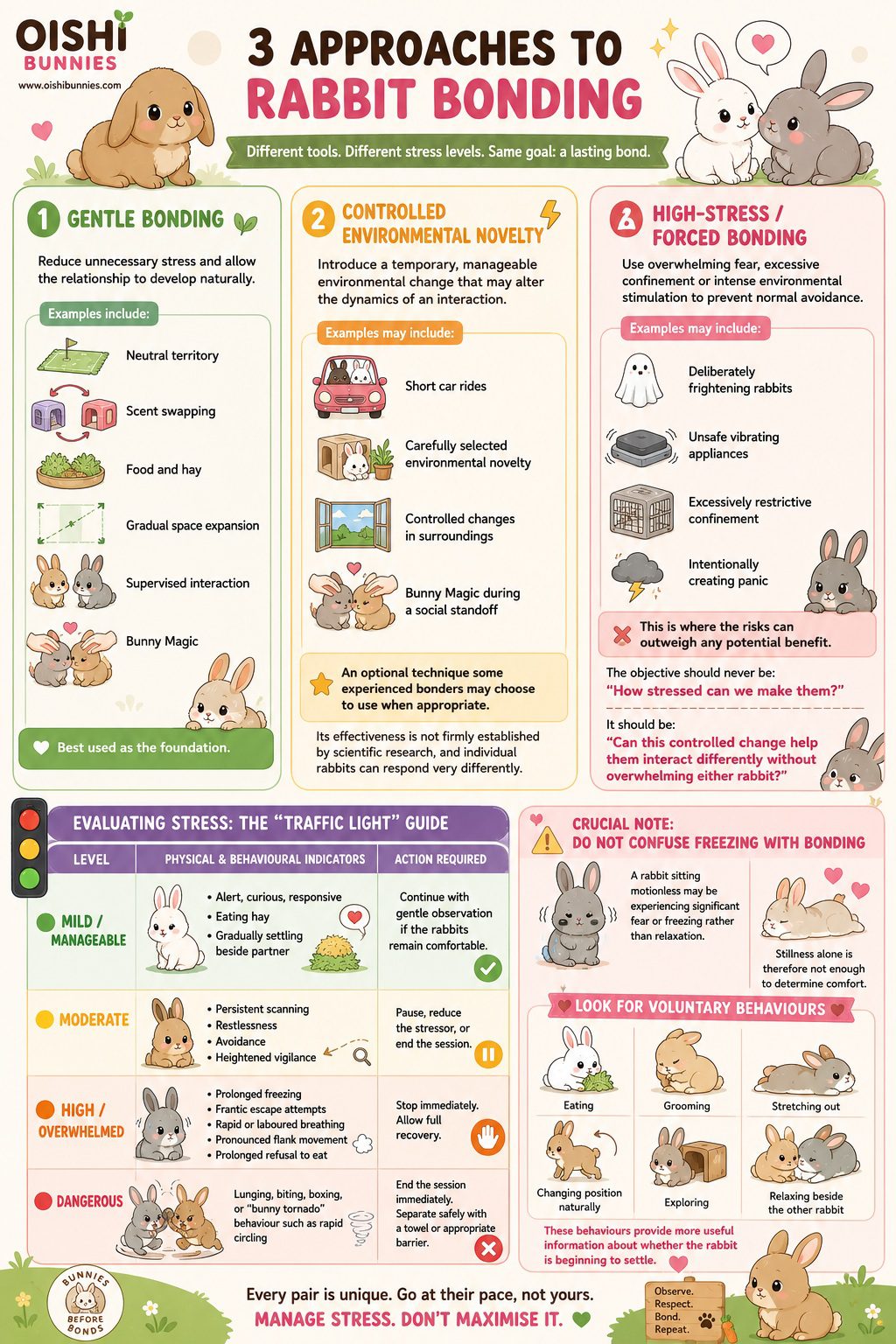
2. THE THREE-TIER BONDING TECHNIQUES FRAMEWORK
 TIER 1:
 Reduce unnecessary stress and allow the relationship to develop naturally.
Examples include:
- neutral territory
- scent swapping
- shared food & hay
- gradual space expansion
- supervised interaction
- “Bunny Magic” / grooming
These lower-stress approaches should form the foundation of a bonding programme.
 TIER 2: CONTROLLED NOVELTY
Optional Tool
Introduce a temporary, manageable environmental change to alter interaction dynamics.
Examples may include:
- brief carrier sessions & short bunny car rides
- controlled changes in surroundings
- Bunny Magic during a standoff
Optional technique when bonding stalls. Effectiveness is anecdotal; stop if overwhelmed.
Controlled environmental novelty is not the same as deliberately creating fear.
 TIER 3: FORCED/HIGH STRESS BONDING
Unsafe
Use overwhelming fear, excessive confinement, or intense stimulation to prevent escape.
Examples include:
- deliberately frightening rabbits
- excessively restrictive confinement
- unsafe vibrating appliances
- intentionally overwhelming rabbits
Carries substantial welfare risks (panic, severe injury) where risks far outweigh benefits.
We strictly advise against this tier.
The Core Objective:
The goal should never be “How stressed can we make them?”
It should always be: “Can this controlled change help them interact differently without overwhelming either rabbit?”

3. FACILITATED GROOMING & SOCIAL INTERACTION
“Bunny Magic” — Human-Assisted Grooming
When two rabbits sit together in a social standoff—each appearing interested in being groomed, but neither willing to initiate—gentle human assistance can help lower tension.
How to do it:
- Place both rabbits side-by-side on a secure, non-slip surface.
- Using both hands, slowly stroke both foreheads and cheek areas simultaneously.
- Keep movements calm and steady, allowing them to relax next to each other.
- Slowly ease your hands away.
- Observe whether either rabbit transitions to voluntary grooming.
The human is facilitating the interaction, not forcing the rabbits to groom one another.
Combing Two Rabbits Together: A Shared Grooming Experience
Combing or gently brushing two rabbits side-by-side can add another layer to the interaction: shared scent exposure.
As the same brush, comb or grooming tools move between the rabbits, small amounts of fur and scent are transferred between them. Combined with close physical proximity, this creates a shared grooming experience rather than two completely separate grooming sessions.
For some rabbits, the experience may also create an interesting social dynamic.
In other words, the groomer may temporarily become the more interesting or irritating part of the situation, giving the rabbits something external to focus on rather than constantly monitoring each other.

The “Common Enemy” Effect
Experienced bonders sometimes describe this playfully as giving the rabbits a “common enemy”. One rabbit gets brushed, then the other, then back to the first. The rabbits remain together while sharing the same experience.
This may:
- encourage them to remain physically close
- introduce each other’s scent through the grooming process
- reduce the focus on territorial or social posturing
- create a shared experience
- give the rabbits something external to react to
- potentially make one rabbit more tolerant of the other’s presence
However, this should be viewed as an observed or anecdotal bonding strategy, rather than a proven mechanism of rabbit bonding. The goal is not to annoy the rabbits until they “team up”.
COMB TOGETHER — DON’T JUST COMB ONE
When using grooming as part of a bonding session:
Rabbit A ➔ Rabbit B ➔ Rabbit A ➔ Rabbit B
This allows the rabbits to experience the same grooming routine while remaining together. For long-coated rabbits, do the difficult dematting and maintenance separately before the bonding session. During bonding, keep the brushing light and comfortable.
rather than: “Make them stressed enough to tolerate each other.”
Reading Grooming Interactions
Mutual grooming is an important affiliative behaviour and can be a positive sign that rabbits are becoming comfortable with one another.
However, a single grooming interaction should not be treated as definitive proof that a bond is established.

Head Lowering / Bowing
A rabbit tucking its head under or near the other rabbit may be requesting grooming.

Turning Away
A rabbit may simply decline. This does not automatically mean the introduction has failed. Give the rabbits an opportunity to communicate before intervening.

Minor Nipping
A brief, light nip may occur as part of normal social communication. However, if nipping becomes forceful, repeated, persistent or aggressive, intervene and reassess the interaction.
Don’t punish normal rabbit communication—but don’t allow communication to escalate into fighting.
4. OPTIONAL AID: FOOD-BASED GROOMING TRICKS
Some bonders place a tiny smear of a familiar treat—such as banana or another rabbit-safe food—on one rabbit’s forehead to encourage the partner to lick it off.
This is an optional, anecdotal technique. There is no scientific evidence establishing that placing food on one rabbit’s head alters the underlying bond between the rabbits.
If using this technique:
- use only a tiny amount
- use a food the rabbit already tolerates
- avoid introducing unfamiliar foods during bonding
- supervise continuously
- stop if it creates competition
- stop if licking turns into nipping or grabbing
The objective is to encourage a calm interaction—not create a food battle.
5. COAT MAINTENANCE DURING BONDING DATES
Rabbits with dense or long coats, such as Angoras, require regular grooming. However, heavy coat maintenance and bonding dates should remain separate activities.

Why coat maintenance must be separated:
Painful mat removal or prolonged tugging can cause a rabbit to flinch or react abruptly. A partner rabbit may misinterpret that sudden defensive movement as an aggressive action.
Before the session:
- Address necessary coat maintenance separately from the bonding session.
- Remove problematic mats where possible.
- Complete routine grooming needs before beginning the social session when practical.
During the session:
- Keep handling gentle.
- Avoid painful dematting.
- Keep the focus on social interaction.
The bonding session should ideally be associated with calm social interaction, rather than uncomfortable maintenance procedures.
6. BUNNY CAR RIDES: A CONTROLLED STRESS TECHNIQUE
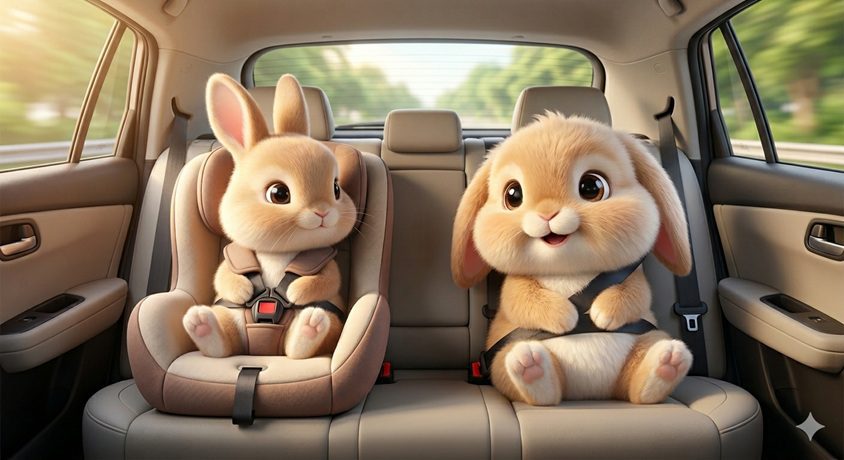
Short bunny car rides are sometimes used as a temporary environmental change when a pair reaches a persistent behavioural stalemate.
The Potential Mechanism
The unfamiliar movement, sounds and environment may temporarily interrupt established patterns of territorial or social behaviour. Some experienced bonders report that this can help rabbits settle together.
However, individual responses vary widely. There is no established evidence that the movement or vibration of a vehicle inherently makes rabbits bond.
Carrier Safety
Use a secure, well-ventilated carrier lined with:
- a non-slip liner
- a secure towel
- or another stable, high-traction surface
Provide secure footing throughout the journey. Slippery flooring can increase instability, scrambling and stress.
Avoid unnecessarily tight confinement—rabbits should have enough room to sit naturally together.
Two-Person Protocol
Whenever possible, use two people: one driving smoothly while the second monitors the carrier.
If conflict occurs:
Stop the vehicle safely before intervening. Use a towel or barrier to separate rabbits safely.
Never put bare hands between fighting rabbits.
7. KEEP THE DRIVE CONTROLLED
The objective is not to create the most intense ride possible. A short, smooth journey is sufficient if an experienced owner chooses to use this technique.
 There is no reason to:
- drive aggressively
- take sharp corners deliberately
- brake suddenly
- create unnecessary movement
- prolong the journey simply because the rabbits have not “bonded”
The aim is a temporary environmental challenge, not panic. Once the experience moves from manageable stress into obvious distress, the technique has gone too far.
8. THE POST-RIDE TRANSITION
The period after the bunny car ride is particularly important. The bunny car ride should never be treated as the entire bonding process.
Once the rabbits arrive:
- Move them into a safe neutral environment.
- Allow them to settle.
- Observe their body language.
- Offer familiar hay and suitable leafy greens if appropriate.
- Use Bunny Magic if both rabbits are receptive.
- Continue monitoring their voluntary interactions.
The real test isn’t whether the rabbits sit together while the car is moving—the real test is what happens when the stressor disappears.
Do they continue to:
Eat beside each other?
Groom?
Relax?
Seek each other out?
If intense aggression immediately returns once normal circumstances resume, the car ride has not resolved the underlying relationship problem.
9. TRANSPORTING ESTABLISHED BONDED PAIRS
For fully bonded pairs, travelling together during stressful situations can provide familiar companionship. This may be relevant during:
Grooming appointments
Relocation
Travel
Boarding
When practical and safe, keeping an established pair together may help preserve familiarity during an already stressful experience.
Note: Safety and veterinary requirements always come first. If a medical condition, veterinary procedure, infectious-disease concern or other circumstance requires temporary separation, follow veterinary guidance.
 Safe & Smooth Rides
Tutubao GaiGai | Exclusive ECO Rabbit Ride
Need reliable, experienced transport for veterinary visits, grooming, or controlled bonding trips?
10.  EVALUATING STRESS: THE “TRAFFIC LIGHT” GUIDE
 EVALUATING STRESS: THE “TRAFFIC LIGHT” GUIDE
 Mild / Manageable
 Moderate
 High / Overwhelmed
 Dangerous
Crucial Note: Do Not Confuse Freezing With Bonding
A rabbit sitting motionless may be experiencing significant fear or freezing rather than relaxation. Stillness alone is therefore not enough to determine comfort.
Look for voluntary behaviours such as:
grooming
stretching out
changing position naturally
exploring
relaxing beside the other rabbit
These behaviours provide more useful information about whether the rabbit is beginning to settle.
11. STRESS & GI STASIS
Stress deserves particular attention in rabbits because significant stress can be one of several factors associated with reduced appetite and gastrointestinal problems.
However, gastrointestinal stasis is multifactorial. It is not accurate to describe it simply as:
Pain, reduced food intake, dehydration, dental disease, illness, diet and other factors can contribute to gastrointestinal hypomotility. This is another critical reason not to deliberately maximise stress.
Veterinary Warning: If a rabbit stops eating, becomes unusually quiet, produces significantly fewer or no droppings, or shows other signs of illness following a stressful event, treat this as a potential health concern rather than simply a normal bonding reaction. When in doubt, seek veterinary advice promptly.
12. WHAT HAPPENS AFTER THE STRESS?
This is ultimately where rabbit stress bonding should be evaluated. A stressful experience may temporarily bring rabbits together, but once the stressor is removed, they still need opportunities to demonstrate that they can interact safely under normal circumstances.
The Ideal Post-Stress Progression:
This is why controlled environmental techniques should be considered supporting tools, rather than replacements for normal bonding work.
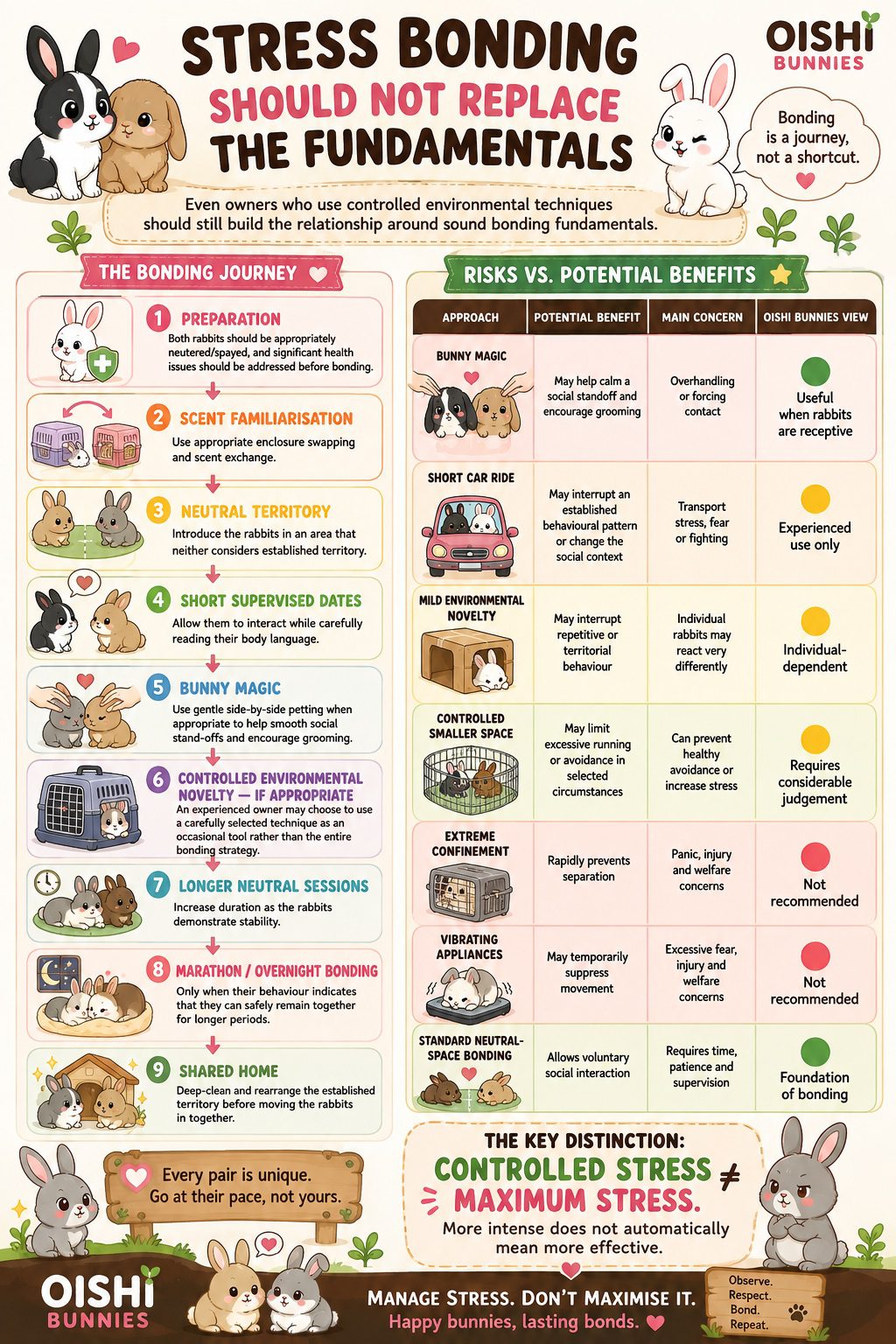
13. RABBIT STRESS BONDING SHOULD NOT REPLACE THE FUNDAMENTALS
Even owners who use controlled environmental techniques should still build the relationship around sound bonding fundamentals.
FINAL THOUGHTS
Rabbit stress bonding isn’t inherently “good” or “bad.” It is a technique.
Rabbit stress bonding is a technique used by some experienced rabbit owners and bonders.
There is currently limited scientific evidence establishing exactly when or why it works, and major rabbit-welfare organisations generally recommend lower-stress bonding approaches instead.
However, some experienced owners report that carefully controlled, short-term environmental challenges can help interrupt stalled bonding dynamics or change the circumstances surrounding a difficult interaction.
We do not believe stress should automatically be labelled as purely “good” or “bad.”
The more useful questions are:
- Is this technique appropriate for these particular rabbits?
- Does the owner understand their individual stress responses?
- Does the stress remain manageable rather than overwhelming?
- Can the rabbits be monitored continuously?
- Can the owner intervene immediately if necessary?
- What happens once the stressor is removed?
- Do the rabbits subsequently choose positive social interaction?
Most Importantly
When the stress disappears, do the rabbits still choose each other?
Spontaneous, voluntary behaviours—such as resting close together, eating together, grooming one another and relaxing in the same space—tell us far more than forced proximity during a stressful event.
- A rabbit sitting motionless beside another rabbit is not necessarily accepting that rabbit.
- A rabbit experiencing panic is not necessarily learning that another rabbit is safe.
- And two rabbits remaining together during a stressful experience does not automatically mean they have formed a stable relationship.
The real test comes afterwards. Do they:
remain close? eat beside each other? relax together? groom one another? seek each other out? voluntarily rest together?Those voluntary behaviours tell us far more than simple proximity during a stressful event.
Stress can be a tool. Fear should never be the goal.
Manage stress. Don’t maximise it. 🙂