Rabbit Urine Color Guide

📱 Pro-Tip: Viewing on a phone? Select desktop mode or rotate to landscape for the best reading experience!

📖 Estimated Read Time: 6 Mins
Decoding Rabbit Urine Color

rabbit urine color
 

The Art of Observation

As a bunny guardian, your litter box isn’t just a daily chore—it’s a sophisticated health report. Because rabbits are prey animals and masters of disguise, they rarely tell you when they feel unwell. However, their chemistry never lies.

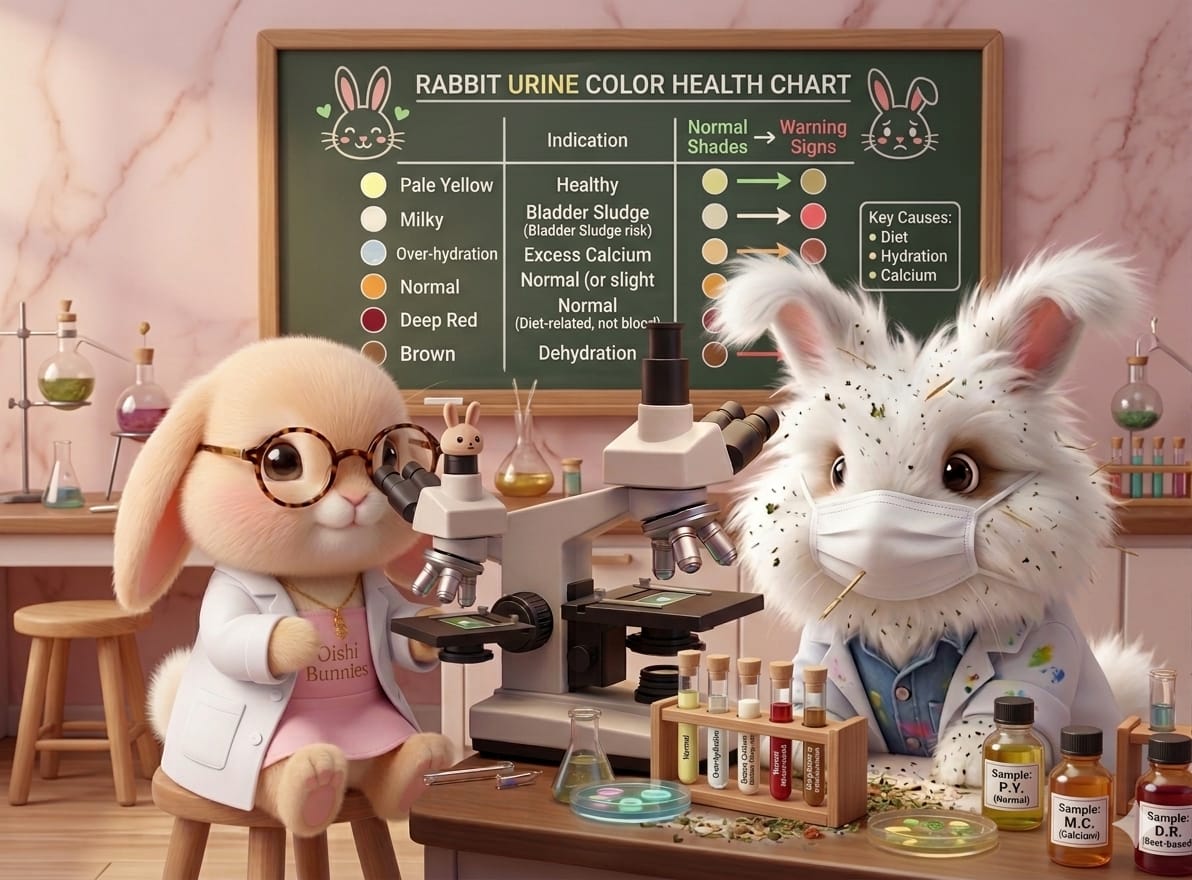
In this edition of our care series, Bunnini and Peecasso step into the lab to help you decode the “masterpieces” your rabbit leaves behind.


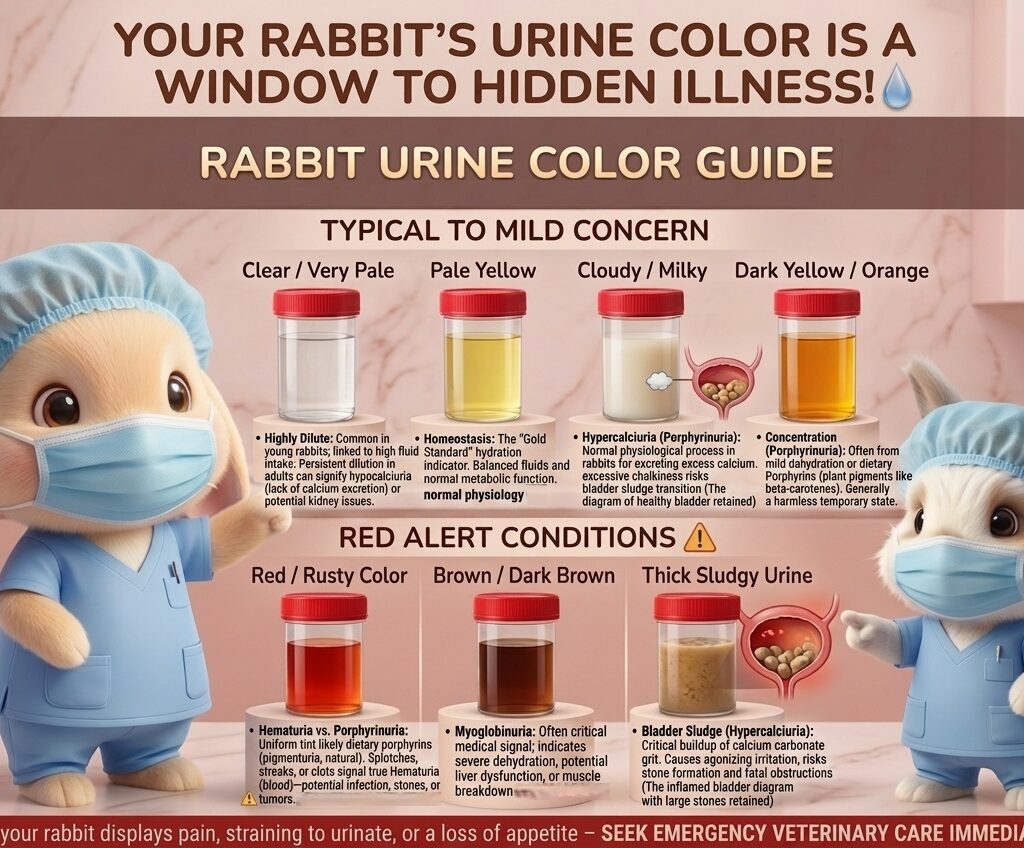
1. Typical to Mild Concern (The “Normal” Spectrum)

Not every strange color is a cause for panic. Rabbit urine color is unique because it is heavily influenced by how they process calcium and the pigments in their diet. Understanding these shifts is the first step in mastering the art of bunny care.

Clear to Very Pale

This is Highly Dilute urine. While common in young rabbits or those with high water intake, persistent dilution in adults can signify Hypocalciuria (lack of calcium excretion) or potential kidney issues.

Pale Yellow

This represents Homeostasis. It is the “Gold Standard” hydration indicator, showing balanced fluids and normal metabolic physiology.

Cloudy or Milky

Known as Hypercalciuria, this is a normal physiological process. Rabbits are unique in that they excrete excess dietary calcium through their kidneys. However, keep an eye on it—excessive chalkiness can lead to bladder sludge.

Dark Yellow to Orange

Usually a sign of Concentration or Dietary Porphyrins. If your bunny has been snacking on carrots, spinach, or beta-carotene-rich treats, you’ll see this harmless temporary shift.

Bunnini’s Lab Note: “Check the litter box daily to establish your rabbit’s personal ‘normal’ baseline.”


2. Red Alert Conditions (Seek Professional Care)⚠️

This is where the art becomes a medical emergency. Knowing the difference between a “pigment” and a “problem” can save your rabbit’s life. If you observe any of the following, a visit to a rabbit-savvy veterinarian is required.

Red / Rusty Color

The great debate: Hematuria vs. Porphyrinuria. If the tint is uniform, it’s likely dietary pigments. However, if you see splotches, streaks, or clots, it signals true blood (Hematuria). This is a warning sign for potential infections, bladder stones, or tumors. Rule out hematuria if you are ever unsure.

Brown / Dark Brown

A signal for Myoglobinuria. This is often a critical medical signal indicating severe dehydration, potential liver dysfunction, or muscle breakdown (Rhabdomyolysis). This requires immediate diagnostic attention.

Thick Sludgy Urine

This is Bladder Sludge (Hypercalciuria). It is a critical buildup of calcium carbonate grit that causes agonizing irritation and risks stone formation or fatal obstructions. If it looks like thick toothpaste, it is an emergency.

— Peecasso’s Lab Note: “Your bunny’s silence is not health. Their chemistry speaks for them.”

3. The “Phantom” Blood – Understanding Oxidized Pee

The ultimate “False Alarm” that sends every kan cheong (anxious) pawrent into a tailspin.

In the world of rabbit care, Oxidized Pee is the master of illusion. You walk over to the litter box and see a deep, dark, brownish-orange or “burnt” red stain. Your heart sinks: “Is my bunny bleeding?!”

The short answer: Probably not.

The Science of the Magic Trick

Rabbit urine contains porphyrins (plant pigments). When these compounds are exposed to oxygen, a chemical reaction occurs—much like an apple slice turning brown on the counter. Rabbit urine can exit the body as a normal “Pale Yellow” and, after sitting for a few hours, transform into a scary “Rusty Red.”

The “Peace of Mind” Tests
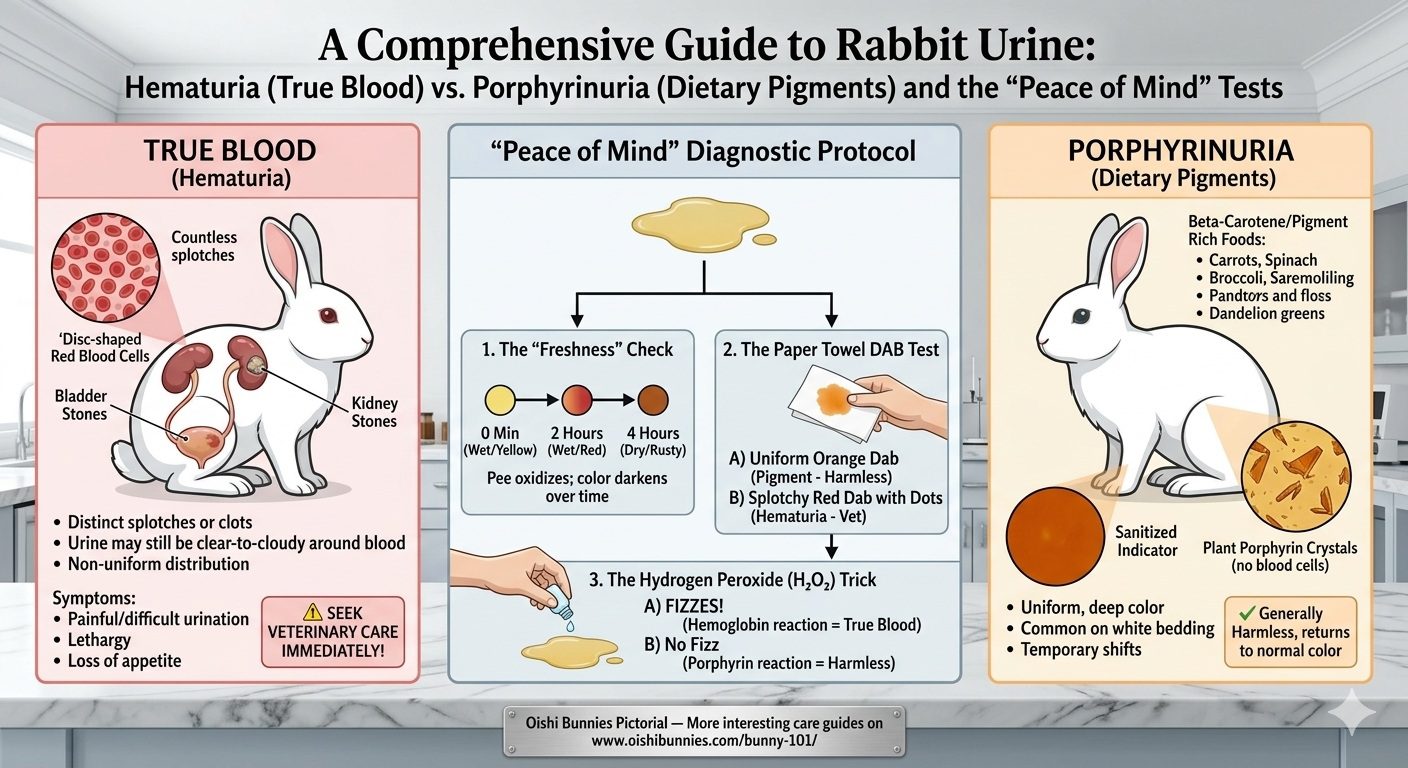
1. The “Freshness” Check:
Is the pee wet or dry? Oxidation takes time. If the “red” is only on the edges of a dry patch, it’s almost certainly oxidation.
2. The Paper Towel Test:
Dab a fresh puddle of pee with a white paper towel. If the color is a smooth, uniform tint with no dark specks or splotches, it’s just dietary pigment.

3. The Hydrogen Peroxide Trick:
Put a few drops of household hydrogen peroxide on the red stain.

  • Fizzes/Bubbles? That’s a reaction to hemoglobin. Seek a vet; it’s likely true blood.
  • No reaction? It’s just porphyrins or oxidation. Take a deep breath and give your bunny a treat.

4. Fine-Tuning Your Bunny’s Chemistry

Expert adjustments for Gold Standard homeostasis.

Rectifying Clear / Pale Urine

If pee is consistently clear, it’s time to audit the greens. High-volume “wet” greens like cucumber or romaine lettuce can over-hydrate. Switch to denser, fibrous hay to balance the system.

Senior Note: Persistent dilution can signal kidney shifts. Request a BUN & Creatinine check during your next vet visit.
Managing Cloudy / Milky Output

Managing calcium is key. Swap Alfalfa for Timothy, Orchard, or Oat hay. Limit “calcium bombs” like kale and parsley. To help flush the system, replace the bottle and try a tiny splash of unsweetened fruit juice in the water bowl to encourage drinking.

De-concentrating Dark Orange

This is usually a sign of dehydration or heat stress in Singapore’s humidity. Upgrade to a heavy ceramic bowl (bunnies drink more from bowls) and ensure they have a aluminum cooling plate or granite tile for thermal regulation.

5. The Golden Rule for Every Parent

While the color palette is a great guide, behavior is the ultimate truth.

🚨 SEEK EMERGENCY CARE IMMEDIATELY IF:

Your rabbit is straining to urinate, lifting their tail for long periods without success, grinding their teeth in pain, or has lost their appetite.

Understanding the “art” of your rabbit’s health starts with a single glance. Keep this guide handy, use white bedding to make color identification easier, and always trust your gut if something looks “off.”
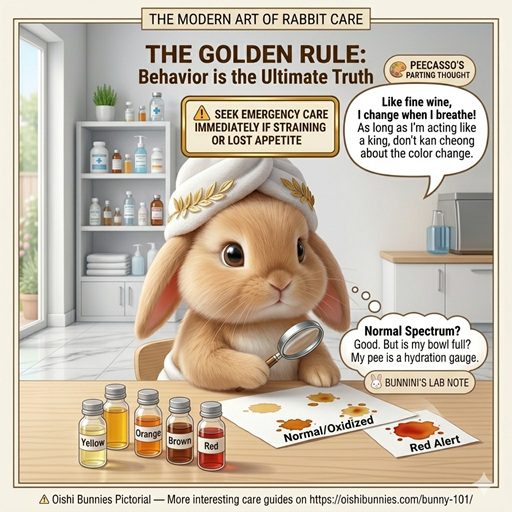
🐰 Bunnini’s Lab Note“Just because I’m in the ‘Normal’ spectrum today doesn’t mean I don’t need my water bowl topped up! Think of my pee as a daily hydration gauge.”

🎨 Peecasso’s Parting Thought“My pee is like fine wine—it changes when it breathes! If I’m still acting like a king, don’t let a little orange stain ruin your day.”

✨ Living Content Notice

The Modern Art of Rabbit Care is a work of passion and precision. This content may be updated from time to time as new scientific data emerges or whenever inspiration hits. We strive for a “masterpiece” level of accuracy, so check back often for the latest refinements.

🩺 Medical Disclaimer

While we provide evidence/experience-based, “anatomy-aware” insights, Cookie Yiyi is a rescuer and researcher, not a licensed veterinarian. The information provided here is for educational purposes and should not replace professional veterinary diagnosis or treatment. Always consult an exotic animal vet for specific health concerns regarding your rabbit.

Want to contribute to the Masterpiece?

If you have a passion for rabbit advocacy, scientific writing, or raising awareness, we’d love to collaborate.

Contact Oishi Bunnies ✉️

oishibunnies.com.sg • Singapore