
🌿 Benefits of Proper External Parasite Control
When external parasites are successfully managed and kept at bay, your rabbit will experience a major upgrade in their quality of life:
- A significantly healthier, softer, and cleaner coat.
- Drastically reduced scratching, lower anxiety, and minimal environmental stress.
- Better quality of sleep, relaxation, and peaceful behaviors.
- A much lower risk of developing painful secondary skin infections.
- Improved overall well-being and happiness.

🦠 Common External Parasites in Rabbits
Rabbits can fall prey to a few primary external hitchhikers:

1. Ear Mites
Psoroptes cuniculi
- Causes thick, painful crusting inside the ears.
- Leads to frequent head shaking and intense scratching.
- Extremely painful if left untreated.
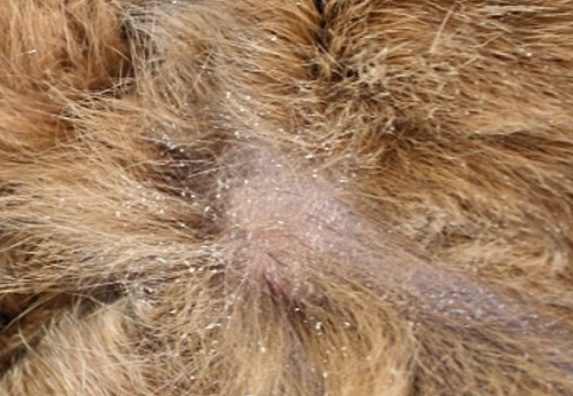
2. Fur Mites
Cheyletiella parasitovorax / Listrophorus gibbus
- Presents as dandruff-like flakes along the skin (often called “walking dandruff”).
- Causes patchy fur loss and general skin irritation.
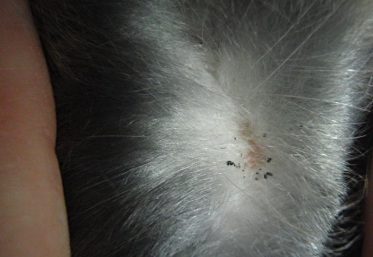
3. Fleas
- More common if there are cats or dogs sharing the home.
- Causes persistent itching, localized redness, and high stress levels.
Other Arachnid & Skin Parasites to Note
Less Common Fur Mites
Trombicula autumnalis & Dermanyssus gallinae
Harvest mites and red poultry mites can occasionally migrate to rabbits, causing targeted hotspots of localized irritation.
Burrowing Mites
Sarcoptes scabiei & Notoedres cati
These mites tunnel deep beneath the skin layers, resulting in intense, severe scratching, crusting lesions, and secondary infections.
Ticks in Rabbits
Typically picked up from outdoor grass or wild vectors, ticks physically attach to draw blood and pose a high risk for transmitting serious systemic diseases.
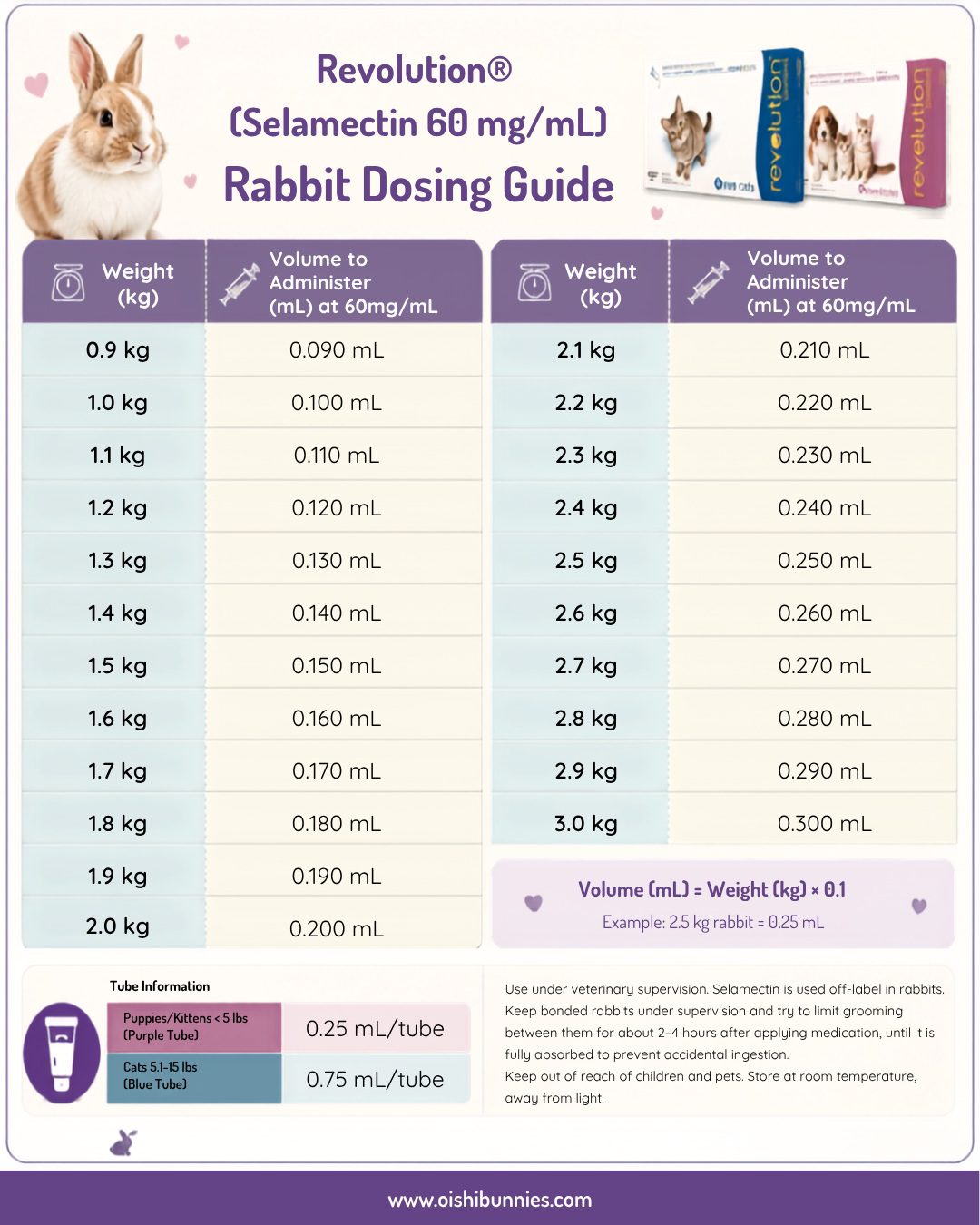
When purchasing Revolution® (Selamectin), you will often notice different packaging colors for cats, kittens, or puppies. It is highly useful to know that both the “Puppies & Kittens” (Pink/Mauve) box and the “Cats” (Blue) box share the exact same active concentration of 60 mg/mL. The only difference is the fluid volume per tube (0.25 mL vs 0.75 mL)
Dosing Formula
Volume to Administer (mL) = Weight of Rabbit (kg) × 0.1
Always use a precise syringe to match your exotic veterinarian’s specified prescription.
 Why We Calculate Dosage by Weight (Instead of “One Tube Per Rabbit”)
 Why We Calculate Dosage by Weight (Instead of “One Tube Per Rabbit”)
A common question we receive from dedicated pawrents is:
“My groomer uses one whole tube on every rabbit, and my vet says that’s okay too. Why does your dosing table calculate the exact amount needed?”
The simple answer comes down to the core principle of modern veterinary medicine: precision medicine and weight-based dosing.
Selamectin has a beautifully wide safety margin, which is why a general “one-size-fits-all” approach is often safely tolerated in standard protocols. However, because rabbits come in drastically different sizes, a fixed tube volume means different sized rabbits receive vastly different strengths per kilogram. This is the exact same principle specialized veterinarians use when calculating critical care treatments like antibiotics, pain medications, or anesthetic drugs.
Let’s look at the mathematics behind a standard Pink Tube (15mg Selamectin) across three different rabbit sizes:
Notice that while the physical tube remains completely unchanged, the actual concentration circulating through your rabbit’s system varies significantly based entirely on their body weight. This mathematical reality is exactly why many rabbit advocates and veterinary professionals prefer to think precisely in mg/kg metrics rather than a fixed vial-per-animal count.
Transitioning to weight-based tracking allows us to achieve:
- Consistent Baselines: Uniform protection levels across multi-rabbit households of different sizes.
- Metabolic Awareness: Accurate tracking of the exact medication volume processing through your rabbit’s liver and kidneys.
- Targeted Security: Reduced risk of administering unnecessarily high doses to exceptionally fragile, senior, or miniature breeds.
- Flawless Adjustments: The ability to seamlessly pivot quantities as growing juveniles reach adult skeletal maturity.
 A note on clinical judgment: Different published medical frameworks exist globally, and an exotic animal veterinarian may intentionally prescribe a full tube depending on your rabbit’s current parasite burden, medical history, or specific treatment protocol. A professional veterinarian’s direct clinical assessment should always remain your family’s absolute priority. Our table serves purely as an educational tool to help you visualize the science of weight-proportionate care.
Home Prevention Tips
 Home Prevention Tips
Medication works best when supported by excellent husbandry at home. You can drastically minimize the risk of a bug outbreak with a few simple hygiene habits:
- Clean bedding and litter trays regularly to eliminate larval environments.
- Vacuum fabric surfaces and carpets often to pick up stray fleas or mites.
- Wash soft furnishings and plush bunny toys when needed.
- Deep Clean Environments: Schedule an annual professional steam cleaning for your mattresses and upholstery to deeply sanitize deep-seated fabrics and eradicate hidden parasite eggs.
- Groom your rabbits to proactively check their skin, coat, and ears for early signs of pests.
- Quarantine any new pets thoroughly before introducing them to your current rabbit.
- Keep bulk hay storage clean, well-ventilated, and completely dry.
Final Thoughts
 Final Thoughts
External parasite control is an essential part of responsible rabbit care. With proper hygiene, regular monitoring, and vet-guided treatment, most infestations are entirely preventable and easily managed.
If your rabbit shows early signs of itching, fur loss, or ear discomfort, don’t wait for it to escalate. Early veterinary care makes a world of difference in their recovery and comfort.
Resources:
https://www.medirabbit.com/EN/Skin_diseases/Parasitic/furmite/fur_mite.htm
https://medirabbit.com/EN/Skin_diseases/Parasitic/earmite/Psoroptes.htm
https://www.medirabbit.com/EN/Skin_diseases/Parasitic/fleas/Fleas.htm