
 Pro-Tip: Viewing on a phone? Select desktop mode or rotate to landscape for the best reading experience!
 Estimated Read Time: 7 Mins
Is Comfrey Safe for Rabbits?
What the Actual Rabbit Studies Say
If you are researching is comfrey safe for rabbits within our herb atlas and rabbit herb guide, asking the internet whether comfrey is safe will get you a confident one-word verdict: “toxic.” Case closed, move along.
|
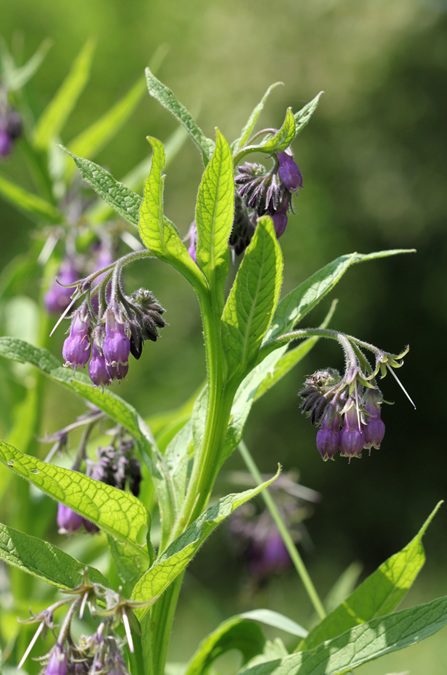
 “Rabbits are unusually resistant to the toxin in comfrey. But resistant isn’t the same thing as immune, and nobody has ever worked out a safe dose.”
 Quick Answer
 Quick Answer
When evaluating comfrey for rabbits and overall herb safety, Symphytum officinale contains pyrrolizidine alkaloids (PAs) — compounds capable of damaging the liver and DNA once metabolised. Rabbit-specific research shows they tolerate dietary PA exposure far better than most mammals, and older feeding trials even reported rabbits eating comfrey for 6–12 months with no obvious ill effects. But microscopic liver changes and dose-related biochemical shifts have shown up in other rabbit studies, and no one has established a validated safe dose or feeding frequency for pet rabbits.
Our take: we don’t recommend feeding comfrey leaf or root as a routine treat. But a single accidental nibble isn’t a five-alarm poisoning emergency, and finding comfrey buried in your pellet mix isn’t a reason to panic either. Nuance, not a red X.
Let’s hop into why both halves of that sentence matter! 
Comfrey makes a whole family of defence compounds called pyrrolizidine alkaloids (PAs) — a lineup that includes intermedine, lycopsamine, symphytine, echimidine, various acetylated PA derivatives, and their N-oxide forms. Not all of them are equally dangerous: the ones toxicologists worry about most are the “1,2-unsaturated” PAs, which the body can metabolise into reactive pyrrolic compounds capable of reacting with proteins and DNA.
That’s the mechanism behind the cellular injury, mutagenicity, and (in experimental animal models) tumour formation linked to comfrey exposure.
The Toxicological Reality

So no, the PA concern isn’t imaginary — there’s a genuine toxicological hazard sitting inside this plant. But here’s the thing: knowing a plant contains a hazardous compound doesn’t actually answer the questions that matter most:
- How much has to be eaten before it causes harm?
- Does the odd nibble behave the same way as months of steady exposure?
- Does a leaf carry the same load as a root?
- Does whole-plant feeding behave like a concentrated extract?
- Are all animals equally vulnerable — or do some species handle PAs better than others?
That last question is where rabbits get genuinely interesting.
Let’s dive into the science!
When exploring our herb atlas and rabbit herb guide regarding is comfrey safe for rabbits, the 1977 study behind that claim is one of my favourite pieces of accidental toxicology trivia. Researchers fed rabbits ragwort (another PA-loaded plant) for 263 days, with total intake averaging 112.5% of the rabbits’ own body weight. No gross liver damage. No changes in blood protein. On paper, an almost comical level of tolerance.
The Plot Twist in the Data

But — and this is the bit every “comfrey is totally fine” post conveniently skips — microscopic liver changes did show up under the microscope, even without visible symptoms. And when the same researchers injected two rabbits with concentrated alkaloid directly, both died within 24 hours. Same toxin. Wildly different outcome depending on the route of exposure. That’s not a contradiction — it’s a clue.
A follow-up study in 1982 chased down why. It turns out rabbits absorb PAs through the gut just fine — the alkaloids aren’t simply passing through unabsorbed. Instead, rabbits appear unusually efficient at eliminating absorbed PAs through urine, clearing them out before they can build up in the liver.
Direct comfrey for rabbits Trials
And yes, when analyzing herb safety, there’s direct comfrey research too, not just extrapolation from ragwort — a 1979 trial (Cheeke) found rabbits fed comfrey-containing diets for 6–12 months with no obvious health or liver problems. So the claim “nobody has ever studied rabbits actually eating comfrey” is simply wrong. It’s been studied, and the historical result was reassuring.
Science brings the nuance!
When checking comfrey for rabbits across our herb atlas, a 1970s “no obvious illness” standard isn’t the same as a modern safety study. Toxicology has moved on since then — today’s PA research looks at metabolic activation, chronic cumulative exposure, DNA-reactive metabolites, genotoxicity, and long-term dose-response relationships, none of which a 1970s “did the rabbit look sick” trial was equipped to catch. That original comfrey study showed real tolerance under the conditions it tested — but it never established a safe PA intake per kilogram, a safe serving size, a safe feeding frequency, or lifetime safety in a companion rabbit. And newer evidence adds real caveats of its own.
The 2014 Trial & Enzyme Markers

A small 2014 trial fed rabbits concentrated comfrey extract (2%, 4%, 8%) for seven days, and liver enzymes AST and ALT rose in a clear dose-dependent pattern. Worth noting: in rabbits specifically, ALT and AST aren’t purely liver markers — AST in particular also shows up from skeletal muscle, cardiac muscle, kidney, and pancreas — so elevated numbers point to “something’s stressed,” not necessarily “the liver is damaged.”
Combined with the small sample size (12 rabbits), the short seven-day window, and the use of a concentrated ethanolic extract rather than ordinary leaf, the fairest read is this: the study shows concentrated comfrey exposure can produce measurable biochemical effects in rabbits. It doesn’t show that an ordinary treat-sized nibble of leaf causes clinically significant liver injury — but it doesn’t prove that nibble is safe either. Absence of proof of harm isn’t proof of safety, and this study wasn’t designed to give us either answer.
Then there’s the dosing problem baked into the plant itself, heavily featured in our rabbit herb guide. A 2023 chemical analysis found comfrey root carries 6 to 14 times more PA content than the leaf. Good reason to skip the root entirely — but the leaf isn’t PA-free either, and concentrations shift depending on where and how the plant was grown. There’s no dial you can set to “safe serving,” because that number has never been established for a pet rabbit.
FEDIAF Guidelines Perspective
 FEDIAF Guidelines Perspective
Even FEDIAF, which publishes Europe’s pet rabbit nutrition guidelines, explicitly notes rabbits appear resistant to comfrey — and still lists it in their 2024 potentially-toxic-plant appendix, sourced from general herb safety references rather than a rabbit-specific PA dose table. Translation: resistance noted, safety not proven. Those two things can both be true at once.
Embracing the nuance of bunny care!
The Core Distinction

Worth sitting with this distinction, because it’s the whole article in two words: a hazard is something capable of causing harm. Risk depends on the dose you actually get. Comfrey clears the hazard bar easily. Whether a specific serving clears the risk bar depends on amount, plant part, frequency, and the individual rabbit — none of which “comfrey is toxic” as a blanket statement captures.
Understanding the true science of bunny nutrition!
Fair objection — some commercial rabbit foods do list comfrey as one of dozens of plants in a meadow-mix blend. That’s a different exposure story entirely. Comfrey as one line among dozens of ingredients, at an undisclosed (likely small) percentage, is nowhere near the same dose as a rabbit eating a handful of dried comfrey leaf on its own. Ingredient-list presence tells you almost nothing about actual PA exposure per serving.
The Exposure Context

So: don’t panic-toss an otherwise good food because comfrey shows up in the ingredient list. And don’t use “it’s in my pellets” as licence to feed comfrey leaf freely either — the dose has completely changed in both directions.
The Verdict
Informed care keeps our bunnies hopping happily!
When evaluating comfrey for rabbits through our herb atlas, finding out your rabbit took one bite of a comfrey leaf in the garden is not the same thing as finding out it ate a known lethal dose of poison. Rabbits’ documented resistance to dietary PAs gives real reason not to panic over every minor accidental nibble — but we also can’t hand you a guaranteed-harmless number, so it’s not a free pass to shrug it off either.
When to Contact an Exotics Vet

As part of our complete rabbit herb guide and herb safety protocols, contact a rabbit- or exotics-experienced vet if any of the following apply:
- A substantial quantity was eaten
- You’re not sure how much was eaten
- It was the root, not the leaf
- It was a concentrated extract or herbal preparation
- Your rabbit has had repeated access (not just a one-off nibble)
- Your rabbit has known liver disease or another significant underlying illness
- You notice reduced appetite, smaller or fewer droppings, lethargy, weakness, behaviour changes, or any other sign of illness
What to Tell Your Vet
 What to Tell Your Vet
When you call, it helps a lot to be able to tell the vet:
- What was eaten
- Which part of the plant
- Roughly how much
- When it happened
If you can, bring a sample or a clear photo of the plant — correct identification matters, since several garden plants get mistaken for each other, and the vet’s advice will depend on getting the right one.
Stay calm, stay informed, and keep your bunnies safe!
Comfrey isn’t the guaranteed poison the internet insists it is — rabbits are genuinely, measurably good at handling dietary PAs. But “better than a horse at surviving liver toxins” is a low bar, and “we haven’t found the safe dose yet” is not the same as “there’s no risk.” With plenty of genuinely low-risk greens on hand — cilantro, basil, mint, dill, romaine — there’s no real upside to making comfrey a habit while the science stays this unsettled.
The Oishi Bunnies Perspective
Oishi Bunnies does not sell comfrey and does not recommend feeding it — not because it’s a proven poison, but because no one has established a safe dose for a pet rabbit. Never the root, and never a reason to panic over an ingredient list you didn’t choose.
With love and whiskers from Cookie Yiyi, Bunnini, and Peecasso!

Discover More in Our Herb Atlas
Curious about what else is safe to forage? Dive deeper into herb safety, plant science, nutrition breakdowns, and evidence-based guides inside our complete bunny herb atlas!
Explore the Oishi Bunnies Herb Atlas
(Bunny Bulletin Chapter 6)
This article is part of our evidence-based approach to rabbit herbs, plants, and foraging. Our research philosophy is simple: rabbit-specific evidence comes first, whenever it exists.
Where the evidence instead comes from other animal species, lab studies, phytochemical analysis, traditional herbal use, or human medicine, we say so — rather than quietly treating it as established rabbit fact.
We think good rabbit care sometimes means moving past “is this plant safe or toxic?” and asking better questions instead: which part, how much, how often, what compounds are actually in it, what’s been studied in rabbits specifically, and what do we honestly still not know. Where the evidence is incomplete, we lean precautionary — without overstating what the science actually shows.
Important Medical & Educational Disclaimer

With that said: this article is intended for educational purposes only and is not a substitute for diagnosis, toxicology advice, or treatment by a qualified veterinarian.
Plant toxicity can depend on species, plant part, dose, preparation, frequency and duration of exposure, and the health of the individual rabbit — so nothing here should be read as a guarantee for your specific rabbit. Every rabbit is different, and factors like age, weight, existing health conditions, and even individual sensitivity can shift how a plant affects them.
This article also isn’t a substitute for reading your own vet’s advice on your rabbit’s specific situation, and it isn’t intended to replace product labelling or manufacturer guidance for commercial rabbit foods.
If you suspect your rabbit has eaten a potentially harmful plant — particularly in a substantial or unknown quantity — contact a rabbit- or exotics-experienced veterinarian for individual advice rather than relying on this article alone.
Rooted in science, guided by care!
- Pierson ML, Cheeke PR, Dickinson EO. Resistance of the rabbit to dietary pyrrolizidine (Senecio) alkaloid. Research Communications in Chemical Pathology and Pharmacology. 1977;16(3):561–564. Rabbits consumed Senecio jacobaea for 263 days; gross lesions were absent but microscopic liver changes occurred.
- Swick RA, Cheeke PR, Patton NM, Buhler DR. Absorption and excretion of pyrrolizidine (Senecio) alkaloids and their effects on mineral metabolism in rabbits. Journal of Animal Science. 1982;55(6):1417–1424. DOI: 10.2527/jas1982.5561417x.
- Cheeke PR. Comfrey: an excellent forage or a poisonous plant? Journal of Applied Rabbit Research. 1979;2(3):7–11. Accessible bibliographic summary reports comfrey-containing diets fed for 6–12 months without apparent adverse effects on rabbit health or liver pathology.
- Norma, Latif UTA, Usman S. Efek Hepatotoksisitas Ekstrak Etanol Herba Kompri (Symphytum officinale L.) Terhadap Hewan Uji Kelinci (Oryctolagus cuniculus) Dengan Parameter SGOT dan SGPT. Biogenesis. 2014;2(1):11–15. DOI: 10.24252/bio.v2i1.462.
- Kimel K, Godlewska S, Gleńsk M, et al. LC-MS/MS Evaluation of Pyrrolizidine Alkaloids Profile in Relation to Safety of Comfrey Roots and Leaves from Polish Sources. Molecules. 2023;28(16):6171. DOI: 10.3390/molecules28166171.
- Washington IM, Van Hoosier G. Clinical Biochemistry and Hematology. In: The Laboratory Rabbit, Guinea Pig, Hamster, and Other Rodents. Academic Press; 2012. Includes rabbit-specific interpretation of ALT and AST and their lack of liver specificity.
- FEDIAF. Nutritional Guidelines for Feeding Pet Rabbits. November 2024. Notes apparent rabbit resistance to several plant toxins including comfrey while also including comfrey in an annex of potentially toxic foodstuffs compiled from rabbit plant-safety references.
- Mei N, Guo L, Fu PP, Fuscoe JC, Luan Y, Chen T. Metabolism, genotoxicity, and carcinogenicity of comfrey. Reviews evidence concerning comfrey PAs, metabolic activation, DNA damage and experimental carcinogenicity.
Exploring the evidence together!