
Do Rabbits Remember Their Owners and Previous Owners?

do rabbits remember their owners

Do Rabbits Remember Their Owners and Previous Owners?

The science of rabbit memory, human recognition, trust and the bonds that may remain long after goodbye.

Do rabbits remember their owners? Scientific research shows that rabbits can distinguish between individual humans and learn from their interactions. However, whether they recognise a former owner after months or years apart remains an unanswered scientific question.

If you’ve ever wondered “Do rabbits remember their owners after a long separation?” you’re certainly not alone. For rabbit owners, rescuers and foster caregivers, it’s a question that touches on rabbit memory, emotional bonds and the relationships we develop with these sentient animals.

While “rabbits remember you forever” is a lovely sentiment, it isn’t an established scientific fact. But does the absence of research mean those memories don’t exist? Not necessarily.

For those of us who rescue, foster, rehabilitate and rehome rabbits, this question carries a deeper meaning. We meet rabbits with different histories, personalities and experiences of human contact. Some appear comfortable around people almost immediately, while others take considerable time to feel safe.

And sometimes, we wonder whether the rabbits who have moved on to new families still remember us.

Understanding Rabbit Memory and Human Relationships

To understand whether rabbits remember their owners and previous caregivers, we need to distinguish four related questions about rabbit behaviour, recognition and emotional attachment:

  1. Can rabbits tell one person from another?
  2. Can rabbits learn to feel safe or unsafe around particular people?
  3. Can rabbits recognise a specific person after a long separation?
  4. Do rabbits emotionally miss someone who is no longer present?

Research offers evidence relevant to the first two questions, but the third and fourth remain open. Understanding these differences helps us appreciate rabbit intelligence without making assumptions about what rabbits remember or feel.

How Do Rabbits Remember Their Owners? Scent, Sound, Sight and Touch

When we talk about rabbit memory, we often imagine a rabbit recognising its owner’s face, much as humans recognise familiar people. But rabbits experience the world differently. Their senses help them locate food, communicate, navigate their surroundings and detect potential danger.

So, how do rabbits remember their owners? They may use a combination of scent, sound, sight, touch and learned associations. These are plausible recognition cues, although scientists have not established which senses domestic rabbits rely on most when identifying their caregivers.

1. Scent — A Familiar Smell
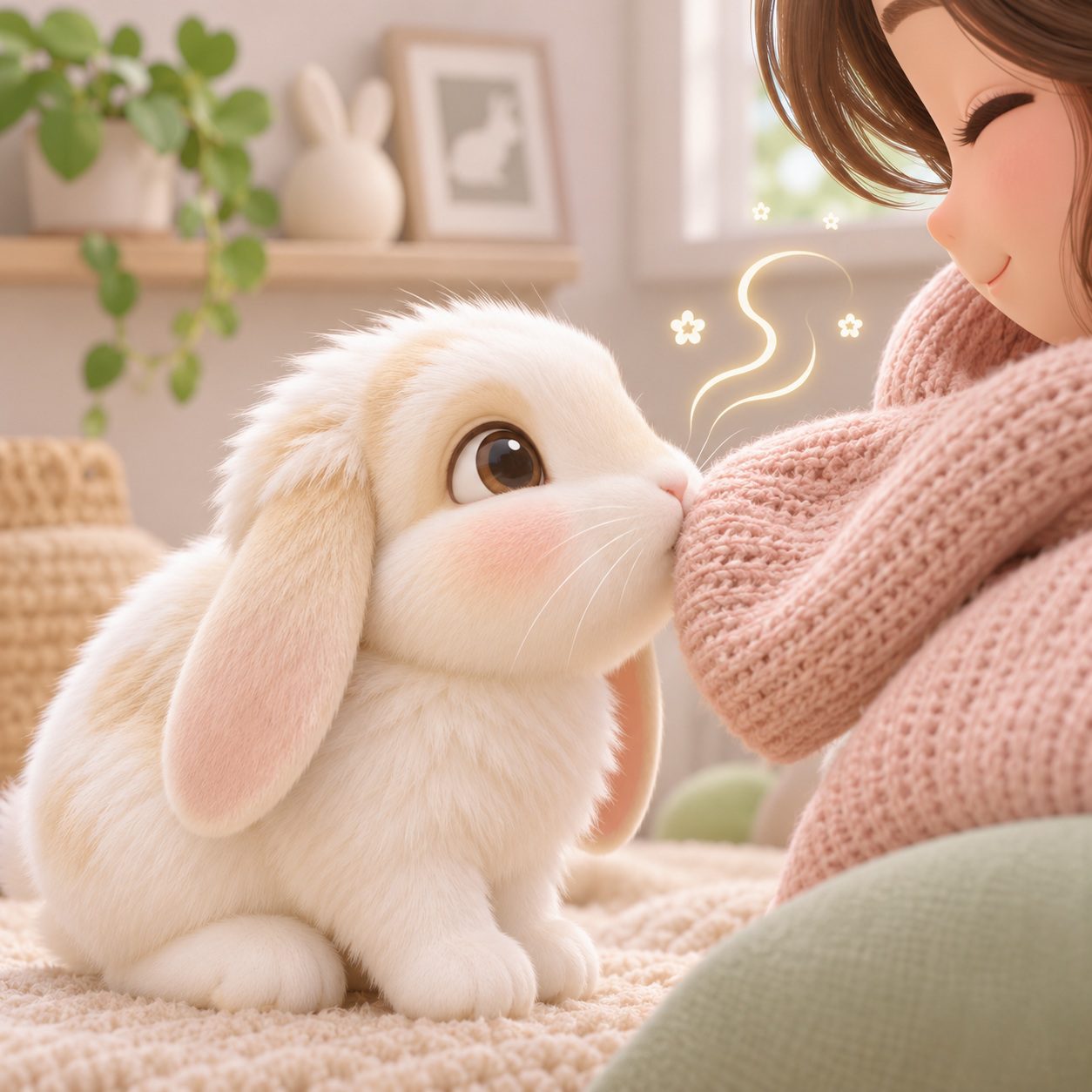
3D chibi rabbit sniffing familiar clothing, illustrating how scent may contribute to rabbit memory and recognition of owners

Rabbits possess a well-developed sense of smell. Olfaction plays an important role in food selection, environmental exploration, chemical communication and recognition of other rabbits.

Their ability to learn odours begins remarkably early in life. Studies involving newborn rabbits demonstrate that they can learn and distinguish complex odour mixtures. Research published in 2014 investigated the persistence of learned odour representations, while a 2025 study examined how odour concentration influences learned responses.

These findings show that olfactory learning is an important part of rabbit sensory development. But do rabbits remember their owners by scent?

It is biologically plausible. A person’s natural body odour, clothing and familiar surroundings may provide sensory information that a rabbit associates with previous experiences.

However, these studies investigated odour learning in newborn rabbits, not long-term recognition of human owners. They cannot establish that an adult rabbit remembers a previous owner’s scent for months or years.

What science supports: Rabbits possess sophisticated olfactory learning abilities. Whether an adult rabbit can identify a former caregiver solely by scent after prolonged separation remains untested.

2. Sound — Voices, Footsteps and Familiar Noises
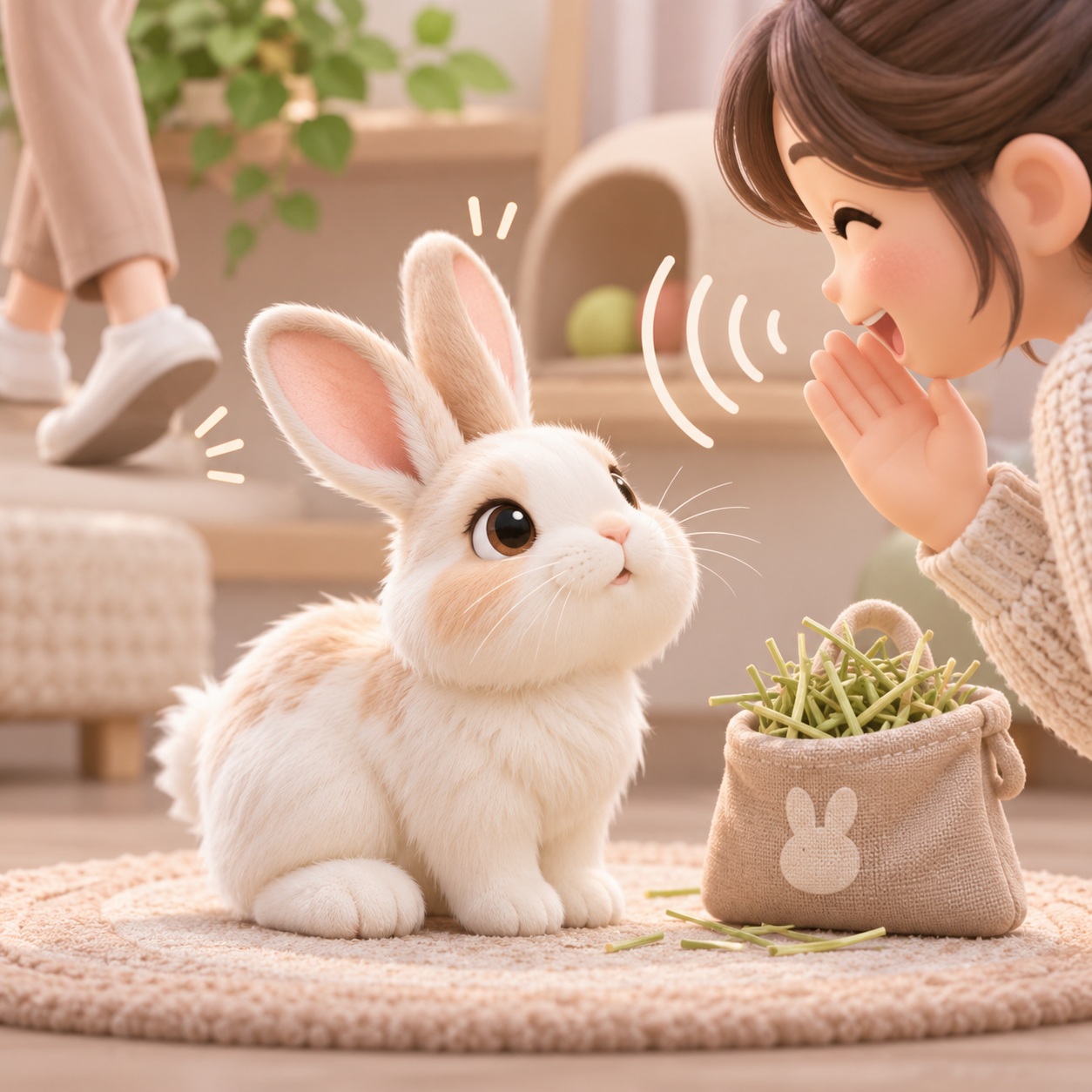
3D chibi rabbit listening to a familiar human voice, illustrating rabbit hearing and auditory recognition

Rabbits have sensitive hearing and can detect a broad range of sound frequencies, including frequencies above the normal human hearing range. Their auditory abilities help them monitor approaching animals, people and unfamiliar disturbances.

In a household, a rabbit encounters recurring sounds throughout the day: footsteps along a corridor, a familiar voice, a door opening, the rustling of a hay bag or food being prepared. Through associative learning, these sounds may become predictors of particular events.

For example, a rabbit that repeatedly hears a particular sound before receiving food may begin approaching its feeding area when that sound occurs. This illustrates how rabbit memory and learned associations can influence everyday behaviour.

But does that mean rabbits recognise their owner’s voice?

Possibly. Yet hearing a familiar voice and identifying the individual speaking are not necessarily the same process. Available evidence does not establish that rabbits recognise individual owners by voice alone, independently of other sensory cues.

What science supports: Rabbits have well-developed auditory abilities and can learn associations between cues and rewards. Owner-specific voice recognition requires direct experimental investigation.

3. Sight — Recognising Shapes, Movement and Appearance
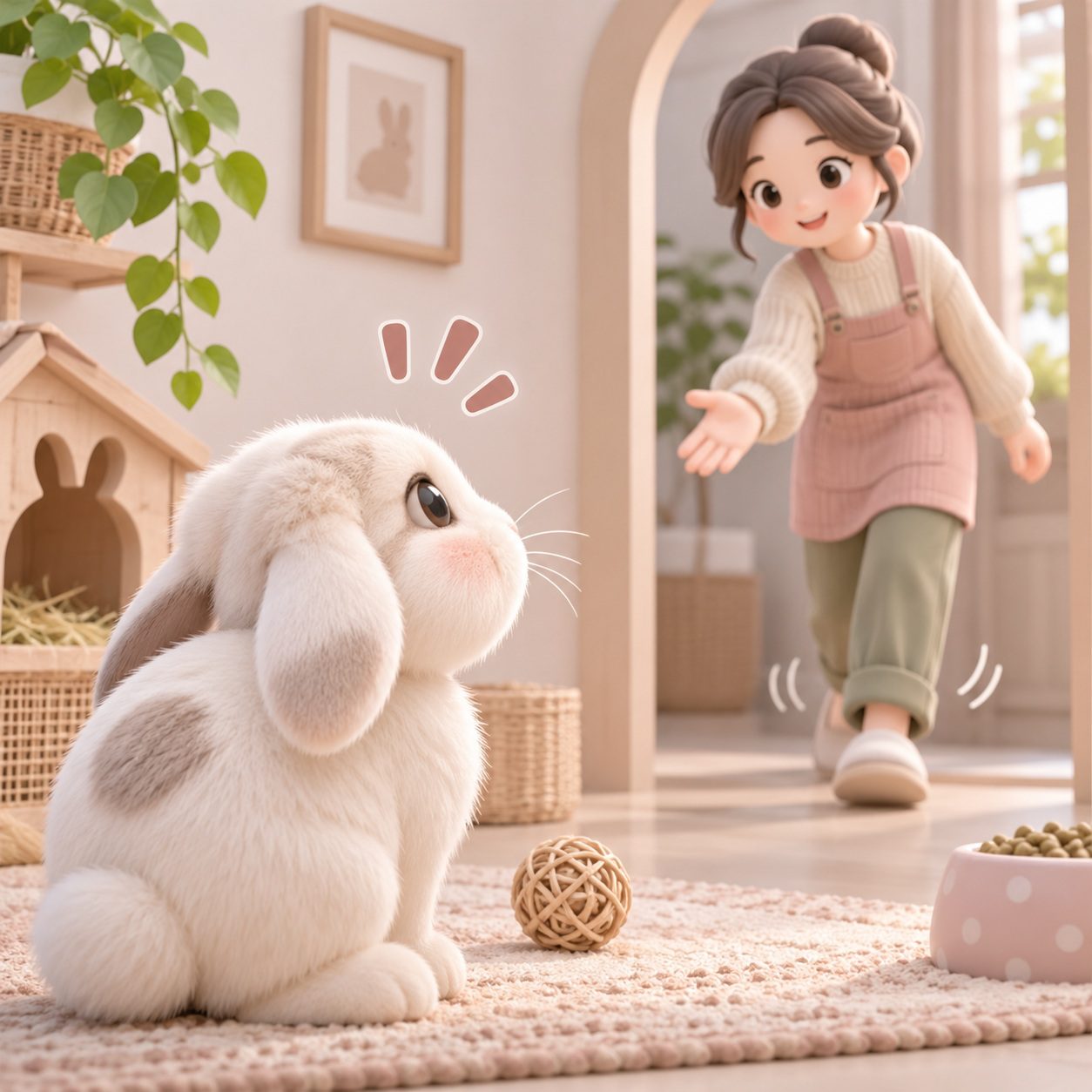
3D chibi rabbit looking towards its approaching caregiver, illustrating rabbit vision and visual familiarity

Rabbit vision is adapted to the needs of a prey animal. Their eyes are positioned on the sides of their heads, providing a wide field of view that helps them detect potential threats. They respond to movement, although their visual abilities differ from ours, including in colour perception and close-range viewing.

A familiar human may present several visual cues, including body size, clothing, posture, walking patterns and movement. These features could contribute to recognising someone who regularly approaches, feeds or interacts with the rabbit.

Research by Davis and Gibson (2000) demonstrated that rabbits could discriminate between two individual humans, an interesting finding relevant to rabbit intelligence and human recognition. However, the experiment did not establish whether the rabbits relied primarily on sight, smell, sound or several cues together.

Therefore, when asking do rabbits remember their owners by appearance, we must distinguish individual human discrimination from facial recognition. The cited research supports the former, but does not establish the latter.

What science supports: Rabbits perceive movement and environmental features and can learn to discriminate between humans. Individual facial recognition has not been established by the cited studies.

4. Touch — Remembering Experiences With Human Hands
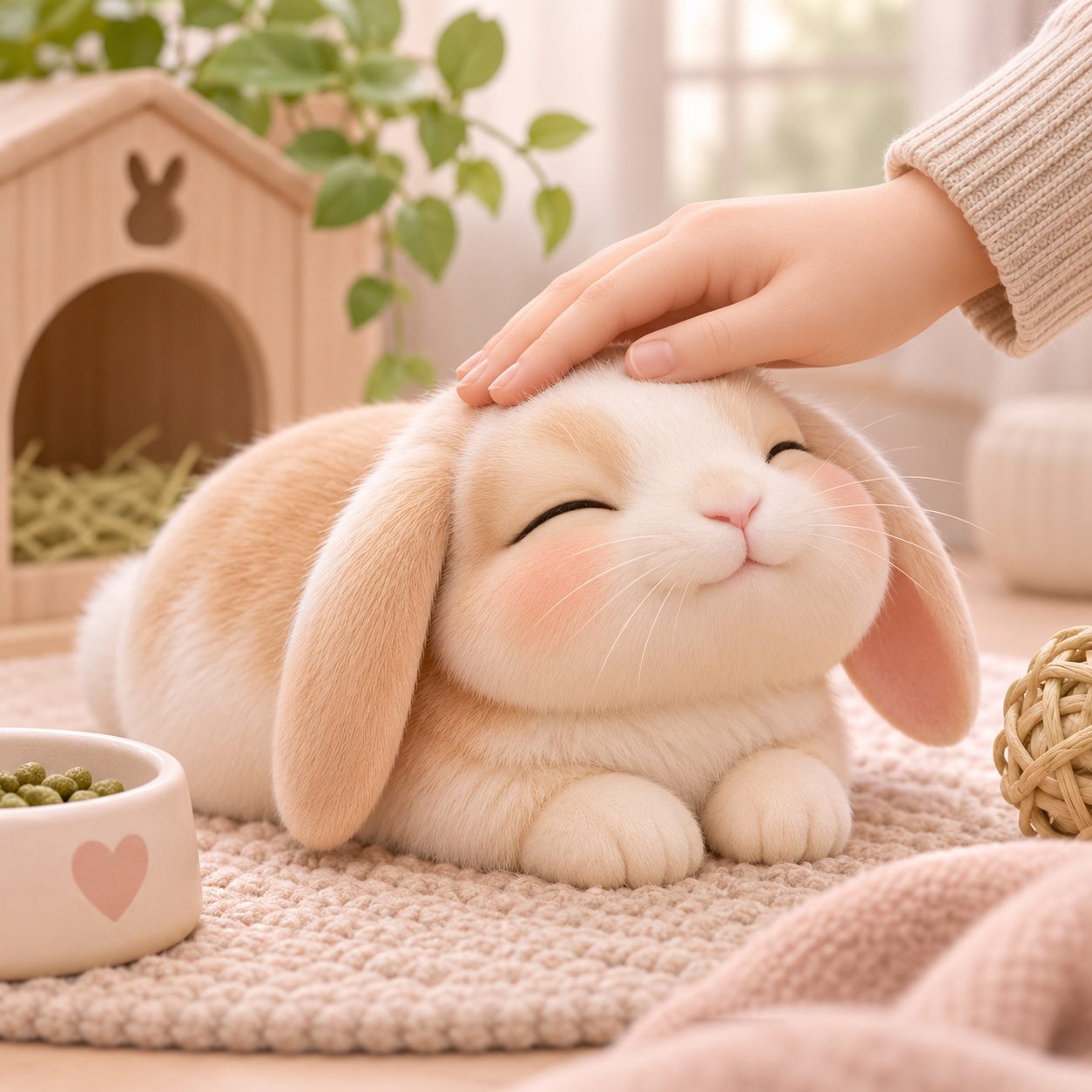
3D chibi rabbit receiving gentle stroking from a caregiver, illustrating touch and learned handling experiences

Touch is another important part of a rabbit’s experience with people. Gentle contact, physical restraint, lifting and grooming can produce very different responses depending on the circumstances and the rabbit’s previous experiences.

A rabbit may voluntarily approach a caregiver and lower its head to request stroking. Another may retreat when a hand approaches because similar movements have previously been associated with uncomfortable handling.

Such differences in rabbit behaviour may reflect learned associations. They do not necessarily mean a rabbit consciously remembers a particular person’s touch.

A 2026 study examined seven adult female dwarf rabbits during stroking sessions involving unfamiliar people. Researchers recorded increased salivary corticosterone and behavioural signs consistent with stress.

Importantly, the study did not directly compare familiar and unfamiliar people under otherwise identical conditions. It therefore cannot establish that an unfamiliar person’s touch is inherently more stressful than a familiar caregiver’s touch.

These findings remind us that remaining still during handling is not necessarily a sign of relaxation. For rabbit welfare, voluntary interaction and careful observation of body language are more meaningful than assuming that accepting touch demonstrates affection.

What science supports: Human handling experiences influence rabbit behaviour, and tactile interactions can provoke stress. Recognising a specific person through touch alone has not been established.

5. Familiar Routines — When Experience Becomes Expectation
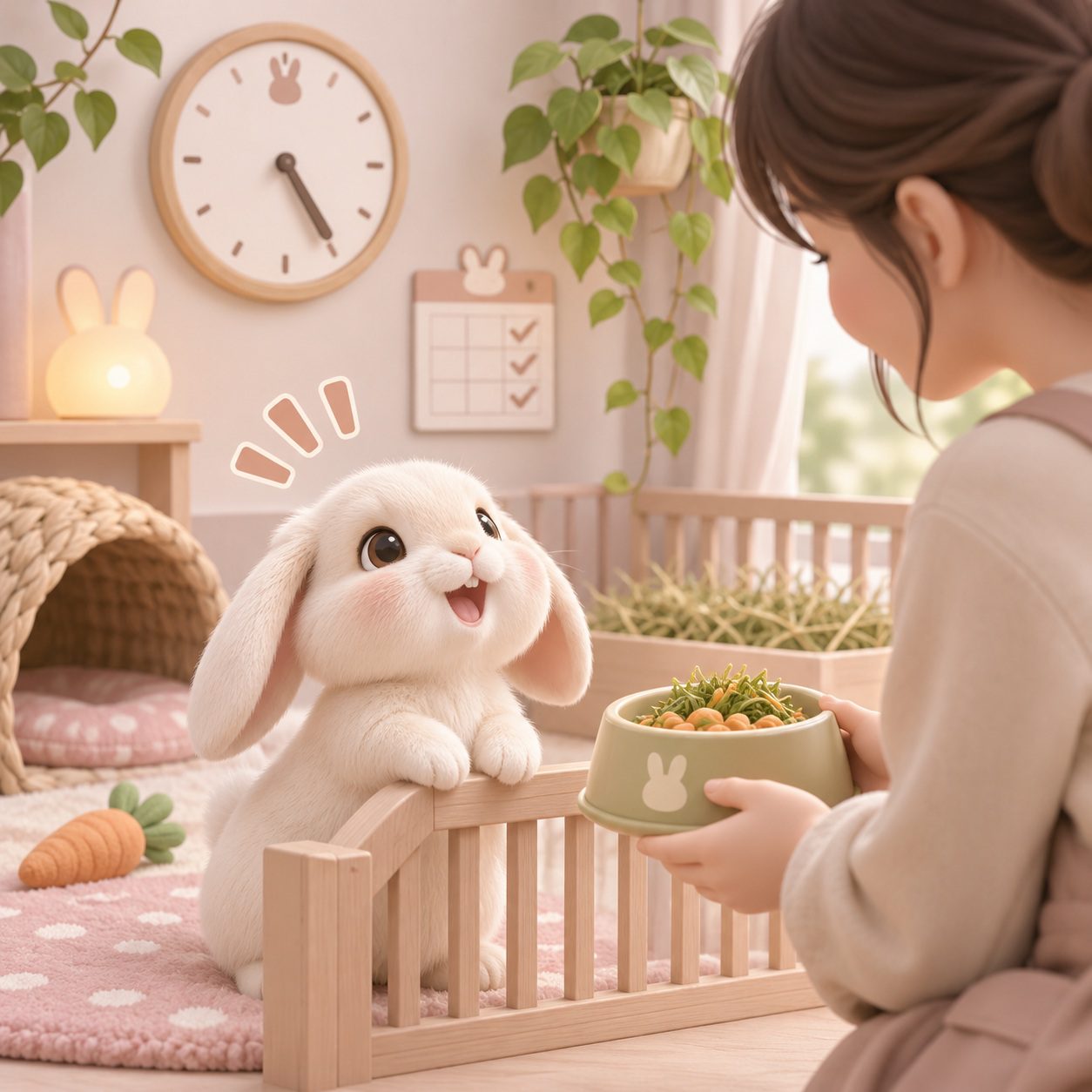
3D chibi rabbit greeting a caregiver during feeding time, illustrating learned routines and rabbit intelligence

Not every apparently affectionate greeting necessarily means a rabbit recognises a specific person. Sometimes, a rabbit may simply be responding to a familiar event.

Consider a rabbit that approaches the entrance to its living area each evening when someone arrives home. Is it recognising the caregiver, anticipating dinner, responding to the sound of the door or reacting to several familiar cues together? These possibilities are not mutually exclusive.

Rabbit intelligence includes the ability to learn associations between environmental cues and outcomes. The Davis and Gibson experiment provides an example: rabbits learned that one individual predicted food availability.

In a separate survey involving 1,516 rabbit owners, some respondents described their rabbits anticipating feeding times, responding to names and recognising familiar people.

These observations offer interesting insights into everyday rabbit memory and behaviour, but owner reports are not equivalent to controlled tests of long-term memory or individual human recognition.

6. Do Rabbits Use Several Senses Together?
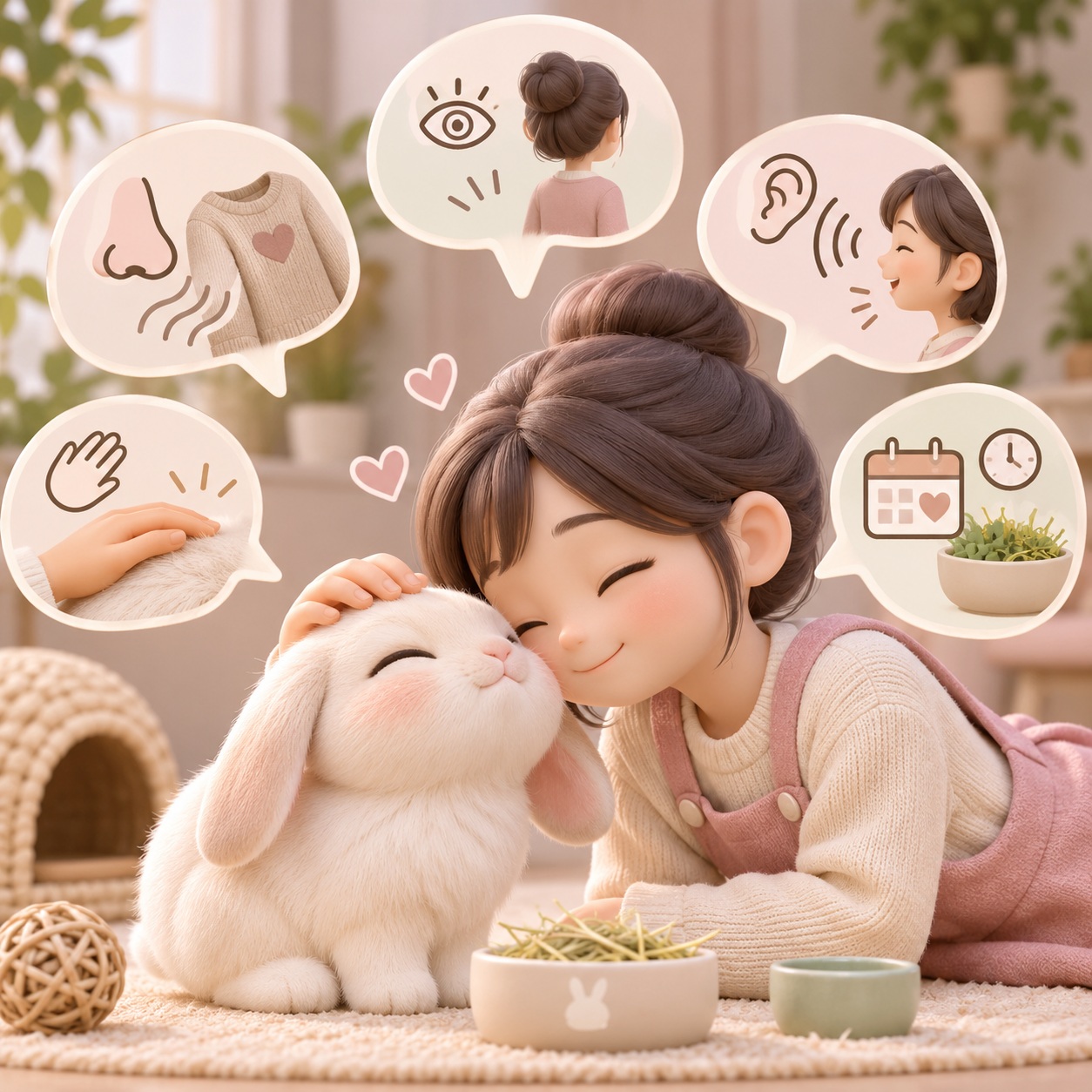
3D rabbit illustration showing familiar scent, sounds, sight, touch and daily routines as possible human recognition cues

In everyday life, rabbits rarely encounter their caregivers through just one sensory channel. A person approaching may bring a familiar combination of footsteps, movement, clothing, body odour, voice and predictable behaviour.

It is reasonable to hypothesise that rabbits may use several of these cues together when responding to familiar humans. However, this remains a hypothesis about owner recognition rather than an experimentally established mechanism.

To understand how rabbits remember their owners, researchers would need carefully controlled experiments separating visual, auditory, olfactory and other sensory information while comparing recognition of familiar and unfamiliar people.

Longer-term studies could then investigate whether recognition persists after weeks, months or years without contact. Such research would help us understand the relationship between rabbit memory, sensory learning and recognition of previous caregivers.

Pee-Casso:
“So I might know my human by their smell, footsteps, voice AND the sound of my treats being opened?”

Bunnini:
“Possibly. But recognising the treat bag is not the same as recognising the person holding it.”

What Can We Conclude?

Do rabbits remember their owners? Scientific evidence shows that rabbits can learn to distinguish individual humans and possess sensory abilities that could support recognition. Their responses may involve scent, sound, visual information, previous handling experiences and familiar routines.

What remains unknown is which cues matter most, how they are combined and whether rabbits can recognise a former owner after prolonged separation.

How Handling Shapes Rabbit Behaviour and Trust

Do rabbits remember their owners through repeated interactions? Rabbits learn from their experiences with people. Gentle, predictable interactions can help reduce fear and encourage voluntary contact, while unpleasant experiences may contribute to avoidance. This form of learning is an important part of rabbit memory and helps explain why familiar human interactions can influence rabbit behaviour.

Three studies illustrate how human handling can influence rabbit behaviour:

Podberscek et al. (1991): Post-weaning rabbits became less fearful following repeated handling and human approaches, including interactions with unfamiliar people.

Pongrácz et al. (2001): Rabbit pups exposed to early human handling showed reduced fearfulness at weaning and were more inclined to approach a person.

Fetiveau et al. (2024): In a study involving 144 young rabbits, those receiving additional food and stroking spent more time near humans and were more likely to accept physical contact.

What Does This Mean for Pet Rabbits?

A rabbit that initially fears human contact may gradually become more comfortable through positive, consistent experiences. These findings demonstrate aspects of rabbit intelligence, including the ability to learn from human interactions and adjust behavioural responses. However, the studies measured changes in behaviour, not whether rabbits remember a particular person after months or years apart.

Trust can develop over time, but accepting human contact is not automatically proof of affection or long-term personal recognition.

Pee-Casso:
“Fine. Rabbits learn who’s nice. That’s basically remembering.”

Bunnini:
“It’s learning. Whether they recognise one specific person after a long separation is the part these studies haven’t established.”

What About Rehomed Rabbits?

New home, new smells, new humans — and absolutely no explanation of why everything has suddenly changed. For a rehomed rabbit, even a loving new home can feel unfamiliar. Some rabbits explore confidently, while others hide, remain vigilant or avoid human interaction.

Do Rabbits Miss Their Previous Owners?

It’s a question many adopters ask when a newly rehomed rabbit seems withdrawn. Although rabbits can learn to recognise individual humans, research has not established whether they emotionally miss former caregivers. Hiding or avoiding contact doesn’t tell us whether a rabbit remembers, misses or has forgotten someone.

Changes in surroundings, feeding schedules, handling, social companions and familiar hiding places can all affect rabbit behaviour. Previous experiences, early socialisation, individual temperament and physical health may also influence how a rabbit responds. An owner survey reported differences in perceived friendliness between rabbits from different acquisition sources, but this doesn’t establish that rabbits remember or miss particular people.

Remember: Rabbit behaviour tells us something about how an animal is responding now, not necessarily what it remembers from its past. Reduced appetite, fewer droppings, unusual inactivity or signs of pain should never be dismissed as adjustment stress. A rabbit that stops eating needs urgent veterinary attention.

Helping a Rehomed Rabbit Feel Safe

Building trust doesn’t require elaborate techniques. Provide a quiet indoor environment with suitable hiding places, familiar food, unlimited access to appropriate hay and fresh water. Keep daily routines predictable, sit at floor level and allow your rabbit to approach voluntarily. Avoid chasing, grabbing or unnecessary lifting, and use gentle interactions and appropriate food rewards to encourage positive associations.

You may have heard of the 3-3-3 rule — three days to decompress, three weeks to adjust and three months to settle. It’s an informal adoption guideline, not a scientifically validated timeline for rabbits. Some settle quickly; others need much longer. A rabbit that prefers limited physical contact isn’t necessarily unhappy or poorly bonded.

Trust isn’t something we can demand from a rabbit. It’s something we help them develop through repeated experiences of safety.

Pee-Casso: “So I don’t have to become best friends with my new human by Day 3?”

Bunnini: “No. Trust isn’t a countdown timer.”

Does Your Rabbit Remember You After Rehoming?

Do rabbits remember their owners after moving to a new home? Visiting a rabbit you once cared for can be emotional. Will they recognise your voice, approach you or simply carry on with their day? Although rabbit memory includes learned associations and individual human discrimination, no scientifically validated test currently establishes recognition of former caregivers after months or years apart.

If you visit, sit at floor level and allow the rabbit to approach voluntarily. Avoid scooping them up to test recognition. An enthusiastic greeting doesn’t prove long-term memory, just as an indifferent response doesn’t prove forgetting. Their behaviour may reflect familiarity, curiosity, previous learning or simply how comfortable they feel at that moment.

A reunion should be an opportunity for a positive interaction, not a test of loyalty. Sometimes, the kindest thing a previous caregiver can do is respect the safe, stable life their rabbit has developed with a new family.

What matters most: Whether rabbits remember previous owners for months or years remains uncertain. But we can make their present experiences safer, more predictable and more positive — and that’s what responsible rescue, fostering and adoption should aim to achieve.

Pet Abandonment Is Against the Law — Singapore & Malaysia

Whether rabbits remember their previous owners or not, one thing should never be forgotten: bringing an animal into our lives comes with a responsibility for its welfare.

Families relocate, finances become difficult, relationships change, or owners discover that rabbit care requires more commitment than anticipated. These situations can be genuinely challenging, but abandoning an animal is not an acceptable solution. In Singapore and Peninsular Malaysia, unlawful animal abandonment can result in criminal prosecution, fines and imprisonment.

Singapore — Animals and Birds Act 1965

Under Section 41C(1)(b), animal owners must not abandon their animals, permanently or temporarily, without reasonable cause or excuse. This applies to rabbits, not just cats and dogs. For ordinary pet owners convicted of breaching these duties, the penalties are:

OffenceMaximum FineMaximum Jail Term
First offenceS$10,00012 months
Second or subsequent offenceS$20,0002 years

Courts may impose a fine, imprisonment or both. Different, higher penalties apply to offences committed in the course of an animal-related business.

Malaysia — Animal Welfare Act 2015

Under Section 29(1)(p) of the Animal Welfare Act 2015 (Act 772), abandoning an animal in circumstances likely to cause trauma, pain or suffering through relocation, starvation, thirst, injury or illness constitutes an animal cruelty offence.

PunishmentPenalty
FineRM20,000–RM100,000
ImprisonmentUp to 3 years
CombinedBoth fine and imprisonment

Unlike Singapore’s general prohibition, this Malaysian provision specifically addresses abandonment in circumstances likely to cause suffering.

Legal distinction: Act 772 applies to Peninsular Malaysia and the Federal Territory of Labuan. Sabah and Sarawak have separate legal frameworks, so these penalties should not automatically be applied to those states.

When You Can No Longer Care for Your Rabbit

Rehoming and abandonment are not the same thing. Sometimes circumstances genuinely prevent someone from continuing to care for their rabbit. Recognising that limitation and arranging a safe transfer of care can be a responsible, compassionate decision.

Seek help early from reputable rabbit rescue groups or experienced caregivers. Screen prospective adopters, share relevant medical and behavioural information, and arrange a proper handover. Continue providing food, water, suitable housing and veterinary care until the new caregiver has formally accepted responsibility.

Never release a domestic rabbit outdoors. Pet rabbits are not equipped to survive independently like wild rabbits. Abandonment can expose them to starvation, dehydration, disease, parasites, traffic injuries, predators and unsuitable weather. Leaving a rabbit outside a rescue centre without an agreed handover is not responsible surrender.

A Rabbit Is Not Disposable

At Oishi Bunnies, our rescue and fostering experiences have taught us that every rabbit deserves more than temporary affection. They deserve stability, appropriate care and people who take their welfare seriously. We may never know exactly how much a rabbit remembers about a previous home, but we do know that our decisions profoundly affect their future.

If you cannot keep your rabbit, find them a safe home. Don’t abandon them.

Pee-Casso:
“So if humans can’t keep us, they have to make sure we’re safe?”

Bunnini:
“Exactly. Responsible rehoming means arranging proper care, not leaving a rabbit to fend for itself.”

Pee-Casso:
“Good. Because I didn’t sign up for wilderness survival.”

A Second Chance Begins With a Safe Home

Every rescue rabbit has a past. You could be part of their future.

Some rabbits arrive frightened, while others are curious, affectionate or simply uncertain about their surroundings. Each carries a history we may never fully know. At Oishi Bunnies, we believe every rescued rabbit deserves the chance to feel safe, respected and loved, regardless of where their journey began.

As rescuers and foster caregivers, we give rabbits time to settle, learn their personalities and prepare them for their next chapter. And when the right family comes along, saying goodbye is part of what rescue is all about.

Meet Our Adoptable Rabbits

Thinking of welcoming a rabbit into your family? Our adoptables are looking for responsible, loving homes where they can enjoy suitable indoor housing, proper nutrition, veterinary care and patient companionship. Every rabbit has a different personality and individual care needs.

Meet Our Adoptable Rabbits ♥

Adoption applications are welcomed from suitable families in Singapore and Malaysia, subject to screening and applicable arrangements. Adoption is a lifelong commitment, not an impulse decision.

The Bottom Line — Some Bonds Leave Pawprints

Science has shown that rabbits can distinguish between individual humans and learn from their experiences with us. What science has yet to establish is how long those memories endure after separation. But the absence of scientific evidence is not evidence that those memories don’t exist.

I believe rabbits remember more than we currently know how to measure. Not only their previous owners, but also the rescuers who brought them to safety, the foster mums who patiently earned their trust, and the people who helped them discover that human hands could offer comfort rather than fear.

As a rescuer and foster mum, I’ve witnessed how rabbits respond to kindness, familiarity and the quiet consistency of being cared for. These experiences aren’t controlled scientific studies, and I would never present them as such. But they matter dearly to me.

Rabbits are sentient beings. They may be voiceless, but they are not without feelings, experiences or memories. Their inability to tell us what they remember doesn’t mean their past holds no meaning.

Every rescued rabbit comes with a history, even when we know very little about it. Some arrive trusting. Some arrive frightened. Some need weeks, months or longer before they begin to feel comfortable around people. And when they finally approach us voluntarily, relax beside us or accept a gentle touch, those moments remind us that the relationships we build with animals matter, even when we cannot fully explain their inner experiences.

Perhaps one day, science will tell us more about how long rabbits remember the humans who have crossed their lives. Until then, I choose to believe that the love and kindness we give them leave something behind, even when we are no longer there to witness it.

Because whether a rabbit remembers our face forever is something science has yet to answer. But making them feel safe, loved and respected while they’re with us is something entirely within our hands.

— Cookie Yiyi, Oishi Bunnies

Further Reading

Rabbit Recognition, Sensory Processing and Learning

  1. Davis, H., & Gibson, J. A. (2000). Can rabbits tell humans apart? Discrimination of individual humans and its implications for animal research. Contemporary Topics in Laboratory Animal Science. PubMed
  2. Csatádi, K., Bilkó, Á., & Altbäcker, V. (2007). Specificity of early handling: Are rabbit pups able to distinguish between people? Applied Animal Behaviour Science. DOI
  3. Podberscek, A. L., Blackshaw, J. K., & Beattie, A. W. (1991). The effects of repeated handling by familiar and unfamiliar people on rabbits in individual cages and group pens. Applied Animal Behaviour Science. Animal Welfare Institute
  4. Pongrácz and colleagues (2001). Research on early human handling and fear responses in rabbit pups. Developmental Psychobiology. DOI
  5. Fetiveau and colleagues (2024). Thoughtful or distant farmer: Exploring the influence of human-animal relationships on rabbit stress, behaviour, and emotional responses in two distinct living environments. Research publication
  6. Odour memory in newborn rabbits (2014). Research examining the persistence of learned odour representations. Full text
  7. Odour learning and concentration (2025). Research on learned odour responses in rabbit pups. Full text
  8. Rabbit auditory processing and sound localisation (2024). Full text
  9. When touch is stressful (2026). Study investigating endocrine and behavioural responses of domestic rabbits to unfamiliar human handling. Full text
  10. All Ears (2020). Research investigating rabbit owners’ perceptions of their pets’ mental abilities. Full text

Rabbit Welfare and Rehoming

  1. Scottish SPCA. Getting Rabbits. Guidance on rabbit behaviour and welfare. Read guidance
  2. Faunalytics. Research discussion of rabbit behaviour and owner-reported temperament differences associated with acquisition source. Read summary

Animal Welfare Legislation

  1. Singapore Government. Animals and Birds Act 1965, Section 41C — Duty of Care of Animal Owners. Singapore Statutes Online
  2. Government of Malaysia. Animal Welfare Act 2015 (Act 772), Sections 1 and 29. Department of Veterinary Services Malaysia

About the Author — Cookie Yiyi

Cookie Yiyi is the founder of Oishi Bunnies, a Singapore-based rabbit care, education and rescue initiative with nine years of experience. Having personally rescued, rehabilitated, fostered and rehomed 18 rabbits, she has firsthand experience observing how rabbits respond to unfamiliar environments, different caregivers, gentle handling and the gradual process of building trust.

Her work combines practical rabbit welfare experience with an interest in evidence-based animal behaviour, nutrition and husbandry. Through the Oishi Bunnies Bunny Bulletin and Herbal Atlas, she explores scientific research while distinguishing established findings from personal observations and beliefs.