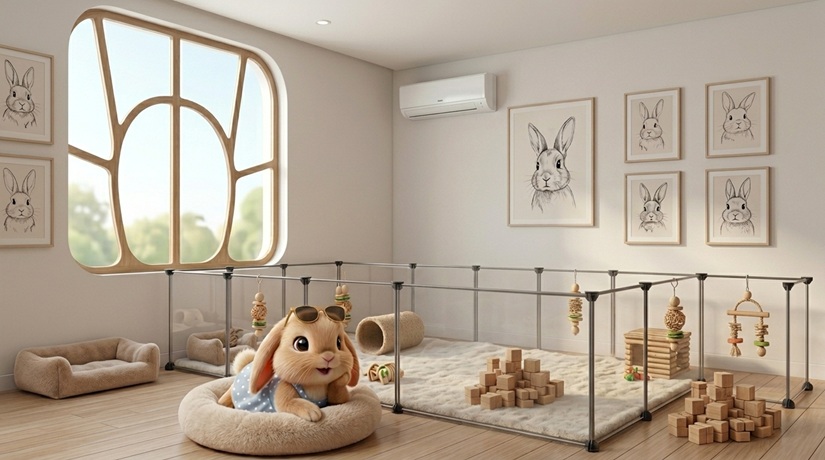
Rethinking the Traditional Rabbit Cage
The Case for Compassionate Rabbit Free Roaming and Pen Living
The traditional “rabbit cage” carries a heavy association in modern pet care, often implying restriction, boredom, and a lack of autonomy. For our pets, however, the issue is exploring practical rabbit cage alternatives that focus on how an enclosure is designed, used, and integrated into their daily life. In contemporary indoor rabbit husbandry, the goal is no longer to eliminate boundaries entirely, but to shift away from confinement-based thinking toward safe environmental freedom.
Domestic rabbits live in human-constructed environments that are inherently controlled. In this context, the most welfare-oriented approach is not unrestricted access to the entire home at all times, but rather a structured rabbit free roaming system supported by a thoughtfully designed rabbit exercise pen or a dedicated rabbit home base.
“A well-designed rabbit exercise pen is not a prison; it is a secure rabbit home base. It provides predictability, security, and resource stability—especially crucial for prey animals who are highly sensitive to environmental unpredictability.”
When this setup is properly configured, it protects vital rabbit skeletal health and acts as a sanctuary where they eat, rest, and retreat when overstimulated, while serving as the perfect launchpad for scheduled access to larger exploration zones.
The Medical and Behavioral Case Against the Cage
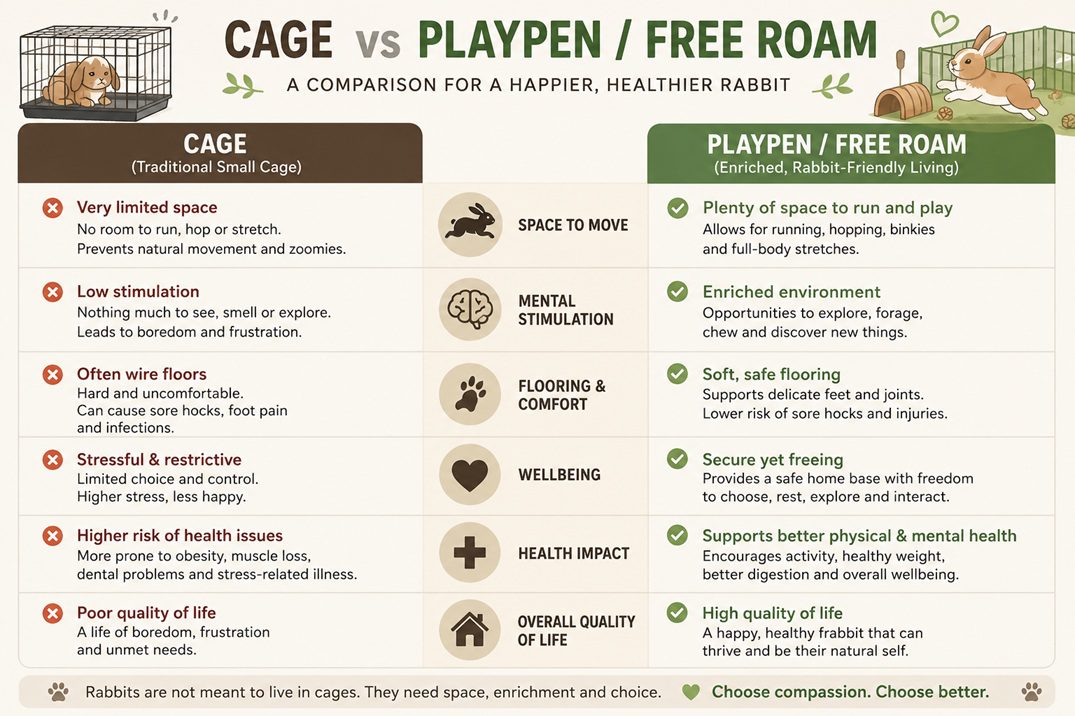
While traditional small commercial cages may appear convenient for humans, they introduce severe physical and psychological limitations. From a physiological standpoint, locking an animal built for high-speed locomotion into a confined box is a medical hazard—one that can be entirely prevented through a transition to a rabbit free roaming lifestyle.
Skeletal Degradation & Muscle Atrophy
A rabbit’s skeleton is remarkably fragile, making up only about 7% to 8% of its total body weight (compared to a cat’s 12% to 13%). Without the spacious layout provided by full or partial rabbit free roaming, a confined pet cannot perform vertical stretching or natural “zoomies,” experiencing rapid bone density loss, muscle wastage, and a heightened risk of spinal fractures.
Gastrointestinal Hypomotility (GI Stasis)
A rabbit’s complex digestive track is entirely movement-driven. Physical activity stimulates cecal fermentation and peristalsis. A sedentary cage life suppresses these natural contractions, making confinement a primary trigger for life-threatening GI stasis, whereas active rabbit free roaming keeps the gut moving optimally.
Pododermatitis (Sore Hocks)
Traditional wire-bottom cages or hard plastic bases place constant, unnatural pressure on a rabbit’s metatarsal region. Lacking thick protective paw pads, a confined rabbit quickly develops painful, ulcerated sores. Embracing a structured rabbit free roaming space layered with soft, supportive flooring eliminates this intense targeted structural stress.
Mental Stagnation
Rabbits are highly intelligent, naturally curious foragers. A restrictive cage offers zero environmental complexity, entirely suppressing their drive to investigate, hop between objects, and engage in routine discovery. Setting up for safe rabbit free roaming cures this profound lack of stimulation, preventing the development of boredom, frustration, and behavioral stereotypic vices like obsessive cage-bar chewing.
Redefining Boundaries: The Housing Spectrum
Transitioning away from the traditional cage doesn’t mean granting unchecked access to your entire home overnight. True compassion lies in balancing autonomy with structural safety.
The Golden Rule of Rabbit Physics: An enclosure must always be long enough for a rabbit to take at least 3 to 4 continuous, unhindered hops from end to end, and tall enough that they can stand fully upright on their hind legs without their ears brushing the ceiling.
| Housing Type | Best For | Spatial Requirement | Key Welfare Benefit |
|---|---|---|---|
| Exercise Pen (X-Pen) / Base Camp | Young, un-neutered, or newly adopted rabbits; or as a permanent nighttime retreat. | At least 4 ft x 4 ft (16 sq ft) | Provides absolute resource stability while allowing 3 to 4 consecutive hops and full vertical stretching. |
| Partial Free-Roam | Fully litter-trained rabbits ready for scheduled exploration. | A dedicated, rabbit-proofed room or zone | Maximizes biomechanical exercise and mental engagement during active peak hours (crepuscular windows). |
| Full Free-Roam | Confident, perfectly bonded, and impeccably litter-trained rabbits. | The entire integrated living space | Total expression of natural social and territorial behaviors; blends the rabbit seamlessly into the family unit. |
Designing a Compassionate “Base Camp”
When setting up your pen or establishing a dedicated free roam home base, the layout should mimic their wild territorial instincts. Ensure the environment is built around these core structural pillars:
Solid, Non-Slip Flooring
Ditch the bare plastic or wire. Layer the area with low-pile rugs, interlocking foam mats, or heavy fleece. This gives their fur-covered feet the precise traction needed to binky and sprint without slipping or developing pododermatitis.
The Mega Litter & Foraging Station
Rabbits possess a strict “poop while they eat” biology. Utilize a large, open-top plastic basin lined with paper-based bedding and piled high with fresh orchard grass or timothy hay to encourage constant, healthy fiber intake.
Dual-Entry Hidey Holes
As prey animals, a single-entry house can feel like a trap if they are startled. Provide shelters (cardboard boxes work beautifully) featuring at least two distinct entry/exit points so they always feel secure and in control of their escape routes.
Ultimately, rethinking the “cage” is not about removing boundaries entirely, but about replacing restrictive housing with dynamic environments that respect the rabbit as an active, intelligent, and highly mobile animal.
By swapping confinement for a structured, pen-supported free roam lifestyle, you aren’t just giving them space—you are protecting their fragile physiology, extending their lifespan, and allowing their true, joyful personalities to shine.
 Living Content Notice

The Modern Art of Rabbit Care is a work of passion and precision. This content may be updated from time to time as new scientific data emerges or whenever inspiration hits. We strive for a “masterpiece” level of accuracy, so check back often for the latest refinements.
DISCLAIMER

The content within The Modern Art of Rabbit Care is intended for educational and informational purposes only. While we blend love with science, this guide does not replace professional veterinary advice, diagnosis, or treatment. Always seek the advice of a qualified rabbit-savvy veterinarian with any questions regarding a medical condition or health goals for your companion. Relying on the information provided here is at your own discretion.


Want to contribute to the Masterpiece?
If you have a passion for rabbit advocacy, scientific writing, or raising awareness, we’d love to collaborate.

oishibunnies.com.sg • Singapore