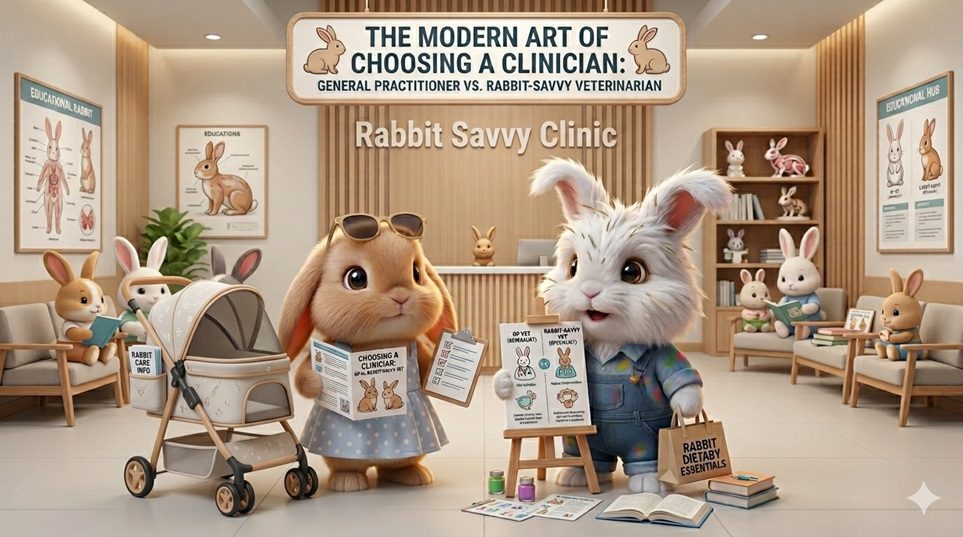
1. Veterinary Training: The Degree Is the Starting Point

A veterinary degree provides a broad foundation in animal health. The amount of teaching and clinical exposure devoted to rabbits varies between universities, placements, and the learning opportunities a student chooses.
After graduation, a clinician’s experience develops through the patients they treat, continuing education, mentorship, and further qualifications. A general practitioner who regularly treats rabbits may become a highly experienced rabbit-savvy vet through focused learning and clinical work.
The practical question when choosing a rabbit-savvy vet: Instead of asking only “Are you an exotic vet?”, ask “Which vet here regularly treats rabbits, and what rabbit cases do they usually manage?”
2. What Makes a Vet Rabbit-Savvy?

A rabbit-savvy vet combines relevant knowledge with regular clinical experience. It includes understanding rabbit nutrition, dental disease, digestive problems, pain assessment, safe handling, and the particular demands of rabbit anaesthesia and recovery.
Rabbits can show illness through subtle changes: eating more slowly, leaving certain foods, producing smaller droppings, moving less, or behaving differently. A rabbit-savvy vet considers these observations alongside the examination and any tests needed. Our guide to recognising changes in your rabbit’s behaviour can help you describe what you have noticed. Looking quiet is not a diagnosis—and looking alert does not rule out illness.
Your observations matter here. Knowing what is normal for your rabbit gives the exotic vet useful context that a short consultation cannot provide on its own.
Bring the everyday details: Your rabbit’s usual diet, recent appetite and droppings, medication list, weight records, and short videos of unusual behaviour can help build the clinical picture.
4. Green Flags: Choosing a Rabbit-Savvy Vet

Whether you are choosing a rabbit-savvy vet in Singapore or a rabbit-savvy clinic in Malaysia, these are useful things to discuss. Treat them as conversation starters, rather than a rigid pass-or-fail checklist.
- Regular rabbit experience: They can explain which clinicians see rabbits and the types of cases they manage.
- A detailed history: A rabbit-savvy vet asks about diet, appetite, droppings, weight changes, behaviour, and existing medication. Our guide to your rabbit’s daily diet can help you prepare an accurate feeding history.
- Calm, supported handling: They adapt their approach to your rabbit and explain any restraint needed.
- Clear clinical reasoning: They explain possible causes, recommended tests, treatment options, and what remains uncertain.
- Thoughtful anaesthesia and recovery care: They can discuss monitoring, pain relief, temperature support, and feeding plans for the individual patient.
- Appropriate dental care: They explain the limits of an awake examination and arrange further assessment or referral when needed.
- Practical follow-up instructions: Your rabbit-savvy vet explains what to monitor, when to seek help, and whom to contact outside normal hours. If assisted feeding is prescribed, our rabbit recovery food and assisted-feeding guide offers practical reading alongside your vet’s instructions.
- Willingness to refer: They recognise when a case needs equipment, expertise, or hospital support beyond what their clinic can provide.
A referral is a green flag, too. A good primary-care rabbit-savvy vet does not have to perform every complex procedure. Recognising their limits and arranging timely specialist support is part of good care.
5. Decoding the Alphabet Soup

When choosing a rabbit-savvy vet or exotic vet, those letters help you understand their education, further training, or specialist qualifications. The useful question is: what do they tell us about their experience treating rabbits?
Veterinary Degrees & Registration
Veterinary degrees: DVM, BVSc, BVMS, BVM&S, BVetMed, and VMD are examples of primary veterinary qualifications. The title varies between universities and countries.
Honours: Hons indicates an honours award; Hons 1 means first-class honours. This is an academic distinction, rather than a rabbit-specific clinical qualification.
MRCVS: Member of the Royal College of Veterinary Surgeons. This indicates registration with the UK’s veterinary regulator; it is not a degree or an exotic-animal specialist qualification.
The Rabbit Nuance: Many general practitioners become highly experienced rabbit clinicians through regular casework, continuing education, and mentorship. A veterinary degree alone does not tell you how often someone treats rabbits—or how comfortable they are with complex rabbit cases.
Additional Qualifications in Exotics & Small Mammals ⭐
What they may look like: MANZCVS in Medicine and Surgery of Unusual Pets; CertAVP (Zoological Medicine), sometimes abbreviated as CertAVP (ZooMed); PgCert in Exotic Animal Medicine; or GPCert (ExAP).
What they mean: These indicate additional assessed knowledge or postgraduate study in the named field. Their scope and assessment requirements differ, so they should not be treated as interchangeable qualifications.
Membership versus Fellowship: MANZCVS means Membership of the Australian and New Zealand College of Veterinary Scientists. Membership recognises knowledge and experience in a specified field, but is not a specialist qualification. FANZCVS means Fellowship, which is a specialist-level qualification in the named discipline.
The Rabbit Nuance: “Exotics” can include mammals, birds, and reptiles. Check the exact subject and the clinician’s current rabbit caseload. An RCVS Advanced Practitioner designation is also a separately awarded status—not something every certificate holder automatically holds.
Board-Certified Specialists & Specialist-Level Fellowships 🏆
DABVP (Exotic Companion Mammal Practice) / Dip ABVP (ECM): Diplomate of the American Board of Veterinary Practitioners in Exotic Companion Mammal Practice. These are alternative ways of expressing the same board certification. This specialty covers rabbits and other companion mammals. Here, “Dip” means Diplomate.
DECZM (Small Mammal) / DipECZM (Small Mammal): Diplomate of the European College of Zoological Medicine in the Small Mammal specialty—another qualification directly relevant to rabbit medicine and surgery.
DACZM / Dip ACZM: Diplomate of the American College of Zoological Medicine. Zoological medicine has a broader species scope, so check the clinician’s particular focus and rabbit experience.
FANZCVS: Fellowship of the Australian and New Zealand College of Veterinary Scientists. This is a specialist-level qualification in the stated discipline; the subject matters when assessing its relevance to rabbits.
What they mean: These qualifications demonstrate advanced expertise assessed by the awarding college. Training routes vary: some involve formal residencies, while others allow approved practice-based pathways. Specialists may provide consultations, diagnostic investigations, ongoing medical care, surgery, and support for referring vets.
Qualification versus Local Registration: Holding an international qualification and being registered to use a specialist title locally are separate matters. Check the relevant regulator’s register when confirming a clinician’s formal local specialist status.
Bunnini: “Read the letters—and check the subject.”
Pee-Casso: “Then ask how often they see patients with ears like ours.”
Qualifications are useful clues. Current rabbit experience, clear communication, appropriate facilities, and knowing when to refer complete the picture.
Singapore Resource Directory
Rabbit-Savvy Clinics in Singapore
Looking for a rabbit vet in Singapore? Use these regional clinic listings as a starting point, then confirm which rabbit-savvy vet is available and whether the clinic can provide the care your rabbit needs.
 West Region
The Animal Doctors (Tiong Bahru)
 Address: 11A Boon Tiong Road #02-07/08, Singapore 161011
 Phone: 6253-3023
 WhatsApp: 98397723 (Text Only)
 Vet Name: Dr Cathy Chan, Dr Tsai Seng Zou, Dr Chionh Su Lin, Dr Serena Oh, Dr Carmen Lee, Dr. Candibyani, Dr Khor Ting En, Dr. Maria Sow
 Opening Hours:
Mon & Fri: 9:30am – 5:00pm
Tue & Thu: 9:30am – 8:30pm
Sat & Sun: 9:30am – 1:00pm
Closed: 12:00pm – 3:00pm & Wed/PH
Vet Affinity
Address: Block 151 Bukit Batok St 11 #01-248, Singapore 650151 Phone: 6970 7505 Vet Name: Dr Koh Bee Sze (Kris)*Additional charges apply for walk-in
Opening Hours:
Mon – Sat: 10:00am – 6:00pm
(Closed 1:00pm – 2:00pm)
Closed: Sundays & Public Holidays
The Joyous Vet (TJV @ CCK)
Address: Blk 475 Choa Chu Kang Ave 3, #01-30A Sunshine Place Singapore 680475 Phone: 6769 0304 (Appointment Only) Vet Name: Dr Grace Heng Opening Hours:
Mon – Sun: 1:00pm – 5:00pm &
6:30pm – 9:00pm
Closed: Public Holidays
Central Region
Pet Space Central Vet Surgery
Address: 482 Serangoon Road, Singapore 218149 Phone: 6252 2623 WhatsApp: 9645 4519 Vet Name: Dr Joey Low, Dr Benjamin Tan 24-Hour Hospitalisation Available
Opening Hours:
Mon – Sun: 10:00am – 8:00pm
Closed: Public Holidays
Vet Central (Toa Payoh)
Address: Blk 69 Lorong 4 Toa Payoh, #01-357, Singapore 310069 Phone: 6635 8646 WhatsApp: Contact Clinic to Request Vet Name: Dr Wendy Chee, Dr Christine Ng, Dr Bernice Cheng, Dr Celine Wong, Dr Moses Tay*Surcharges apply for walk-ins
Opening Hours:
Mon – Sat: 9:00am – 1:00pm &
3:00pm – 7:00pm
Closed: Sundays & Public Holidays
Monster Pet Vet
Address: Blk 6 Everton Road, #01-16, Singapore 080006 Phone: +65 6327 9148 WhatsApp: Contact Clinic to Request Vet Name: Dr Song V-Lynn, Dr. I-Lynn Song*Walk-in surcharge and late fees apply
Opening Hours:
Mon – Sat: 9:00am – 7:00pm
Closed: Sundays & Public Holidays
North Region
AVH Animal Ark (Springleaf)
Address: 5 Mandai Road, Singapore 779391 Phone: +65 6467 3287 WhatsApp: +65 9781 4902 Vet Name: Dr Joyce Lauw Opening Hours:
Mon – Sun: 10:00am – 1:00pm &
2:00pm – 8:00pm
The Animal Doctors (Ang Mo Kio)
Address: Block 108, Ang Mo Kio Avenue 4, #01-94/96, Singapore 560108 Phone: 6451-4531 WhatsApp: 96549124 (Text Only) Vet Name: Dr Cathy Chan, Dr Tsai Seng Zou, Dr Chionh Su Lin, Dr Serena Oh, Dr Carmen Lee, Dr. Candibyani, Dr Khor Ting En, Dr. Maria Sow Opening Hours:
Mon – Fri: 10:00am – 8:00pm (Closed 1-3pm)
Sat & Sun: 11:00am – 5:00pm (Closed 1-2:30pm)
Closed: Public Holidays
Brighton Vet
Address: 74 Serangoon Garden Way, Singapore 555970 Phone: +65 6282 2484 WhatsApp: Contact Clinic to Request Vet Name: Dr Gwenda Lowe*By appointment only
Opening Hours:
Mon – Sun: 10:00am – 2:00pm &
3:00pm – 7:00pm
Closed: Public Holidays
East Region
Vet Central (Swan Lake)
Address: 9 Swan Lake Ave, Singapore 455708 Phone: 6635 8646 WhatsApp: Contact Clinic to Request Vet Name: Dr Wendy Chee, Dr Christine Ng, Dr Bernice Cheng, Dr Celine Wong, Dr Moses Tay*Surcharges apply for walk-ins
Opening Hours:
Mon – Sat: 9:00am – 1:00pm &
3:00pm – 7:00pm
Closed: Sundays & Public Holidays
AVH Animal Ark (Tampines)
Address: 139 Tampines St. 11 #01-54, Singapore 521139 Phone: +65 6587 1798 WhatsApp: +65 9650 2419 Vet Name: Dr Joyce Lauw Opening Hours:
Contact clinic directly for current shift schedules.
Urgent After-Hours Emergency Hospitals
Note: Always call ahead to confirm an rabbit-savvy vet is on triage duty before departing.
Westside Emergency Vet Clinic
Address: No. 86-88 Serangoon Garden Way, Singapore 555982 Phone: 6931 0095 After-Hours Emergency Triage
Pet A&E / Landon Veterinary Specialists
Address: 41 Eng Kong Terrace, Singapore 599013 Phone: 6463 7228 After-Hours Emergency Triage
Beecroft Animal Specialist Hospital
Address: 991E Alexandra Road, #01-27, Singapore 119973 Phone: 6996 1812 After-Hours Emergency Triage
Malaysia Healthcare Resources
Rabbit-Savvy Clinics in West Malaysia
Looking for a rabbit vet in Malaysia? These West Malaysia listings include Johor, Kuala Lumpur, Selangor, and other locations. Contact the rabbit-savvy clinic directly to confirm its current rabbit services and the clinician’s availability.
Kuala Lumpur
Klinik Haiwan iVet Petcare (Keramat)
Address: 1-7, Jalan Jelatek, Au 1, 54200 Kuala Lumpur, Selangor
Phone: 03-4265 4115
Leow Veterinary Clinic & Surgery
Address: Jalan 5/26a, Bandar Menjalara, 52200, Kuala Lumpur
Phone: 011-1160 0667
Petcare Veterinary Clinic
Address: 9145, Jalan Bandar 4, Taman Melawati, Hulu Klang, 53100, Kuala Lumpur
Phone: 03-4106 7515
Selangor
 Selangor
Hands N Paws Veterinary Clinic
Address: G-21, Block B, Merchant Square, Jalan Tropicana Selatan, Tropicana, 47410 Petaling Jaya, Selangor
Phone: 03-7804 6539
 Email: jvet2004@gmail.com
Vet: Dr. Jenny
Dr Dolittle Veterinary Clinic
Address: No 32A(GF), Jalan PJU 5/20D, THE STRAND, Kota Damansara, 47010 Petaling Jaya
Phone: 012-949 0289
Vet: Dr. Cheng
Kota Damansara Vet Clinic & Surgery
Address: 20-1, Jalan PJU 5/10, Dataran Sunway, 47810 Petaling Jaya, Selangor
Phone: 03-6143 5988
Lian Animal Clinic
Address: 253, Jalan Sentosa 41, Taman Bunga Melor, 41050 Klang, Selangor
Phone: 03-3345 1828
Vet: Dr. Lim
EL’S Veterinary Clinic
Address: No.15-01, Jalan Simfoni 1, Menara Simfoni Balakong, 43300 Seri Kembangan
Phone: 017-223 8827
Vet: Dr. Abraham
Healing Pets Animal Clinic
Address: 28, Jalan SS21/62, Damansara Utama, Selangor
Phone: 03-7732 8878
Hillpark Veterinary Medical Centre
Address: 18 & 20, Jalan Anggerik Eria At 31/At, Kota Kemuning, 40460 Shah Alam
Phone: 03-5122 8386
Vet: Dr. Lynett
Heaven Veterinary Clinic (HVC)
Address: No.21, Jalan 3/69, Seksyen 3 Bandar Baru Bangi, 43650, Selangor
Phone: 03-8210 4491
Gasing Veterinary Hospital
Address: 53 & 55, Jalan 5/58, Gasing Indah, 46000 Petaling Jaya
Phone: 03-7782 3553
Vet: Dr. Lam
One Sierra Veterinary Clinic
Address: No.3A, Jalan OS1, Taman One Sierra Selayang, 68100 Batu Caves
Phone: 03-6734 1519
Heshmael Clinic For Pets
Address: 21, Jalan PJU 5/13, Dataran Sunway, 47000 Kota Damansara
Phone: 03-6156 2478
Vet: Dr. Hasnul
St. Angel Animal Medical Centre
Address: 19, Jalan Bandar Empat Belas, Pusat Bandar Puchong, 47100 Puchong
Phone: 03-5891 1884
Vet: Dr. Ding
Yeoh Veterinary Clinic & Surgery
Address: 126, Jalan SS 24/2, Taman Megah, 47301 Petaling Jaya
Phone: 03-7804 8684
Johor
Eden Veterinary Clinic
Address: 33, 34, Jalan Utama, Mutiara Rini, 81300 Skudai, Johor
Phone: 018-668 9334
Vet: Dr. Chan Jing Ting
LNB Doctor Paw Veterinary Centre
Address: 39G, Jalan Bestari 12/2, Taman Nusa Bestari, 79150 Iskandar Puteri, Johor
Phone / WhatsApp: +60 10-761 1104
Vet: Dr. Daryl Lum
Negeri Sembilan
Goh & Tan Veterinary Clinic
Address: 43, Jln MPK 4, Taman Bukit Kepayang, 70200 Seremban
Phone: 012-267 9540
Klinik Haiwan Ee
Address: 197, Ground Floor, Taman Cheong Loong, 70100 Seremban
Phone: 06-761 7211
Melaka
Valey Animal Clinic Melaka
Address: No.109, Jalan Laksamana Cheng Ho, 75000 Malacca
Phone: 06-284 9918
Companion Veterinary Clinic
Address: 203-J (Ground), Jalan Kenanga 3/29a, Taman Kenanga Seksyen 3, 75200 Melaka
Phone: 011-5620 5520
My Animal Clinic & Surgery
Address: 238-1, Jalan Sungai Putat, 75350 Melaka
Phone: 011-3623 6053
Penang
Ark Veterinary Centre
Address: 25, Lebuh Lembah Permai 1, 11200 Tanjung Bungah, Penang
Phone: 04-898 2328
Vet: Dr. Lynn
Important Disclaimer & Terms of Use
 Important Disclaimer & Terms of Use
1. Informational & Community Reference Only: The data in this directory is compiled strictly for educational, informational, and community resource needs. While we continuously keep listings verified, this table does not constitute an exhaustive or definitive medical endorsement.
2. No Veterinary-Patient Relationship: Accessing this database or contacting clinics listed herein does not establish a formal medical consultation or veterinarian-patient bond. It is not designed to replace local expert clinical diagnoses.
3. Owner Verification Mandate: Doctor rotations, exotic diagnostic equipment availability (such as specialized rabbit-safe anesthesia or dental blocks), and emergency slots can shift unexpectedly. Rabbit guardians are strongly urged to directly phone and pre-screen facilities prior to travel.
4. Liability Limitation: Directory administrators and contributors are volunteer community advocates, not veterinarians. We assume no legal responsibility or liability for treatments chosen, operational outcomes, or subsequent professional clinic interactions.
 EMERGENCY PROTOCOL: If your companion shows critical signs—no feeding or output for 12+ hours), deep lethargy, heavy head tilt, or breathing difficulty – Transport them immediately to your nearest open emergency hospital.


