
Oishi BUNNIES Herbal Atlas
Echinacea
Echinacea purpurea, Echinacea angustifolia, Echinacea pallida
Welcome to the Herbal Atlas. When considering herbal supplementation for your companion house rabbits, understanding proper safety, nutritional value, and tropical cultivation is essential for optimal foraging and daily enrichment.
Educational Notice: Herbal profiles are for educational and enrichment purposes only. They never replace professional veterinary diagnosis, treatment, or prescription medication. Always consult an exotic-savvy veterinarian for advice tailored to your individual rabbits.
Herb at a Glance
| Botanical name | Echinacea purpurea (purple coneflower) |
| Family | Asteraceae |
| Edible parts | Leaves, stems, petals, seed heads & roots |
| Rabbit suitability | Highly safe wellness supplement and foraging herb when introduced gradually |
| Standout nutrients | Alkylamides, immunostimulatory polysaccharides, caffeic acid derivatives, structural fibre |
| Taste profile | Earthy, slightly bitter, with a distinctive tingle from alkylamides |
| Main practical notes | Feed as an occasional supplement 2-3 times per week; must be free of systemic nursery pesticides |
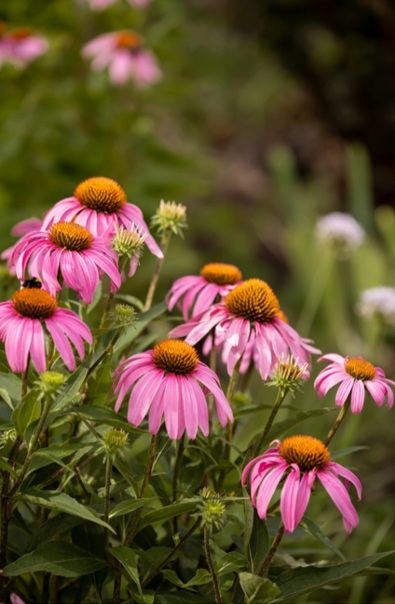
Echinacea purpurea
Oishi Evidence Profile
These ratings describe the quality, depth, and relevance of available evidence within each category. They are not ratings of overall safety, therapeutic effectiveness, or whether an herb is “good” or “bad” for rabbits.
| Category | Rating | Brief rationale |
|---|---|---|
| Botanical Identification | ★★★★★ | How well the plant can be reliably identified and characterised |
| Traditional Herbal History | ★★★★★ | Depth and documentation of historical medicinal use |
| Edibility / Food Use | ★★★★★ | How well documented the plant is as a food or forage material (explicitly separating food use from concentrated medicine) |
| Phytochemical Evidence | ★★★★★ | Strength of evidence concerning constituent chemistry and biological activity |
| Rabbit-Specific Evidence | ★★★★☆ | How much direct evidence exists in rabbits |
Echinacea carries a popular reputation as an immune herb, which reflects its research history rather than serving as a prescription for daily medication. Controlled feeding trials with Echinacea pallida demonstrate specific physiological shifts—such as altered phagocytic activity—without proving clinical illness prevention. Its safest and most balanced role in companion rabbit care is as an occasional, well-sourced botanical enrichment that respects natural foraging behavior instead of acting as a medical cure.
Meet the Plant
Echinacea is one of those plants that is surprisingly easy to recognize once you know what you are looking for. The classic Echinacea purpurea features a sturdy upright, hairy stem topped by a flower head with pink-purple ray flowers surrounding a raised, prickly-looking central cone.
The central “cone” is not just decorative. It is made up of numerous small disc flowers packed together into a capitulum, which is a key characteristic of the daisy family (Asteraceae). Leaves are generally ovate to lanceolate with toothed margins, growing broader toward the base while becoming smaller higher up the stem.
Field ID Checklist
- Sturdy, upright, and hairy stems
- Pink-purple ray flowers surrounding a spiny central cone
- Ovate to lanceolate leaves with toothed margins
- Flower centre resembling a little hedgehog (echinos)
The genus name Echinacea comes from the Greek echinos, referring directly to the spiny or hedgehog-like appearance of the flower centre. Never identify plants based on flower colour or shape alone; Oishi recommends positive botanical verification before feeding.
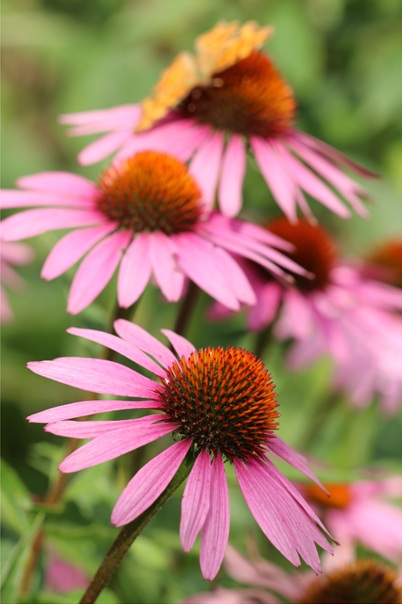
Spiny central cone & ray petals
Botanical & Scientific Profile
Taxonomy: Asteraceae. Three species are particularly prominent in herbal literature: Echinacea purpurea (purple coneflower), Echinacea pallida (pale purple coneflower), and Echinacea angustifolia (narrow-leaved purple coneflower). Different species and even plant parts have varying chemical profiles.
Echinacea contains a complex mixture of natural compounds rather than a single active molecule. Active constituent concentrations vary depending on the plant part, growing conditions, harvest stage, and extraction method.
Key Bioactive Groups
AlkamidesAssociated with roots and non-polar extracts, showing biological activity in lab models involving inflammatory signaling. Lab effects do not guarantee direct therapeutic outcomes when eaten. | Caffeic-Acid DerivativesChicoric acid is especially characteristic of E. purpurea, offering verified antioxidant activity in experimental systems. |
Polysaccharides & GlycoproteinsInvestigated for immunomodulatory properties, focusing particularly on macrophage interactions and cytokine signaling pathways. | Flavonoids & PhenolicsContribute to the plant’s broader phytochemical profile as a complex natural mixture rather than acting as isolated isolated compounds. |
Together, these compounds explain why Echinacea generates scientific interest. However, laboratory activity from an isolated extract is entirely distinct from a clinical effect when a companion rabbit nibbles the raw plant.
Nutritional Profile
Echinacea is not a nutritional powerhouse like major leafy forage such as grasses or dandelion, but serves instead as a minor botanical component of dietary variety:
| Fresh FormHigh Moisture Lower nutrient concentration per gram | Dried FormConcentrated Water removed, condensing constituents | Extract FormHighly Processed Far more concentrated than ordinary forage |
Macronutrients & Minerals: Aerial portions contain water, structural carbohydrates, fiber, and trace protein. Because ratios shift based on soil, maturity, plant part, and processing, no reliable universal Ca:P ratio exists for rabbit feeding, meaning Echinacea should not be used to correct mineral intake.
Dietary Context: A pinch of dried leaf is not pharmacologically equivalent to a standardized Echinacea extract.
Traditional Use & Modern Scientific Understanding
The Oishi Bunnies Herbal Atlas does not position traditional herbal medicine and modern science as opposing systems. Traditional knowledge records generations of observation and practice; modern science investigates those observations through botany, phytochemistry, pharmacology, experimental research, and clinical study. The purpose of the Atlas is to bring these layers together without confusing them.
Traditional knowledge generates hypotheses; modern science investigates them using increasingly controlled methods. Here is how historical practice and modern pharmacognosy intersect for Echinacea:
1. Traditional Herbal PracticeHistorically used for wounds, stings, inflammatory complaints, and respiratory illnesses. Ethnobotanical history represents accumulated human observation, forming foundational hypotheses for modern pharmacognosy. | 2. Modern PhytochemistryAnalysis reveals bioactive constituents like alkamides, caffeic-acid derivatives, polysaccharides, and glycoproteins. Concentrations vary distinctly depending on species and plant part. |
3. Experimental ResearchConstituents influence inflammatory and immune pathways in experimental systems, providing a plausible pharmacological basis for traditional observations. | 4. What We Still Don’t KnowPharmacological activity does not automatically equal clinical effectiveness. Preparation, species, dose, plant part, and lagomorph physiology all matter immensely. |
Potential Relevance of Echinacea for Rabbits
Bringing echinacea into your rabbit’s routine is a wonderful way to spark curiosity and add vibrancy to their daily diet:
Nutritional
| Foraging & Behavioural
| Natural Vitality
|
A Quick Note: While science continues to uncover fascinating properties in herbs like Echinacea, its absolute greatest superpower in companion care is keeping mealtime endlessly enriching and joyful!
A Closer Look at Herbal Properties
Echinacea has earned its place in herbal traditions for good reason. Behind every leaf is a rich profile of plant compounds that catch the eye of modern researchers.
Immune SupportControlled dietary supplementation with species like E. pallida has produced measurable changes in immune parameters, such as enhanced phagocytic activity in growing rabbits, though this does not equal proven clinical health benefits. | Anti-Inflammatory PropertiesTraditionally used to reduce inflammation and promote healing. While active compounds interact with biological pathways, it serves as a dietary addition rather than a medical treatment for conditions. |
Antioxidant EffectsRich in flavonoids and polyphenols that help neutralize free radicals. These compounds protect cells from oxidative damage and support overall wellness as part of a diversified foraging mix. | Respiratory Health ContextWhile traditionally linked to upper respiratory comfort, Echinacea does not prevent or treat rabbit respiratory disease or infections, nor does it replace professional veterinary care. |
Natural ForagingIncorporating organic herbs into your rabbit’s habitat provides an authentic outlet for natural behavior, stimulating mental and physical activity. | Sourcing & QualityAlways choose clean, organically grown, properly dried, and pesticide-free botanical mixes to ensure safe foraging enjoyment for your bunnies without unwanted chemical residues. |
Edible Anatomy
An anatomical breakdown of Echinacea parts, outlining their role in routine feeding and foraging enrichment:
Leaves & FlowersLeaves Best part for botanical enrichment (fresh or properly dried, in small quantities). Growing conditions and plant part influence flavor and phytochemical composition. Flowers Botanically edible, though the central cone is spiny and textured, which may vary in palatability for individual rabbits. | Stems & RootsStems Young stems may be consumed incidentally with leaves, but older stems are tough and unappealing. Seeds are unnecessary as a dietary component due to impractical size. Roots High concentration of alkamides and distinct phytochemical profiles compared to aerial parts; there is no nutritional reason to feed concentrated root preparations to companion rabbits. |
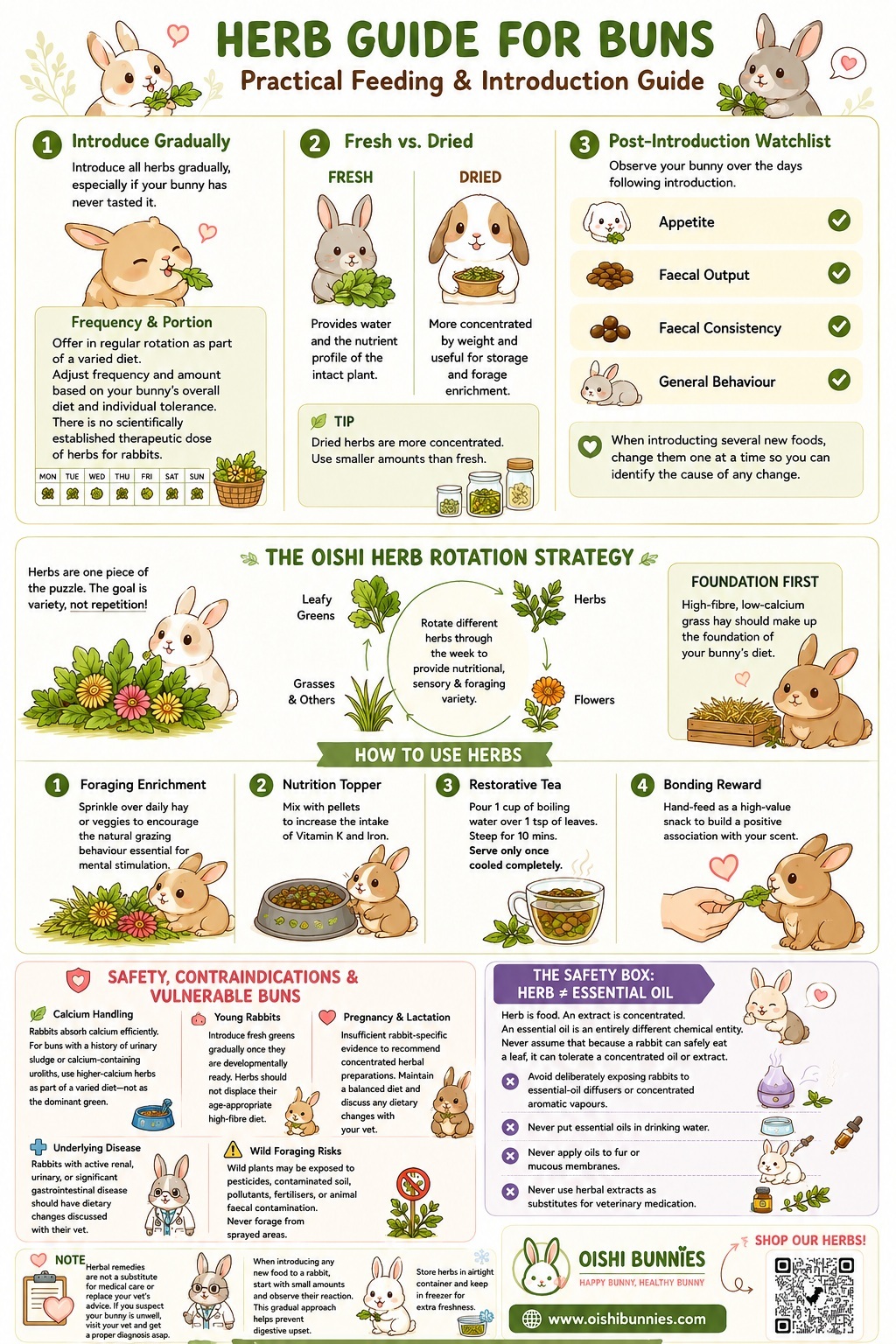
Cultivation & Harvest in Singapore
Practical guidelines for growing, safeguarding, and processing Echinacea purpurea under tropical conditions:
Tropical Cultivation
| Rabbit Safety
| Harvest & Storage
|
Forage & Botanical Alternatives
For guardians who want to provide exceptional sensory enrichment, premium organic options offer a convenient, safe alternative designed specifically for companion rabbits:
Organic Echinacea LeavesCarefully selected, pure organic echinacea leaves ready for daily foraging bowls. Designed to fit into a varied enrichment approach without turning ordinary food into a medical claim. | Organic Echinacea RootCleaned and dried organic root pieces offering diverse textural engagement. Best offered sparingly as an occasional botanical curiosity rather than a daily staple. |
Baked Bunnana Chips with EchinaceaGently baked snacks combining wholesome ingredients with beneficial herbs like echinacea for maximum palatability and sensory enrichment. | Hay PiaAn engaging, rabbit-focused botanical treat crafted to stimulate natural foraging behaviours and add delightful textural variety to your bun’s daily routine. |
Herb-Specific FAQ
Common questions regarding echinacea inclusion, safety, and feeding practices for companion rabbits:
Can rabbits eat Echinacea?
Does it boost immunity?
Which species has the most research?
Can I feed the roots or flowers?
Are tinctures and essential oils safe?
Can it grow in Singapore?
References & Further Reading
Scientific literature, official databases, and veterinary references supporting this guide:
- Dabbou, S., Rotolo, L., Kovitvadhi, A., et al. (2016). Rabbit dietary supplementation with pale purple coneflower. 1. Effects on the reproductive performance and immune parameters of does. Animal, 10(7), 1101–1109.
- Kovitvadhi, A., Gai, F., Dabbou, S., et al. (2016). Rabbit dietary supplementation with pale purple coneflower. 2. Effects on the performances, bacterial community, blood parameters and immunity of growing rabbits. Animal, 10(7), 1110–1117.
- Phytochemistry Reviews: Literature covering alkamides, chicoric acid, and polysaccharides in Echinacea purpurea and E. pallida (PubMed Central (PMC)).
- Botanical Guides: USDA Natural Resources Conservation Service (NRCS) & Singapore NParks botanical databases.
- Animal & Veterinary Service (AVS), Singapore. Caring for a Rabbit.
Clean, correctly identified Echinacea is a useful forage botanical that can contribute nutritional and sensory variety to a rabbit’s diet. Its strongest case is as food and enrichment — not as medicine. That distinction is important: a herb can be valuable without needing to be a medicine. If your rabbits have any specific health history, a quick conversation with an exotic veterinarian is always the smartest first step.
Important Notes & Disclaimer
- Educational Use Only: This profile is provided for botanical learning and enrichment, not as veterinary advice, medical diagnosis, or treatment protocols.
- Whole Herb vs Medicine: Edible herbs can contain biologically active phytochemicals and may have interesting nutritional or physiological properties. However, feeding a whole herb is fundamentally different from administering a standardized medicinal preparation, and dietary herbs should not be treated as substitutes for veterinary treatment.
- Dietary Foundation: Unlimited grass hay and clean water remain fundamental; herbs are intended as complementary plant foods and foraging additions, not replacements for the rabbit’s staple diet.
- Individual Sensitivities: Rabbits vary widely in age, digestive health, and medical history. Always introduce new botanicals gradually and watch for changes in appetite or droppings.
- Concentrates & Extracts: Whole dried herbs differ chemically from concentrated extracts or essential oils. Never diffuse or administer concentrated aromatic oils to rabbits.
- Vulnerable Rabbits: Exercise extra caution with young rabbits, seniors, pregnant or nursing does, and rabbits with known kidney, urinary, gastrointestinal, or other chronic health conditions.
- Safety & Sourcing: Ensure proper plant identification and clean sourcing. Discard spoiled or moldy items, and never delay prompt veterinary care if your rabbit shows signs of illness.
The Oishi Bunnies Bottom Line:
Herbs offer wonderful flavour, variety, and natural foraging enrichment, but good rabbit care relies on moderation, high-quality hay, and proper veterinary guidance.
If your rabbit is sick, please seek professional veterinary care rather than relying on dietary remedies.