THE MODERN ART OF RABBIT CARE
Rabbit Succession Planning: How to Plan for Your Next Bunny (Without Feeling Like a Traitor)
By Cookie Yiyi
This post was inspired by Shine, Sparkle and Smile, our adopters with senior bunnies who did their rabbit succession planning well ahead of time — proof that thinking this through early is entirely possible, and worth it.
 Quick Answer
 Quick Answer
Rabbit succession planning means thinking ahead about what happens when your rabbit household changes — whether, when, and how another rabbit might eventually join your family. For a bonded pair, that could mean deciding what you’d do if one rabbit dies. For a single senior, it could mean considering companionship while they’re still well enough to bond. For an established pair, it might mean deliberately doing nothing except having a plan for later.
It also means looking further ahead. Do you actually want to keep rabbits for another 8–12 years? And who looks after them if something happens to you first?
 There’s no universally correct age, date, or waiting period. But there is one very poor time to start thinking about all of this: when you’re already grieving, your surviving rabbit is suddenly alone, and someone asks, “So… are you going to get another bunny?”
Why Is This Even a Thing?
Because rabbits create an unusual long-term welfare problem. Imagine a nine-year-old rabbit living happily with a five-year-old companion. Eventually the older rabbit dies, and the younger one — still with years ahead of her — could benefit from another companion. So you adopt a two-year-old. Years later, that middle rabbit dies too, and the newest arrival is now the survivor. Do you find her a friend as well? And when she eventually passes?
Suddenly, the two rabbits you originally adopted have quietly turned into twenty or thirty years of continuous rabbit keeping. There’s nothing wrong with that — plenty of us would happily sign up for a lifetime involving hay in places hay has no business being. But it should be a conscious choice, not something you discover one bereavement at a time. That’s the whole point of rabbit succession planning.
Rabbit Bonding and Companionship: Why Rabbit Succession Planning Matters
Rabbits are a genuinely social species. Proper rabbit bonding and companionship gives them things even a very devoted human can’t fully replicate: mutual grooming, resting in physical contact, rabbit-to-rabbit communication, shared exploration. Effective rabbit succession planning relies on solid evidence — a 2026 University of Copenhagen study tracking 122 privately owned rabbits across 74 households found that socially housed rabbits, including successful bonded rabbit pairs, showed greater behavioural diversity and spent significantly less time in “awake inactivity” (a marker linked to boredom or low mood in other species) than solitary rabbits. Socially housed rabbits spent about 75% of observed time either in direct contact with a companion or within close proximity of one — a strong sign that closeness isn’t incidental, it’s something rabbits actively seek out.
That doesn’t mean every rabbit should be placed with whichever bunny happens to be available when getting a second rabbit or adopting through local networks like rescue rabbits Singapore advocates. Compatibility matters enormously. Poor introductions or mismatched pairings can cause chronic stress, resource guarding, and serious injury — the RSPCA is explicit that success depends on compatible pairing and careful, gradual introductions, not just proximity.
So the succession-planning question isn’t “when should I get another rabbit?” It’s “if my rabbit household changes, what social arrangement is most likely to protect the welfare of the rabbits involved?” A much better question.
First, Work Out Which Situation You Actually Have
Effective rabbit succession planning gets confusing because several different scenarios get treated as one. Let’s break down where your huddling household currently stands regarding proper rabbit bonding and companionship:
1. A healthy rabbit living alone
This isn’t purely a future-succession question — it’s worth considering whether a compatible companion would improve their welfare now, assuming health, temperament, and practical circumstances allow for it.
2. A stable bonded rabbit pairs setup
Succession planning does not automatically mean adding a third rabbit. Sometimes the best plan is: enjoy the pair, protect the bond, know what you’ll do later. Planning early doesn’t mean adopting early.
3. One rabbit in a pair is ageing
Now it’s worth actively thinking about what you’d do if the older rabbit dies, whether you’d rebond the survivor, what age or temperament you’d look for when getting a second rabbit or adopting through rescue rabbits Singapore advocates, and whether you have the space and money for a bonding process. You don’t have to act yet — you just stop leaving the decision entirely to a future version of yourself who may be having a terrible week.
4. One rabbit has already died
Now you’re managing two kinds of grief at once — yours, and whatever behavioural response the survivor is going through. Having thought about this beforehand means you’re not starting from zero.
“Whichever category you’re in, knowing your layout keeps the treat distribution fair and stress-free!” — Bunnini & Pee-Casso
The Two Main Strategies
There are broadly two approaches, and neither is automatically better.
Strategy 1: The Overlap Approach
You introduce another rabbit while your existing one is still alive. This plays out differently depending on your starting point.
If your rabbit is currently living alone, introducing a companion is primarily a welfare decision, not a succession one — the age gap just happens to mean one may outlive the other. Reasonably straightforward.
Turning a bonded pair into a trio is a different matter entirely. The theoretical plan looks tidy on paper: A and B are bonded, you add C, A eventually dies, and B still has C. Social continuity achieved. Unfortunately, rabbits haven’t reviewed the spreadsheet. Adding a third rabbit doesn’t create one new relationship — it creates three interacting ones (A–B, A–C, B–C), and disturbing any one of them can destabilise the others. In the RWAF’s 2020 survey of 1,218 rabbit owners, introducing new rabbits was cited in 18% of reported bond breakdowns — a real, non-trivial risk, second only to illness or forced separation (32%) as a trigger. Don’t add a third rabbit to a stable pair casually.
Potential advantages of overlap: the eventual survivor already knows another rabbit; you get to make decisions before bereavement, not during it; introductions happen on a calmer timeline; and there’s less pressure to search urgently for a new companion right after a loss. Owners and rescues also commonly report that senior rabbits seem more active or engaged after gaining a companion — but treat that as a nice anecdotal bonus, not medicine. A new rabbit is not a treatment for arthritis, chronic disease, or age-related appetite loss. If an older rabbit becomes withdrawn or stops eating well, that’s a vet visit, not a matchmaking project.
Strategy 2: The Sequential Approach
You leave your existing relationship untouched and consider another rabbit only after one has died.
If no rabbit remains in the household after a loss, this is often entirely reasonable — your current rabbits keep their familiar structure, a frail rabbit isn’t put through an unnecessary introduction, and if nobody’s left, there’s no welfare deadline forcing your hand. Grieve for however long you need. Never adopt again if that’s the honest answer. That decision belongs to you.
The situation changes if a rabbit does remain. Rescues and rabbit welfare organisations commonly note that many bereaved rabbits do well with a new companion once they’re ready, and losing a bonded partner is well documented to cause real behavioural changes — appetite changes, lethargy, withdrawal, and in some cases a heightened risk of GI stasis brought on by stress. That doesn’t mean “rabbit died Tuesday, speed date Saturday.” There’s no scientifically established bereavement stopwatch. Instead, the order of operations should be: health first, behaviour second, calendar third.
What Should You Do After One Bonded Rabbit Dies?
Watch the surviving member of your bonded rabbit pairs setup closely. A change in behaviour may be tied to loss — but one of the easiest mistakes to make in proper rabbit succession planning is deciding “she’s sad” when she’s actually sick. Reduced appetite, reduced faecal output, lethargy, weight loss, or a hunched posture can all indicate medical disease and deserve prompt veterinary assessment. Don’t let “grief” become a diagnosis of convenience.
Once the rabbit is medically stable, factor in their behaviour, social history, temperament, and health when deciding when to start getting a second rabbit or exploring new avenues of rabbit bonding and companionship, including working with local rescue rabbits Singapore advocates. There’s no reliable evidence behind a fixed waiting period — 7 days, 14 days, a month. The right timeline depends on the rabbit and the household. Avoid unnecessarily prolonged isolation out of a feeling that adopting again would somehow disrespect the rabbit who died — and avoid rushing into an unsuitable match just because the house feels painfully quiet. Succession planning is precisely what helps you steer between those two extremes.
“But Won’t It Feel Like I’m Replacing Them?”
Probably — at least for some people, and that feeling is one reason it helps to think about succession before bereavement rather than during it. A new rabbit isn’t a version 2.0 of the one you lost. They’ll have a different personality, hate the food your previous rabbit adored, sleep somewhere entirely different, and invent new household crimes you haven’t budgeted for. They don’t erase the rabbit who died — and if there’s a surviving rabbit, this isn’t solely about filling the space in your life. It’s also about rebuilding the social life of the rabbit who’s still here. You can grieve one rabbit and still care about another’s future welfare. Those two things aren’t in conflict.
Should You Pair a Young Rabbit With a Senior?
Possibly — but there’s a useful scientific wrinkle here. That same 2026 Danish study found that a larger age gap between two rabbits was significantly associated with a lower “Friendship Index” (a measure combining time spent in physical contact and mutual grooming). That doesn’t prove wide-age-gap pairs are doomed, and it doesn’t mean “only bond same-age rabbits” — the study itself had real limitations, including a sample biased toward already-successful relationships. But it’s a good reason to question the common assumption that old rabbit + very young rabbit = ideal succession pair.
Think about it in terms of life stage rather than birthdays. A nine-year-old with mild arthritis who enjoys naps and slow grooming sessions probably isn’t looking for an eight-month-old who’s just discovered vertical surfaces and does 2 a.m. laps of the living room. There’s nothing wrong with either rabbit — but a five-year age gap can work beautifully if temperaments and energy levels line up, while two rabbits born three weeks apart can still despise each other. Match on energy level, mobility, temperament, health, and social style — not age alone. Rabbit matchmaking is still matchmaking.
The Real Factors That Should Drive Your Decision
1. Your current social structure
A solitary rabbit, a pair, a trio, or a larger group — losing a member from each is not the same welfare event.
2. The existing bond
Is the bonded rabbit pairs setup genuinely relaxed — grooming each other, resting together, sharing resources, seeking each other out? If so, treat that as something worth protecting. Illness, separation, and the introduction of new rabbits were the top reported triggers for bond breakdown in the RWAF survey — don’t disturb a stable relationship casually.
3. Medical fitness
Before a major introduction, weigh pain, arthritis, dental or GI disease, mobility issues, recent surgery, or advanced illness. Chronically ill or disabled rabbits can absolutely have wonderful companions — the question isn’t whether they’re “healthy enough to deserve a friend,” it’s whether this introduction, at this moment, is likely to improve or compromise their welfare. For a very fragile rabbit, preserving an established routine may matter more than starting a demanding new bonding process.
4. Temperament
Confident, nervous, territorial, pushy, laid-back, resource-defensive — age and sex influence compatibility, but the individual rabbit gets the final vote.
5. Neuter status
Adult rabbit bonding and companionship is generally undertaken with neutered rabbits. The RSPCA and RWAF both particularly favour neutered male-female pairings as the most reliably successful combination — puberty and reproductive hormones can seriously complicate a relationship.
6. Time
Some rabbits bond quickly; others need a much slower process, so don’t treat “weeks to months” as a fixed rule. What matters is having enough time to move at their pace, not yours. The RSPCA recommends gradual, supervised introductions starting with separate but adjacent housing and neutral territory — not simply putting unfamiliar rabbits together and hoping.
7. Space
Before rabbit number three arrives when getting a second rabbit, ask what happens if the introduction doesn’t work. You may need temporary — or permanent — separate housing, with room for enclosures, exercise, hiding places, feeding stations, litter areas, and safe separation during the bonding process. “Don’t worry, they’ll definitely bond” is not a housing plan.
8. Money
A second or third rabbit isn’t just another food bowl — factor in vet exams, neutering, vaccination where locally relevant, routine care, dental work, imaging, medication, and eventual senior care. And remember: rabbits adopted around the same age tend to become elderly around the same time, which can mean two sets of senior-care costs at once. Effective rabbit succession planning is partly financial planning.
9. Biosecurity
Any new rabbit from local rescue rabbits Singapore networks or elsewhere should be appropriately assessed before introduction — a vet check, parasite screening, vaccination where locally available, and a period of separation before social contact. A new companion shouldn’t accidentally bring a preventable illness into an established household.
10. Your own life
Easy to forget. If your ten-year-old loses her companion and you adopt a one-year-old, that new rabbit could still be with you a decade from now — rabbits commonly live 8–12 years or longer. Ask honestly: do you want another decade of rabbits, not just whether you could probably manage it. There’s no shame in answering no.
The Rabbit Succession Loop
Few adoption guides talk about this part of effective rabbit succession planning. Rabbit A needs Rabbit B for proper rabbit bonding and companionship. A dies; B needs Rabbit C when getting a second rabbit or expanding your huddle. B dies; C needs Rabbit D. And somewhere along the way you realise you’ve accidentally subscribed to rabbits, cancellation policy unclear.
For some of us, that’s a delight — rabbits for life. For someone nearing retirement, moving abroad, or facing a major life change, maybe not, and that’s worth factoring into what kind of companion you look for. An older rabbit can sometimes suit a household better than a baby simply because babies are easier to find — and senior rabbits need homes too, particularly through local rescue rabbits Singapore networks.
A Practical Succession Timeline
| Your situation | What succession planning looks like |
|---|---|
| Healthy rabbit currently living alone | Consider whether compatible companionship would benefit them now |
| Stable young or middle-aged bonded rabbit pairs | Enjoy the bond; set your future plan rather than automatically adding a third |
| Stable pair, one rabbit entering senior years | Start discussing future options and practical arrangements |
| Healthy senior living alone | Age alone doesn’t rule out bonding — assess health, temperament, and suitable companions |
| Pair with one medically fragile rabbit | Prioritise medical stability and preserve the existing relationship |
| Recently bereaved rabbit | Assess health promptly, observe behaviour, then consider matchmaking when ready |
| Stable trio or group | Think through how the remaining structure may change after one member dies |
| No rabbits remain after a loss | No welfare deadline — adopt again only if and when you genuinely want to |
That last distinction matters: a bereaved human and a bereaved rabbit are not the same succession problem.
This is exactly the framework Shine, Sparkle and Smile put into practice — with senior bunnies at home, they thought through their household’s “what if” well before it became urgent, rather than scrambling to figure it out mid-crisis. That’s succession planning working as intended: not a rulebook, just a bit of foresight bought early.
When “Not Yet” Is the Best Answer
Responsible succession planning sometimes means not adopting. Not while your senior is medically unstable. Not while an existing pair is thriving and you don’t want to risk the relationship. Not while you lack adequate separate housing. Not when vet costs are already stretching the household. Not when you know you can’t commit to another decade. Planning doesn’t force you to act — it gives you the freedom of not being forced to act later.
Don’t Forget the Other Kind of Succession Planning
There’s another uncomfortable question this topic raises: what happens to your rabbits if something happens to you? This isn’t about choosing the next rabbit — but no succession plan is complete without it. Hospitalisation, sudden illness, relocation, or worse can happen long before your rabbits reach old age.
At least one trusted person should know how many rabbits you have, which ones are bonded and must stay together, where their food and carriers are, what medications they take, which vet treats them, their normal diet, any major medical issues, who could take them temporarily, and what you’d want to happen if you can’t resume their care.
Put it in a simple Rabbit Emergency File — photos, names, ages, sex and neuter status, normal weights, medical history, vet details, diet, behavioural quirks, bonding relationships, and emergency contacts — and update it. An immaculate file from years ago isn’t much use if two rabbits have since died, a medication has changed, and the emergency contact moved overseas.
Financial provision is also worth considering, particularly for rabbits with ongoing medical needs — formal arrangements vary by jurisdiction, so this is worth a conversation with a locally qualified professional. The principle itself is universal: don’t leave a decade of rabbit care entirely dependent on someone else’s goodwill and guesswork.
Pros and Cons of Rabbit Succession Planning
| Benefits | Possible downsides |
|---|---|
| Reduces rushed decisions made during bereavement | Forces you to think about ageing and death before you’re ready to |
| Helps protect continuity of rabbit bonding and companionship | Adding a rabbit too early when getting a second rabbit can destabilise an existing bond |
| Gives you time to find an appropriate match through local rescue rabbits Singapore networks | A well-planned bond between bonded rabbit pairs can still fail |
| Makes long-term financial commitments visible | More rabbits mean more vet and housing costs |
| Encourages thinking about life-stage compatibility | Age-matching can’t guarantee compatibility |
| Helps you prepare for emergencies | Plans need updating as circumstances change |
| Makes it easier to decide when not to adopt | There may be no perfect solution for every rabbit |
| Can reduce prolonged solitary housing after bereavement | You and the surviving rabbit may be ready on different timelines |
The Succession Checklist
About your rabbit: Is my rabbit currently alone, paired, or in a group? Is the existing relationship stable? What’s their life stage and medical status? Would another rabbit improve their welfare now, or am I solving a hypothetical future problem?
About another rabbit: Am I choosing primarily for temperament and compatibility? Is the age difference sensible for both their lifestyles? Are health and biosecurity checks in place? Do I have a plan if bonding doesn’t take?
About your household: Do I have the space, time, and money — including for two elderly rabbits at once, if it comes to that? Am I genuinely prepared for another 8–12 years?
About the future: What will I do if one bonded rabbit dies? Would I rebond the survivor? Would I consider an older rabbit, or a trio? At what point do I want my rabbit-keeping journey to end — and who looks after them if something happens to me first?
If you can answer these before the crisis happens, effective rabbit succession planning has already done its job.
If any of this has you thinking about who might join your household next, here are three rabbits from our JB cross-border rescue network who are currently looking for a home to call their own:

Snowflake
English Angora | 1.5 Years | Female | Sterilised
Angoras carry a long wool coat that needs regular grooming to stay mat-free and comfortable, so she’ll suit a household ready for that routine — but the payoff is a genuinely striking, cloud-soft companion.

Meteor
Lionhead | 1.5 Years | Male | Sterilised
Lionheads are named for the wool “mane” around their head and flanks, giving them a small, fluffy-maned look. At a year and a half, he’s past the baby-chaos stage but still very much a young adult.
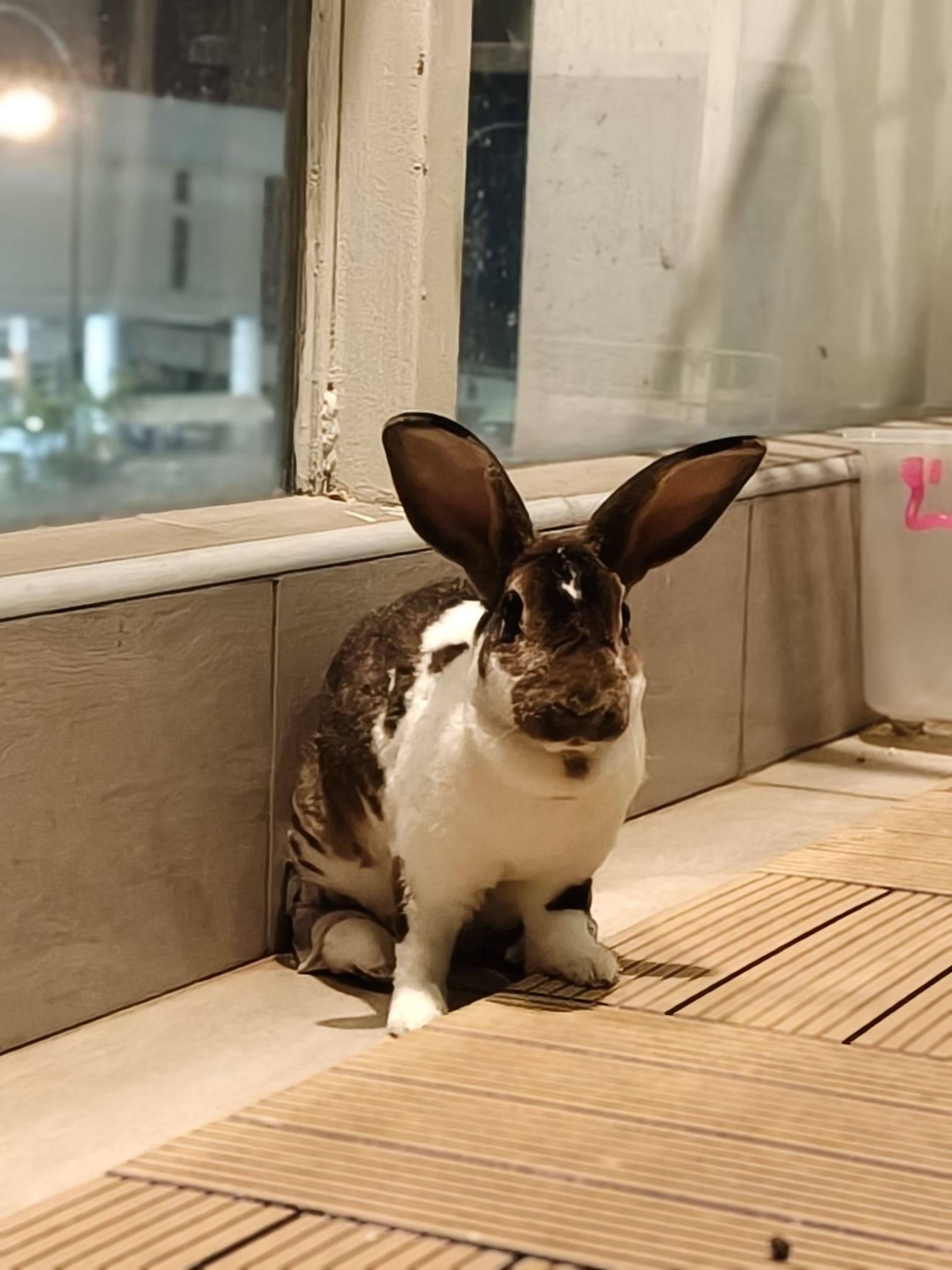
Sirius
Mini Rex | 2 Years | Female | Sterilised
Mini Rex are known for an unusually soft, velvet-plush coat — often described as one of the nicest rabbit coats to pet. At two, she’s an adult with a settled personality already showing through.
All three are already sterilised, which — as covered above — removes one of the biggest variables in successful bonding. If you’re weighing a companion for a rabbit you already have, or starting your own succession plan early, reach out and we can talk through compatibility for your specific household.
FAQ
Is getting another rabbit “cheating” on my current one?
+
No. Rabbits don’t appear to experience companionship as human-style exclusivity, so the real question isn’t whether you’re betraying your rabbit — it’s whether introducing another one is likely to improve the welfare of everyone involved. If your current bonded rabbit pairs are already happy, improving welfare may mean leaving their relationship exactly as it is without disrupting rabbit bonding and companionship.
Should I get a third rabbit before one of my bonded pair dies?
+
Not automatically. A successful trio can provide social continuity later, but adding a rabbit also changes the dynamics of an established pair, and new introductions when getting a second rabbit are a documented trigger for bond breakdown. Weigh health, temperament, and compatibility — not just ages.
Can senior rabbits bond again?
+
Yes. Age alone doesn’t mean a rabbit can’t form a new relationship — medical condition and temperament matter far more than an arbitrary birthday when exploring options through rescue rabbits Singapore networks.
How long after one rabbit dies should I get another?
+
There’s no scientifically established universal waiting period for rabbit succession planning. For a surviving rabbit, assess health and behaviour first, then consider matchmaking once the rabbit and your circumstances are ready. If no rabbits remain, there’s no welfare deadline at all — take the time you need.
What if I don’t want to start another ten-year commitment?
+
Build that into the plan. Depending on your situation, you might consider an older, already-settled rabbit, talk to an experienced rescue about your constraints, or rethink how you manage companionship for your last rabbit. Responsible rabbit keeping doesn’t require an endless conveyor belt of increasingly younger rabbits.
References
- Skovlund, C. R., Corneliussen, N. M., Kofod, L. B., Mejlstrup, I. T., Sandøe, P., & Forkman, B. (2026). Companionship counts: Investigating social housing conditions and welfare in privately owned rabbits. Applied Animal Behaviour Science, 294, 106864.
- Bradbury, G. (2020). Owner, rescue centre and veterinary professional experience in rabbit bonding. Rabbit Welfare Association & Fund (RWAF).
- RSPCA. Bonding rabbits — guidance on introductions and companion selection.
- Best Friends Animal Sanctuary — case reporting on rebonding senior rabbits after companion loss.
Our Approach & Disclaimer
At Oishi Bunnies, we don’t believe there’s a single “correct” succession timeline — only a right-for-your-household one, built on honest answers about your rabbits’ health, your finances, and your actual (not aspirational) time.
The information in The Modern Art of Rabbit Care and the Oishi Bunnies blog draws on over 9 years of hands-on experience in rabbit rescue, rehabilitation, and organic nutrition. We hold ourselves to a high bar for medical and scientific accuracy, but this content is educational — it isn’t a substitute for advice from your rabbit-savvy vet or local rescue, who know your rabbits’ specific history and temperament, and it doesn’t constitute professional veterinary diagnosis or treatment.
The Modern Art of Rabbit Care is a living, evolving guide. We update it as new evidence emerges or as our own understanding sharpens — so if something here changes down the line, that’s the point, not a flaw. Check back for refinements.
Always consult an exotic-savvy vet for concerns specific to your rabbit.