
Scientific Welfare & Health Guide
What Should My Rabbit Weigh? A Scientific Guide to Healthy Rabbit Weight & Body Condition Score
By Cookie Yiyi
“Your rabbit is too fat.”
“Your rabbit is too skinny.”
How many times have you asked yourself, what should my rabbit weigh when trying to figure out if they are maintaining a truly healthy rabbit weight? Maybe you heard it from a vet, a groomer, or another rabbit owner who somehow completed a full body-composition assessment from one photograph on Facebook.
But when evaluating a proper rabbit ideal weight, what do terms like “too fat” or “too skinny” actually mean? Is it just a number on the scale, or a breed chart? Are you checking whether you can feel the ribs, or whether your rabbit looks suspiciously potato-shaped from above? Determining an accurate body condition score rabbit assessment requires looking at more than just mass — making a proper bcs rabbit evaluation essential for long-term health.
Quick Answer The Holistic Weight Baseline
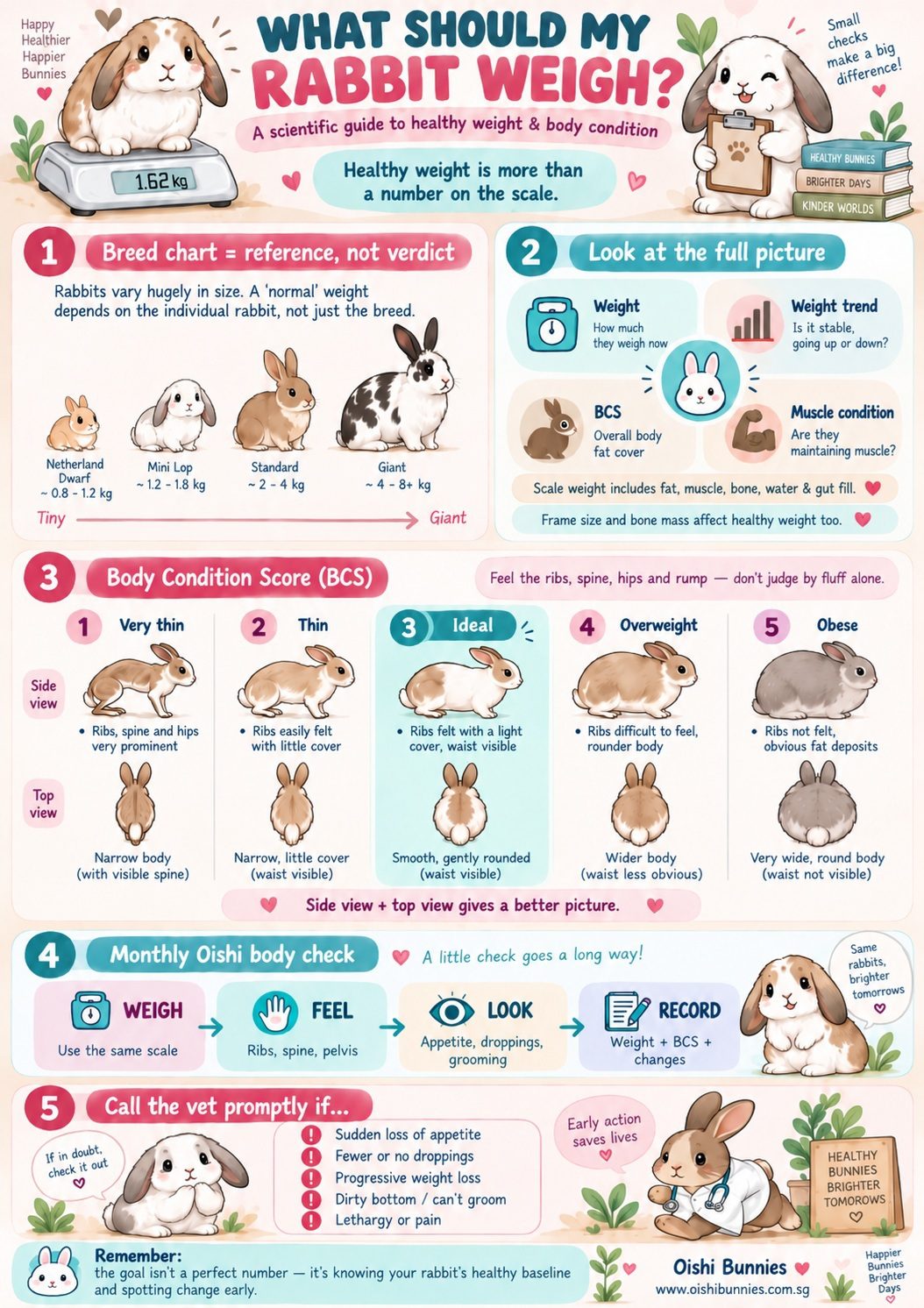
There’s no single universal answer when asking what should my rabbit weigh because domestic rabbits vary enormously in size, and even within a breed, body weight can look perfectly normal while body condition has already shifted away from a healthy rabbit weight.
To determine a true rabbit ideal weight, the best picture comes from combining a proper body condition score rabbit (or bcs rabbit evaluation), your rabbit’s own weight trend, muscle condition, and overall health.
On the traditional five-point rabbit BCS scale, around 3 is considered ideal. But BCS is a hands-on estimate of body condition, not a direct measurement of body-fat percentage — and newer research published in 2025 and 2026 has shown that the person doing the scoring matters too.
 In other words: When figuring out what should my rabbit weigh, remember that the scale matters, your hands matter, and change over time matters most.
Why the Number on the Scale Can Lie to You
Domestic rabbits span an enormous size range — from roughly 1 kg in some dwarf breeds to 6–8 kg or more in giant breeds. That’s before you account for frame, sex, genetics, and normal variation within the same breed, all of which influence a truly healthy rabbit weight.
This question is closely tied to figuring out what should my rabbit weigh, but it has no useful answer until you know which rabbit you’re talking about and evaluate its rabbit ideal weight beyond simple breed variation.
Clinical Insight The Edinburgh Feeding Study
A controlled feeding study at the University of Edinburgh followed 32 Dutch rabbits over nine months on four different feeding regimes to examine shifts in a healthy rabbit weight.
Rabbits given an extruded diet with hay or muesli with hay developed above-ideal Body Condition Scores even though their body weights remained within the normal breed-standard range. The hay-only group, which weighed less, had a median BCS of 3 — considered ideal.[1] When performing a regular body condition score rabbit assessment (or a quick bcs rabbit check), this disparity becomes critical.
The takeaway: When asking what should my rabbit weigh, remember that the scale and the breed chart can both look reassuring while body condition has already quietly shifted in the wrong direction.
Two More Factors Stacking the Deck Against You
1. Fur Hides Everything
A plush coat can make a fat rabbit look merely fluffy and hide a thin rabbit’s bones surprisingly well. Long-haired breeds (like Angoras!) are especially talented at this particular deception, making an accurate bcs rabbit check essential to verify their rabbit ideal weight.
2. Prey Animal Masking
Rabbits naturally hide illness. As prey animals, they show only subtle signs during early disease stages. Changes in appetite, fecal output, behavior, and a shifting body condition score rabbit matter long before a rabbit looks obviously unwell.
Weight-in-kg is a data point, not a diagnosis.
BCS adds another piece of information. Weight trend adds another. Muscle condition adds another. The useful answer to what should my rabbit weigh comes from putting them all together!
Body Condition Score: The Tool Vets Actually Use
BCS is a hands-on, breed-independent way to estimate body condition and fat coverage.
That wording matters. While BCS can certainly reflect severe tissue loss at the thin end of the scale, it is not a dedicated measurement of muscle mass — a vital distinction we will come back to.
Size-O-Meter The 5-Point Rabbit BCS Framework
| Score | What You’ll Feel & See |
|---|---|
| 1 — Very thin / Emaciated | Pelvis, ribs, and spine are very prominent and sharp. Minimal tissue coverage. Rump curves inward. |
| 2 — Thin | Ribs and pelvis are easily felt and relatively sharp. Little fat cover. Rump is generally flat. |
| 3 — Ideal | Pelvis and ribs are easy to feel but have rounded edges. Rump is generally flat. |
| 4 — Overweight | Firm pressure is needed to feel the ribs. Increased fat coverage. Rump becomes rounded. |
| 5 — Obese | Ribs become very difficult or impossible to feel. Rump is markedly convex. |
 The Pocket Stationery Test
 The Pocket Stationery Test
Rabbit BCS guidance gives one wonderfully low-tech comparison:

BCS 3: Ribs feel like a pocket full of pens.

No laboratory equipment required. Just stationery!
Practical Protocol
How to Perform an At-Home Palpation Check
Give yourself two quiet minutes and use gentle handling:
- Spine: Run your fingers from shoulders toward the tail. Does it feel smoothly covered or sharply prominent?
- Ribs: Gently palpate the ribcage rather than simply stroking over the fur. How much pressure is needed before you find them? (RWAF notes that ribs, particularly just behind the elbows, are especially useful for detecting smaller changes in subcutaneous fat, while the spine and hips change more obviously at extremes).
- Hips & Pelvis: The bones should be locatable, but not razor-sharp in an ideally conditioned rabbit.
- Rump Silhouette: A deeply concave rump suggests poor condition; progressive rounding suggests increasing body condition.
- Under the Tail: While you’re there, check for urine or fecal staining. It doubles as a very useful hygiene check!

Owner vs. Veterinarian Accuracy
A 2019 study involving 64 owners and 69 rabbits found that 64% of owners gave exactly the same BCS as the veterinarian, even though 74% had never used the system before! Most remaining scores were remarkably close.[2]
That’s encouraging — but then the scientists came back with a larger study and made things even more interesting…
The 2025–2026 Update: BCS Is Useful, But It Isn’t Infallible
This is the cutting-edge science that most rabbit weight guides haven’t caught up with yet!
The 2025 Study
n = 205
Tested standard 5-point Rabbit Size-O-Meter in 205 rabbits across vets, students, and laypeople to evaluate a healthy rabbit weight:
- Overall agreement: Relatively poor (α = 0.58)
- Vet professionals: Higher agreement (α = 0.72)
- Repeat self-assessments: Strong reliability (κ = 0.69–0.90)
The 2026 Follow-Up
n = 400
Scaled up to 400 rabbits and 3,113 individual scores evaluating 5-point vs expanded 9-point systems to target a proper rabbit ideal weight:
- 9-point overall reliability: Modest bump (α = 0.60–0.65)
- 9-point among vets: Highest reliability (α = 0.79)
- Best performer: Revised 9-point scale with detailed descriptors.
So, Should You Throw Away Your 5-Point Chart?
Absolutely not.
The 5-point system remains simple, practical, and highly effective for routine home checks when determining what should my rabbit weigh. The newer science simply gives us two crucial, empowering lessons:
1. Don’t treat BCS like an exact lab instrument.
It is an estimated guide, not a precise machine giving body-fat percentages.
2. Your personal consistency is your super-power!
The same person assessing the same rabbit repeatedly scores with high reliability. You know your rabbit best!
BCS isn’t useless because it’s subjective.
It works best when we understand what it can — and cannot — tell us. Learn what your own rabbit feels like and evaluate them consistently over time!
Beyond BCS: What a Vet Checks That You Might Not
A rabbit body condition score is one of the best practical tools we have at home, but a full veterinary assessment goes further — especially when the numbers don’t make sense.
Clinical Nuance
Muscle Condition vs. Fat Adiposity
The rabbit weight chart or BCS primarily estimates adiposity. It does not reliably tell you how much skeletal muscle a rabbit has retained. This distinction becomes particularly critical in senior, chronically ill, or recovering rabbits.
 A rabbit can lose vital muscle mass while retaining enough body fat that its BCS still looks fairly respectable — and its total body weight may barely move either!
While dogs and cats benefit from formal Muscle Condition Scores (MCS), a comparable widely validated rabbit-specific MCS system has not yet been established. Rather than relying on unvalidated metrics, vets focus on muscle-condition monitoring around the spine, pelvis, and hindquarters.
The simple home question: Does this rabbit feel less muscled than they used to?
Quality of Life
Functional and Hygiene Checks
A thorough veterinary assessment evaluates what physical condition is actually doing to the rabbit’s day-to-day life, especially when tracking proper rabbit weight management:
- Movement and mobility
- Hocks and feet condition
- Grooming ability and flexibility
- Cleanliness around the perineum
- Ability to reach and consume caecotrophs
 The Dirty Bottom Misconception:
A soiled rear end isn’t automatically proof of an unhealthy rabbit weight. Arthritis, spinal disease, neurological hurdles, or systemic weakness frequently produce the exact same issue. The diagnostic question is always: Why can this rabbit no longer keep themselves clean?

Bloodwork and Species-Specific Interpretation
When unexplained weight shifts occur, bloodwork provides vital diagnostic clues — though it rarely yields a single magical “weight-loss result.” Rabbit biochemistry requires strict species-specific interpretation:
For example, ALT is not liver-specific in lagomorphs, AST appears in muscle and other tissues, and GGT activity is normally low with limited sensitivity. Veterinarians must interpret the complete biochemical profile alongside physical exams and clinical history rather than trusting isolated enzymes.[13]
Cutting-Edge Science
Imaging & Body Composition Research
Scientists have long explored objective fat markers. Early studies on perirenal fat (such as a 2000 evaluation of 42 young female rabbits) used ultrasound to predict total fat with up to 93% accuracy.[5]
More recently, 2026 companion rabbit CT scan research analyzed post-mortem CT fat estimates against whole-body chemical carcass analysis. Most CT approaches correlated strongly with measured whole-body fat (rₛ > 0.7 across regions).[6]
 No, your bunny doesn’t need a CT scan because their trousers feel a bit snug!
The vital takeaway is simpler: What we feel from the outside is immensely useful, but it is not identical to directly measuring total body composition in a laboratory setting.
How to Weigh Properly
Precision matters: Use grams, not just rounded kilograms. A 50 g shift may mean very little in a giant breed, but it represents several percentage points of total body weight in a small companion rabbit.
1. Equipment & Conditions
- Use a sensitive digital scale: Kitchen or pet scales work wonderfully for small-to-medium rabbits; baby or veterinary scales are much easier for larger breeds.
- Keep conditions similar: Use the same scale every time. Normal gut contents, hydration levels, and recent urination can subtly shift a reading.
2. Don’t Panic & Log It
- Don’t react to one odd number: Avoid panicking over a single strange reading. Repeat the weigh-in and examine the overall trend.
- Maintain a detailed log: Record Date + Weight + Approximate BCS + Any unusual observations.
Transforming Vague Worries Into Actionable Data
 Transforming Vague Worries Into Actionable Data
That simple logging habit is what transforms vague intuition:
into precise, clinical veterinary insights:
That is immensely more useful information for your veterinarian!
Monitoring Schedule How Often Should You Check?
- Stable Healthy Adults: Incorporating routine weighing and BCS into a monthly health check is entirely reasonable. RWAF likewise recommends monthly BCS checks.
- Special Care Cases: Rabbits undergoing active weight management programs, senior bunnies, or those managing chronic illnesses may require much closer, customized monitoring according to their individual veterinary care plan.
Section 7.8
The Overweight & Underweight Rabbit
Condition Analysis The Overweight RabbitWhat causes it?Often it’s the familiar stuff: too much concentrated food, too many calorie-dense extras, too little activity, or a diet that has drifted away from hay being the foundation. But obesity is not always reducible to “Someone fed too many treats.” A 2022 review of pet-rabbit obesity identified several possible risk factors, including age, breed, sex/neuter status, diet, housing and owner-related factors. So look at the whole rabbit and the whole routine. Why it’s not “just cosmetic”An overweight or obese rabbit may face several practical and medical problems:
Fatty Liver Disease — The Part People Often MisunderstandHepatic lipidosis involves excessive fat accumulation within the liver and is closely tied to negative energy balance. If a rabbit substantially reduces or stops eating because of illness, pain, stress or GI dysfunction, stored energy begins to mobilise, developing relatively quickly during prolonged anorexia with obesity as an added risk factor. This doesn’t mean “Fat rabbit misses dinner = instant liver failure.” What it means is: An obese rabbit should not be crash-dieted, and loss of appetite in any rabbit should be taken seriously. How to fix it — the part people get wrongThe instinct is often to cut food hard and fast. Don’t. A sensible weight-loss plan usually means:
⚠️ And if a dieting rabbit suddenly stops eating, develops marked lethargy, pain or declining faecal output, this stops being a “diet” issue and becomes a medical one. | Condition Analysis The Underweight RabbitWhat causes it?This list matters because “just feed more” is often the wrong first move. Possible causes include:
Dental Disease Deserves Special AttentionDental disease is common and clinically important in pet rabbits. However, we cannot call it “the single most common cause of unexplained weight loss” unless we had a study specifically demonstrating that ranking. A large 2025 VetCompass study identified 2,219 rabbits with dental disease in UK primary veterinary care, where 25.1% had reduced food intake and 10.9% had reduced faecal output, leading researchers to describe it as a major welfare concern. Retiring a myth: Rabbit teeth don’t simply behave like fingernails that need hay to “file them down.” Teeth continuously erupt, and diet/chewing behaviour matter, but biology is complex. In the 2015 Edinburgh diet study, muesli-fed rabbits developed longer cheek teeth, greater curvature and wider interdental spaces than hay-only or extruded-plus-hay diets (with three muesli-only rabbits developing dental disease). Separate experimental work shows dietary abrasiveness affects both tooth wear and growth, responding dynamically. Hay remains essential, but dental disease isn’t explained by one sentence about grinding teeth down. Why “just feed richer food” isn’t the fixIf a rabbit is losing weight because chewing hurts, adding more calories may temporarily disguise the problem while the disease continues. The same applies to chronic pain, organ disease or gastrointestinal illness. The right first move for unexplained progressive weight loss is veterinary investigation — including an appropriate dental assessment — rather than a pantry raid. What if the rabbit genuinely needs to gain weight?Once disease has been investigated and a vet has determined that nutritional rehabilitation is appropriate, calorie intake can be adjusted gradually for the individual rabbit. That might involve modifying the amount or type of rabbit-appropriate concentrated feed while still maintaining adequate fibre intake. There isn’t one universal “fattening food” recipe suitable for every underweight rabbit. Especially in a medically compromised rabbit, the cause comes first. Calories come second. 💡 Cause comes first. Calories come second.  |