
 Pro-Tip: Viewing on a phone? Select desktop mode or rotate to landscape for the best reading experience!
 Estimated Read Time: 10 Mins
Oishi Bunnies Herbal Atlas
Broadleaf Plantain | Ribwort Plantain
Plantago major & Plantago lanceolata
First things first: this is plantain the roadside leaf, not the starchy cooking banana. It’s the low, ribbed rosette growing in the crack of your pavement right now—and it’s actually two different species wearing the same common name. Broadleaf and ribwort plantain have separate leaf shapes, separate flower spikes, and, as it turns out, separate herbal résumés going back centuries.
Old folk herbalism nicknamed broadleaf plantain the “band-aid plant,” reached for on scrapes and stings long before it ever reached a rabbit’s bowl. Ribwort earned its own reputation across Europe as a leaf for a scratchy throat. Neither history tells you much about feeding fresh leaves to a rabbit—but both are worth knowing before you decide whether this weed belongs in the forage basket. Short answer: it does. Here’s the species-by-species case for why.
Written by Cookie Yiyi, founder of Oishi Bunnies, rabbit rescuer who has rehomed 18 rabbits, guardian of four resident house rabbits, and avid gardener who grows herbs and greens for her bunnies.
Educational Notice: This profile concerns fresh or dried broadleaf and ribwort Plantago leaves as rabbit forage. Seeds (including psyllium), extracts, tinctures and human herbal preparations are different materials and outside its scope. Offer only correctly identified plantain from a clean source, and seek rabbit-savvy veterinary care when your rabbit is unwell.
The Verdict
Yes. Broadleaf plantain (Plantago major) and ribwort plantain (Plantago lanceolata) are both well-established rabbit forage plants—correctly identified, cleanly sourced, and introduced gradually.
They’re also two of the more historically interesting leaves your rabbit will ever browse. Here’s what belongs to each species, what the research actually says, and what that means for a rabbit working through a whole leaf.
One housekeeping note before we start: this is plantain the herb, a Plantago. Not the banana relative you fry.
Herb at a Glance
| Feature | Broadleaf plantain | Ribwort plantain |
|---|---|---|
| Botanical name | Plantago major | Plantago lanceolata |
| Family | Plantaginaceae | Plantaginaceae |
| Leaves | Broad, oval, low rosette | Narrow, lance-shaped, in a rosette |
| Flower head | Long, slender spike | Shorter, denser head on a long stalk |
| Main rabbit use | Fresh or dried leafy forage | Fresh or dried leafy forage |
| Herbal history | Folk skin and wound preparations | European tradition for throat irritation and cough |
| Singapore note | Recorded by NParks as naturalised | Local abundance has not been established |
Spot the Difference
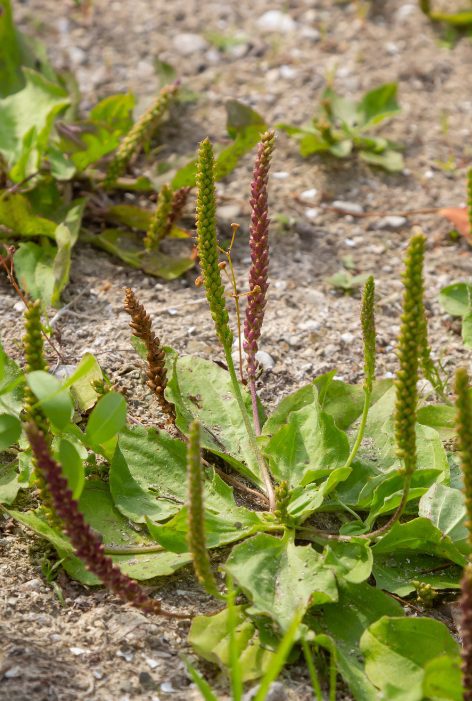
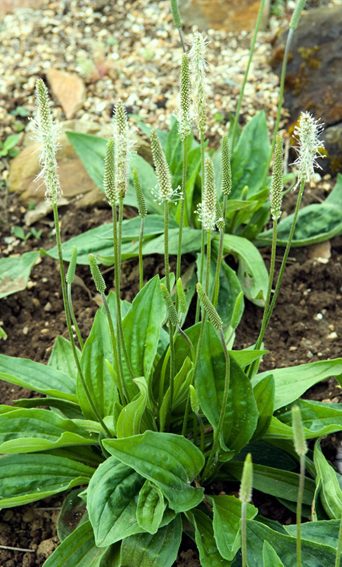
Broadleaf Plantain: Oval leaves spread in a low rosette beneath a long, slender flower spike.
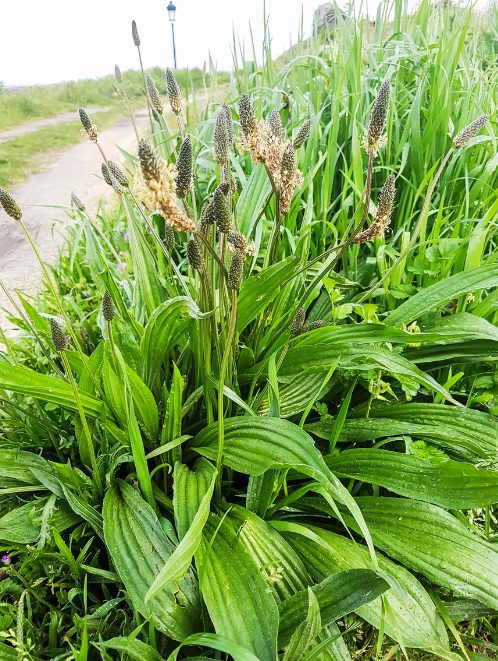
Ribwort Plantain: Narrow, strongly ribbed leaves surround stalks topped with short, dense flower heads.
Our view: Treat plantain as an interesting forage plant with a genuinely documented medicinal past. Those two identities—everyday leaf and historical remedy—sit together fine. Neither one needs to inflate the other.
Why Offer Plantain?
Foraging and Enrichment
Rabbits are natural foragers, and a big part of their day in the wild goes into searching out different plants—not eating the same green on repeat. A different leaf shape, texture and scent gives your rabbit something to actually work for among the usual rotation of greens. That’s what “enrichment” means in practice: not a vague wellness buzzword, but a rabbit spending a few extra minutes sniffing, nibbling and deciding whether this new leaf is worth the fuss. Fresh plantain also carries water, adding a little extra hydration alongside what your rabbit drinks.
Leafy Forage
Plantain leaves bring plant fibre to the table and earn a legitimate spot in the leafy portion of the diet. But “fibrous-looking” and “does the same job as hay” are different things. Hay supplies the continuous, coarse, long-strand fibre central to a rabbit’s digestion and tooth wear. Think of plantain as a supporting player in the diet, with hay in the lead role.
More Than a Common Weed
There’s more going on beneath plantain’s “common weed” reputation. Centuries of folk use pointed herbalists and, eventually, researchers toward the compounds in different Plantago species. Those compounds vary by species and by plant part. That’s why this article stays precise about which plantain and which part: get that right, and the herb’s chemistry, traditional use and research findings mean something.
Edible Anatomy & Feeding Notes
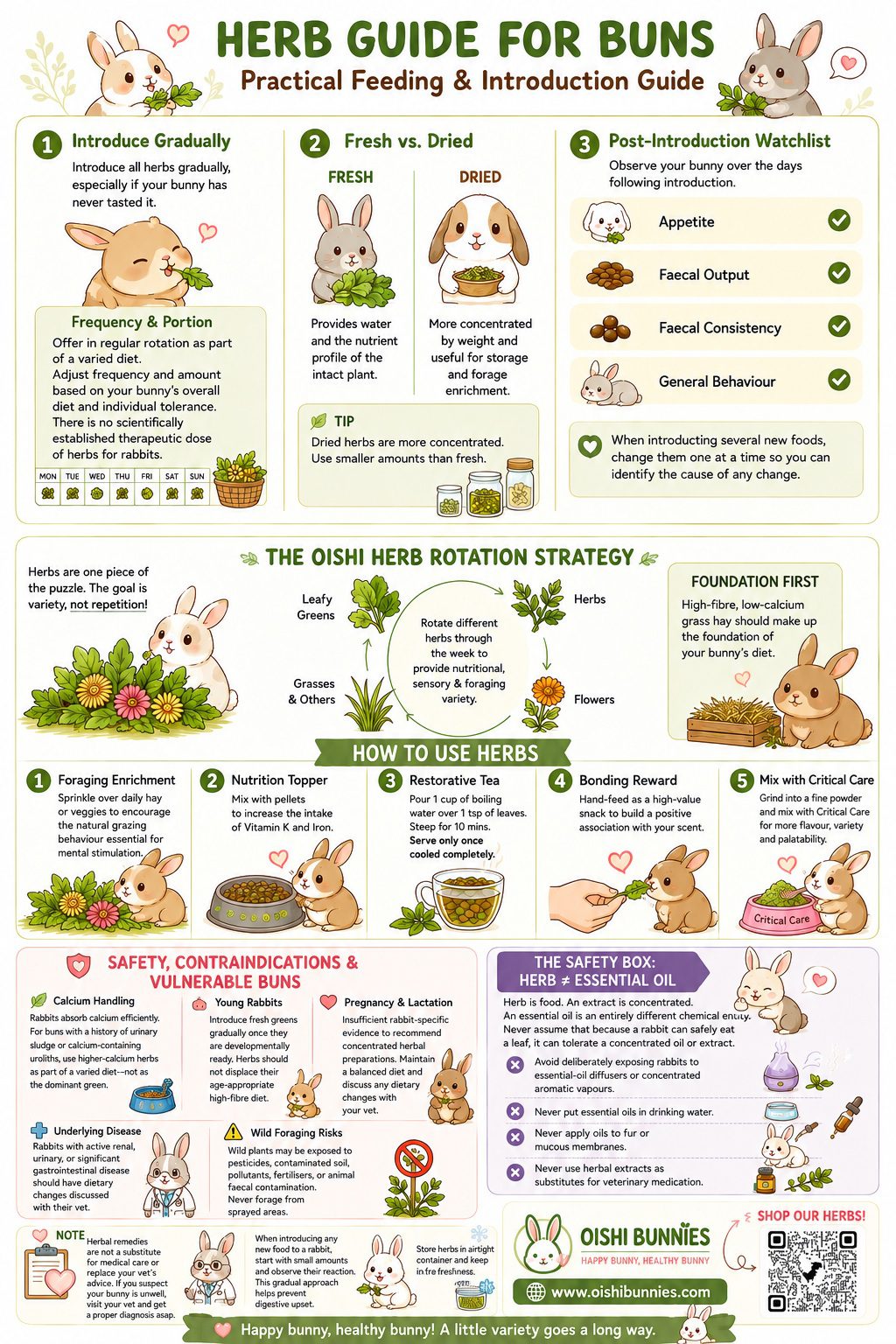
For general introduction guidance, herb rotation and vulnerable-bun cautions, see our Herb Guide for Buns. The notes below cover what’s specific to plantain.
| Plant Part | Rabbit Guidance |
|---|---|
| Leaves | The simple choice: offer fresh, sound leaves or leaves that have been fully dried and stored away from damp. Tender leaf stalks can stay attached. Skip anything mouldy or musty. |
| Flower stalks | A little young, clean flower spike can join a forage bundle. NParks lists immature P. major inflorescences as edible for people too. There’s no need to make mature seed heads a regular feature. |
| Roots and seeds | Leave the roots in the ground. Concentrated seed products—including anything sold as psyllium—are different ingredients and sit outside this leaf-feeding guide. |
A little foraging fun: Fresh leaves tucked into hay make a nice search-and-find. Dried leaves work as a topper when clean fresh forage isn’t around. Neither should displace hay.
Plantain-Specific Safety Notes
With plantain, the most important question is often where it grew. Broadleaf plantain is good at settling into compacted urban ground; a thriving roadside patch is still a poor place to collect rabbit food.
- Identify the whole plant. Check the rosette, lengthwise leaf ribs and flower head. Skip anything you cannot confidently identify.
- Choose the patch carefully. Avoid roadsides, treated lawns, dog-walking areas and spots exposed to animal waste. Rinsing removes surface dirt; it cannot make a questionable growing site safe.
- Inspect each harvest. Rinse fresh leaves and discard anything slimy or badly damaged. Store dried leaves away from damp and throw out anything mouldy or musty.
- Keep seed products separate. A tender flower spike in a forage bundle is different from concentrated seed or psyllium products. This guide focuses on the leaves.
- Watch the individual rabbit. Introduce plantain as you would another new green. A noticeable drop in appetite or droppings calls for prompt rabbit-savvy veterinary advice.
Meet the Plants
Broadleaf plantain hugs the ground, its oval leaves ribbed with several prominent veins running base to tip, with small flowers gathered along an upright spike. Singapore’s NParks records P. major as a naturalised perennial—gardens, urban sites, disturbed ground, the works. It tolerates compacted, moist soil, which is exactly why it shows up in the worst possible harvesting spots: roadsides, path edges, anywhere foot traffic keeps the ground packed down.
Ribwort plantain runs slimmer—narrow, strongly ribbed leaves and a compact flower head riding a mostly leafless stalk.
Look Beyond the Leaf Shape
Leaf shape alone won’t get you a confident ID on either species. Check the rosette, veins and flower head against a reliable local reference. When you’re not sure, let it keep growing where it is.
The Rabbit Welfare Association & Fund (RWAF) lists both broadleaf and ribwort among suitable wild greens for rabbits—a practical forage recommendation, not a guarantee every rabbit will vote yes on both. Bunnini would want to check the identification twice. Pee-Casso would already be three leaves in.
Botanical and forage references: NParks: Plantago major · RWAF: Recommended Vegetables and Herbs
Broadleaf vs. Ribwort: Does It Matter Which One You Feed?
Not much for everyday feeding—but the differences matter when identifying, growing and researching the plants. Sharing a common name does not make them interchangeable on paper.
Availability in Singapore
NParks documents broadleaf plantain as naturalised here, including in gardens and disturbed urban ground. We do not have the same local record to rely on for ribwort. That makes broadleaf the better-documented starting point for local identification—not proof that every plantain patch you find is broadleaf, or that ribwort cannot grow here.
Growing Your Own
Broadleaf comes with a documented Singapore growing profile: sun, moderate water and some shade tolerance. If you want to grow ribwort, start with correctly labelled seed and observe how your own patch responds to local heat, rain and drainage. Your plant will tell you more than a temperate-climate growing guide can.
Chemistry and Herbal History
Both contain iridoid glycosides and phenolic compounds, but their exact profiles vary by species, plant part and growing conditions. Their herbal histories also took different paths: broadleaf is prominent in folk skin and wound preparations, while ribwort leaf has a European throat-and-cough tradition. Naming the species keeps each finding attached to the plant actually studied.
For the Rabbit Eating It
Both appear on RWAF’s rabbit forage list and can bring a different texture to a varied selection of greens. Neither has an established nutritional advantage for pet rabbits. Choose the one you can confidently identify and obtain from a clean source, then see what your rabbit thinks.
The practical answer: This is an identification and access question, not a contest to find the “better” plantain. Feed the correctly identified, clean leaves your rabbit enjoys.
Nutritional Profile of Broadleaf Plantain and Ribwort Plantain
Plantain carries fibre and minerals, but neither species has one fixed nutritional profile. Leaf age, soil, growing conditions and whether figures are reported by fresh weight or dry matter all move the numbers. This is true of most leafy forage—and explains why a tidy nutrition-facts box would give a false sense of precision here.
One Patch, Different Leaves
A young leaf and a tougher older one need not have the same composition, even from the same patch. Mineral content also changes with growing conditions. The species name tells us which plant we’re discussing; it does not give every harvested leaf an identical nutrition label.
Fresh Weight vs. Dry Matter
A fresh leaf contains plenty of water, so nutrients appear more diluted per gram. Remove that water and a gram of dried leaf contains more plant solids. Two studies can report very different figures for the same species and both be correct if one measures fresh weight and the other dry matter.
What Ribwort Pasture Research Adds
Comparisons with grass show that ribwort’s calcium, magnesium, sodium and potassium levels can differ substantially. That’s useful context from livestock pasture research. It is not an analysis of Singapore-grown plantain destined for a rabbit’s bowl. Without an analysed sample and a fair comparison point, a blanket “low calcium” or “high calcium” label sounds more precise than it is.
Why Calcium Deserves Context
Rabbits absorb substantial dietary calcium and excrete much of the surplus through urine. That makes the calcium content of the whole diet relevant, particularly for a rabbit with diagnosed urinary disease. Water intake, activity and the rabbit’s clinical history matter too. A rabbit-savvy veterinarian can assess that complete picture more usefully than a label attached to one herb.
What This Means at Feeding Time
Offer plantain among a variety of suitable greens and let hay do the heavy lifting for fibre and dental wear. Neither broadleaf nor ribwort has an established advantage for rabbit tooth wear or hydration. Both offer fresh leafy forage; the better choice is the one you can identify, source cleanly and fit into your rabbit’s usual diet.
Can Rabbits Eat Plantain? Traditional Use & Modern Research
Plantain has several herbal histories, and the botanical names matter. Broadleaf, ribwort and the species named in Chinese medicinal-material references have their own traditions. Modern research adds another layer by examining particular plant parts, preparations and effects.
Broadleaf Plantain in Folk Herbalism
Plantago major leaves have centuries of documented use across many regions, particularly in preparations applied to wounds and skin complaints. Respiratory and digestive uses appear in the historical record too. How the leaf was prepared and applied is part of that history; a poultice and a forage leaf are different uses.
Anne Berit Samuelsen’s 2000 review of P. major brings that traditional history together with its chemistry and experimental research.
Ribwort in European Herbal Practice
Ribwort leaf has its own European tradition. The European Medicines Agency recognises specified P. lanceolata leaf preparations for traditional use with mouth or throat irritation and associated dry cough, cough with a cold, and minor skin inflammation.
That classification concerns defined human herbal preparations and a long history of use. It does not supply a treatment dose for a rabbit eating fresh ribwort in a forage bundle. Read the EMA plant profile.
The Chinese Plantago Tradition: Herb and Seed Have Different Names
车前草 refers to the dried whole herb, while 车前子 refers to the dried mature seed. The Chinese medicinal-material entries cited here name Plantago asiatica and P. depressa as sources. Traditional descriptions include clearing heat and promoting urination.
These are meaningful traditions with named source plants and plant parts. They cannot supply a feeding dose for broadleaf or ribwort leaves simply because all four plants share the genus Plantago.
What’s in Broadleaf and Ribwort Leaves?
Plantago species contain iridoid glycosides such as aucubin, along with phenolic compounds, flavonoids and polysaccharides. Their amounts and proportions vary with species, plant part, growing conditions and preparation.
A whole leaf, a seed and a concentrated extract tell different chemical stories.
What Have Plantain Studies Actually Tested?
Researchers have studied extracts, isolated compounds and topical preparations in laboratory and animal experiments. The work includes inflammation and wound-related questions; some experiments use isolated tissues or induced injury rather than ordinary feeding.
A study involving rabbits is worth examining, but the route matters. Applying a preparation to an experimental wound or testing isolated rabbit tissue cannot tell us whether eating fresh plantain leaf treats illness in a pet rabbit.
How This Applies to Rabbits
For everyday rabbit care, correctly identified broadleaf and ribwort leaves have a clear role as forage and enrichment. The Rabbit Welfare Association & Fund lists both among suitable greens. Their traditional histories and experimental research give us more to investigate, while keeping the species and preparation attached to each finding.
Research has not established a whole-leaf feeding dose or schedule for treating gut or urinary conditions in pet rabbits.
Herb Profile: Plantain for Rabbits
How to read this profile: Each assessment describes the available evidence for that particular question. A well-documented herbal history and a rabbit feeding study, for example, are different kinds of evidence.
| Evidence Layer | Assessment | What We Can Say |
|---|---|---|
| Botanical Identification | Strong | Both species have established botanical descriptions, and NParks documents P. major as naturalised in Singapore. Each wild specimen still needs a confident identification. |
| Traditional Herbal History | Well documented | Broadleaf and ribwort have documented uses in their respective traditions. Che Qian Cao and Che Qian Zi refer to other specified Plantago species and plant parts in Chinese materia medica. |
| Edibility / Food Use | Established forage guidance | RWAF includes broadleaf and ribwort plantain among suitable rabbit greens. NParks also records young P. major leaves and immature flower spikes as edible for people. |
| Phytochemical Evidence | Substantial | Constituents and laboratory activity have been studied extensively. Findings depend on the species, plant part and preparation tested. |
| Rabbit-Specific Evidence | Limited for feeding outcomes | Rabbit-welfare guidance supports leafy forage use. Rabbit experiments have also examined topical extracts and isolated intestinal tissue, but these do not establish a therapeutic effect from eating the leaves. |
What Has Actually Been Studied in Rabbits?
There is rabbit-specific research here, but the route of exposure is the key detail: researchers have studied extracts applied to wounds and plant preparations tested on isolated intestinal tissue. Those are interesting experiments. They are not feeding trials with fresh plantain leaves.
Topical Leaf Extracts and Wound Healing
Separate experimental studies applied 10% P. major or P. lanceolata leaf-extract preparations to surgically created wounds in rabbits. Researchers assessed wound contraction and tissue changes against control wounds.
This connects directly to plantain’s skin-use history. The studies examined topical preparations under experimental conditions; they did not test whether eating plantain helps a rabbit’s wound heal.
Isolated Intestinal Tissue
A gastrointestinal experiment tested a P. major leaf preparation on isolated rabbit duodenum, alongside tests in rats. It explored tissue responses in a laboratory setting. It did not follow live pet rabbits eating plantain or establish a feeding approach for digestive illness.
The Oishi Bunnies Read: Broadleaf plantain and ribwort plantain have a solid place in varied rabbit forage and distinct, well-documented herbal histories. Rabbit experiments add a fascinating chapter to the story, especially for topical preparations. For a rabbit eating fresh or dried leaves, the supported everyday role remains food, variety and foraging enrichment.
Growing Plantain for Rabbits in Singapore
The most inviting patch of plantain is rarely the cleanest one. NParks records Plantago major along roadsides and disturbed urban sites—exactly the places to avoid when collecting rabbit food. A home-grown pot gives you much better control over where those leaves have been.
Choosing a Foraging Site
- Identify first: Confirm the species using the rosette, veins and flower spike—not leaf shape alone.
- Know the site: Choose a known pesticide-free spot away from traffic, dog-walking routes, animal waste and drainage runoff.
- Get permission: If the plants are growing on someone else’s land, ask before collecting them.
Growing Broadleaf at Home
- Local track record: P. major is the species NParks documents as naturalised in Singapore. It grows best in full sun and moist soil but tolerates partial shade.
- Container: Use clean growing medium in a pot with drainage holes. Keep it from sitting in water during heavy rain.
- Source control: Keep pets and wildlife off the growing area, and avoid ornamental pesticides on plants destined for the rabbit bowl.
Harvest & Handling
- Choose sound leaves: Leave wilted, slimy or mouldy material where it is.
- Rinse: Wash fresh leaves with potable water to remove surface dirt.
- Know the limit: Rinsing cannot undo chemical treatment or heavy contamination. If the growing site is questionable, skip the harvest.
The Singapore gardener’s takeaway: Broadleaf has a documented local growing profile. If you want ribwort specifically, judge its performance from your actual seed source and growing conditions rather than assuming it will behave just like broadleaf. For either species, a clean, well-drained home-grown patch makes forage sourcing much easier to manage.
For the wider microbial and garden-biosecurity picture—including contaminated soil, animal faeces, watering practices, compost, equipment hygiene and rabbit-specific infection risks—see the Oishi Bunnies Safe Gardening & Biosecurity for Rabbits guide.
Local growing reference: NParks Flora & Fauna Web — Plantago major.
Bring Plantain to the Forage Basket
Shop with Oishi Bunnies
Explore a little leafy variety for your bunny’s forage basket.
Prefer Shopping on Shopee?
Make the next hay hunt more interesting with plantain leaves.
The Oishi Bunnies Bottom Line
After caring for rabbits through the easy days and the difficult ones, we have learnt that good care does not always look the same.
For a healthy rabbit, herbs can be part of the simple pleasures of everyday life—different scents to investigate, leaves to forage through, new flavours to taste and a little more botanical variety alongside a hay-based diet. Many of these same plants also carry long histories of traditional medicinal use, with fascinating chemistry that modern science continues to investigate.
We believe there is room to respect both traditional herbal knowledge and modern science without asking either to be something it is not. Traditional use does not automatically prove that a herb will treat disease, while limited scientific evidence does not necessarily mean that generations of observation have nothing useful to teach us. Sometimes research supports an old idea, sometimes it changes our understanding, and sometimes the answer simply remains uncertain.
That uncertainty becomes especially important when caring for a rabbit who is elderly, chronically ill or approaching the end of life. There may come a time when surgery is no longer suitable, treatment options have become limited, or the burden of further intervention may outweigh what it can realistically give the rabbit.
In those moments, care does not stop simply because cure is no longer possible.
The priorities may change towards comfort, pain relief, appetite, hydration, familiar foods, companionship, mobility, rest and the small things that tell us a rabbit is still finding pleasure in their day. Herbal and botanical support may sometimes have a place within a veterinary-guided comfort plan. At other times, a particular herb may offer little benefit or may be inappropriate because of the rabbit’s condition or medications. The individual rabbit matters more than the reputation of any herb.
For us, palliative care is not about trying everything simply because something might help. Nor is it about dismissing a supportive option simply because it comes from traditional herbal practice. It is about choosing thoughtfully, watching the rabbit in front of us, working alongside appropriate veterinary care, and continually asking whether what we are doing is adding comfort and quality to that rabbit’s life.
Sometimes medicine is about curing. Sometimes it is about managing a condition for years. And sometimes our responsibility is simply to make the days that remain comfortable, familiar, interesting and filled with as many good moments as possible.
Respect the tradition. Understand the plant. Follow the evidence. But above all, look at the rabbit in front of you—because their comfort, dignity and quality of life are what ultimately matter.
Plantain FAQ
Can rabbits eat broadleaf plantain and ribwort plantain?
Yes. Both are listed by the Rabbit Welfare Association & Fund as suitable forage. Introduce them gradually and collect only correctly identified plants from a known clean source.
Can a rabbit have plantain regularly?
As one of several familiar greens, sure. No plantain-specific daily quota or mandatory rotation schedule has been established for pet rabbits. Keep hay as the dietary foundation and offer plantain alongside a variety of other suitable greens.
Are flower spikes edible?
A small amount of clean, tender flower spike can join a forage bundle. Leaves remain the easiest part to identify, prepare and offer routinely.
Does plantain leaf work like psyllium husk?
No—these are different materials. Ispaghula husk, often sold as psyllium husk, is the processed seed coat of another species, usually Plantago ovata. Its gel-forming properties should not be carried over to a serving of broadleaf or ribwort leaves.
What about plantain tea, tinctures or essential oil?
This guide covers ordinary fresh or dried forage leaves. Teas, extracts, syrups, tinctures and concentrated products differ in composition and use. Speak with a rabbit-savvy veterinarian before considering any of them for a therapeutic purpose.
References & Further Reading
These sources support the plant identification, traditional-use history, forage guidance and research discussed in this profile. The rabbit experiments below used topical extracts or isolated tissue; the pasture studies examined livestock forage. Each answers a different question from feeding intact leaves to a companion rabbit.
Botanical Identification & Rabbit Forage
- Rabbit Welfare Association & Fund — Foraging for Rabbits. Identifies broadleaf and narrow-leaf plantain and gives practical collection guidance.
- RWAF — Recommended Vegetables and Herbs. Lists broadleaf and ribwort plantain among suitable rabbit greens.
- Singapore NParks — Plantago major. Local status, identification, edible plant parts and growing conditions.
- Royal Botanic Gardens, Kew — Plantago major L.. Accepted botanical name and distribution.
- Royal Botanic Gardens, Kew — Plantago lanceolata L.. Accepted botanical name and distribution.
Traditional Use & Plant Materials
- Samuelsen, A.B. (2000). The traditional uses, chemical constituents and biological activities of Plantago major L.: A review. Journal of Ethnopharmacology, 71(1–2), 1–21.
- European Medicines Agency — Plantago lanceolata leaf. Includes the revised European Union herbal monograph and assessment report for specified human herbal preparations.
- Hong Kong Baptist University — Che Qian Cao (车前草). Whole herb sourced from P. asiatica or P. depressa.
- Hong Kong Baptist University — Che Qian Zi (车前子). Mature seeds sourced from P. asiatica or P. depressa.
- European Medicines Agency — Ispaghula husk. Identifies this gel-forming material as the seed coat of P. ovata, distinct from broadleaf or ribwort leaves.
Nutrition & Rabbit Research
- Mineral Composition and Nutritive Value of Some Common Pasture Weeds. Compares the mineral composition of ribwort plantain and other pasture plants with ryegrass and clover; it is livestock pasture data.
- Mahmood, M.M., & Mahdi, A.K. (2022). Experimental study of P. major leaf extract on contaminated wound healing in rabbits. Iraqi Journal of Veterinary Sciences, 36(Supplement I), 31–39. Topical extract, rather than oral leaf feeding.
- Experimental study of P. lanceolata leaf extract on contaminated wound healing in rabbits. International Journal of Health Sciences, 6(S4), 12385–12397 (2022). Topical extract, rather than oral leaf feeding.
- Evaluation of Some Medicinal Plant Extracts for Antidiarrhoeal Activity (2005). Tested a P. major leaf preparation in rats and on isolated rabbit duodenum; it was not a feeding trial in live rabbits.
General Rabbit Diet & Veterinary Context
- RSPCA — Feeding Your Pet Rabbit a Healthy Diet. Hay, fresh food and dietary variety.
- MSD Veterinary Manual — Nutrition of Rabbits. Veterinary context for fibre, calcium and the whole diet.
How these sources are used: Botanical references establish identity; RWAF provides practical rabbit-forage guidance; traditional-use and phytochemical sources describe particular species and preparations. Pasture research and experimental rabbit studies add useful context without defining a medicinal serving of fresh plantain leaves.
Our Approach to Herbs and Disclaimer
We write the Herbal Atlas because we believe herbal knowledge is worth taking seriously — humans have found value in these plants for centuries, rabbits naturally interact with a remarkably diverse botanical diet, and modern research keeps giving us better ways to understand what these plants contain and what they may do. This rabbit herb guide pairs that respect for herbalism with a few practical ground rules.
- Educational use, not a prescription. This profile is for botanical learning and enrichment — it isn’t veterinary advice, a diagnosis, or a treatment protocol. Use it to make an informed feeding decision, not to replace a vet visit.
- Whole herb ≠ medicine. Edible herbs can carry genuinely active phytochemicals and interesting nutritional properties, but feeding a whole herb is a different act from administering a standardised medicinal preparation. Dietary herbs can complement a healthy rabbit’s diet; they don’t substitute for veterinary treatment of a sick one.
- Hay comes first. Unlimited grass hay and clean water are the foundation of a rabbit’s diet. Herbs are a complementary, rotational addition — flavour, variety and enrichment on top of that foundation, not a replacement for it.
- Every rabbit is different. Age, digestive health and medical history all vary. Introduce anything new gradually, in small amounts, and watch appetite, droppings and general behaviour over the next 24–48 hours.
- Concentrates and extracts are their own category. A dried herb and a standardised extract are chemically different exposures, and neither should be confused with essential oils. Never diffuse or administer concentrated aromatic oils to rabbits, orally or topically.
- Extra care for vulnerable rabbits. Kits, frail seniors, pregnant or nursing does, rabbits taking medication, and rabbits with significant chronic disease may tolerate dietary changes differently. Introduce new herbs more cautiously and check with a rabbit-experienced veterinarian when the rabbit’s condition or medication makes food choices clinically relevant.
- Sourcing matters as much as the herb itself. Identify plants correctly, source cleanly, and discard anything spoiled, mouldy or of uncertain origin. No herb is safe if it’s the wrong herb — or a bad batch.
- When in doubt, see a vet. If your rabbit is unwell, professional veterinary care always comes first — no dietary remedy is a substitute for prompt treatment.
Our evidence promise: This Atlas reflects our best current reading of the evidence, and we update it as better research comes along.