
 Pro-Tip: Viewing on a phone? Select desktop mode or rotate to landscape for the best reading experience!
 Estimated Read Time: 10 Mins
Oishi Bunnies Herbal Atlas
Flaxseed | Linseed
Linum usitatissimum L.
Bunnini has flaxseed filed neatly under “genuinely interesting seed.” Pee-Casso has it filed under “snack,” and has already cracked one open with his teeth to check. Both of them are a little bit right.
Flaxseed shows up constantly in “shiny coat” advice for pets, and rabbit owners understandably wonder if it deserves a spot in the bowl. It’s a genuinely interesting seed with real rabbit research behind it — but that research is about formulated production diets, not about a spoonful on top of pellets, and it’s more mixed than most “just sprinkle some on” advice lets on.
Written by Cookie Yiyi, rabbit rescuer and fosterer of 18 rabbits, guardian to four resident house rabbits, and avid gardener growing forage for her bunnies.
Educational Notice: This profile explores flaxseed’s traditional uses, nutritional chemistry, and rabbit research. Seeds, ground seed, extracts, and pressed flaxseed oil are different preparations; findings about one should not automatically be applied to another. Flaxseed is part of a wider diet and does not replace veterinary care when a rabbit is unwell.
When researching flaxseed for rabbits as part of our Rabbit Herb Guide, studies show it has been examined as an ingredient in commercial diets, mostly to enrich rabbit meat with omega-3 fatty acids. The results are interesting, though mixed. These trials used carefully formulated diets for growing rabbits, providing a starting point for understanding Linum usitatissimum rather than a tested serving size for a house rabbit’s treat bowl.
There’s also a part of this that’s personal to Oishi Bunnies. Over years of baking bunny cookies using quality linseed, pawrents have reported that their rabbits’ dry, flaky skin improved when mites were not the reported cause, and that coats looked shinier.
I value those reports. They tell us what pawrents noticed in their own rabbits, while leaving room for research to explore how much of the change, if any, came from the seed itself.
The Verdict on Flaxseed for Rabbits
Flaxseed can reasonably be offered to healthy adult rabbits in small, occasional amounts — but there’s no rabbit trial that has established a validated home serving size or frequency. Everything below about “how much” is informed judgement, not a dosed, tested recommendation, and it should be read that way.
What the research tells us: flaxseed for rabbits has been studied as an ingredient, mostly to enrich meat with omega-3. Findings are mixed rather than uniformly reassuring. Some trials included linseed at up to 10% of the diet with no significant difference in final weight or growth rate, though feed conversion sometimes improved.
A well-designed 2025 trial found that 5% extruded linseed significantly reduced average daily weight gain compared with the control diet. The researchers proposed residual mucilage and other anti-nutritional compounds slowing digestion as a possible explanation, but the trial wasn’t designed to isolate the mechanism. Treat that as a plausible theory, not a proven cause. A separate 2021 trial found reduced digestibility at 6% and 8% inclusion specifically.
None of those percentages describes anything close to a treat-sized amount of Linum usitatissimum. They do give us a good reason to keep flaxseed as an occasional rotation item rather than assuming more must be better.
Herb at a Glance
| Common names | Flaxseed, linseed; the plant is commonly called flax | |
| Scientific name | Linum usitatissimum L. | |
| Family | Linaceae | |
| Plant type | Annual flowering plant | |
| Native range | Türkiye to Iran, according to Kew; cultivated widely around the world | |
| Part used | Mature seed, whole or ground | |
| Seed profile | Oil-rich and energy-dense, with protein and both soluble and insoluble fibre | |
| Key compounds | Alpha-linolenic acid (ALA, an omega-3 fatty acid), seed-coat mucilage and lignans, particularly secoisolariciresinol diglucoside (SDG) | |
| Other seed constituents | Naturally occurring cyanogenic glycosides and phytic acid |
| Part or Form | Practical View | What’s Inside / What We Know |
|---|---|---|
| Seed coat | Part of the mature seed | Contains the mucilage that becomes gel-like in water. Flax lignans, including SDG, are concentrated in seed-coat layers rather than the oily interior of Linum usitatissimum. |
| Cotyledons and embryo | Part of the mature seed | The oil-rich interior supplies much of the seed’s fat and protein. Researchers studying flaxseed for rabbits have also detected particular cyanogenic glycosides in the endosperm and embryo. |
| Whole mature seed | Small, occasional amount | The intact coat protects the oils during storage. While evaluating linseed options, note that no direct rabbit study has established how much ALA or SDG pets absorb from whole seeds. |
| Ground mature seed | Measured ingredient in food or treats | Grinding breaks the coat and distributes the seed through a recipe. When utilizing Linum usitatissimum in balanced recipes, freshness and proper storage matter significantly. |
| Young flax sprouts | Studied as a separate food form | A trial included 20 g/day of sprouts in formulated feeding for weaned rabbits, assessing meat characteristics rather than establishing casual pet forage guidance. |
The distinction that matters: Whole seed, ground seed and young sprouts are different food forms. The whole-versus-ground question when feeding flaxseed for rabbits is about nutrient availability and storage safety.
Flaxseed-Specific Feeding Cautions for Rabbits
When reviewing our Rabbit Herb Guide, incorporating flaxseed for rabbits requires careful management. Linseed is a food with interesting chemistry, not a plant that needs treating like a tiny landmine. For pet rabbits, the practical questions are how much is offered, whether it’s whole or ground, and how fresh it is.
- Keep the amount in proportion: Flaxseed is roughly 40% fat, making it much more energy-dense than the forage at the centre of a rabbit’s diet. A little seed in an oishi bunny cookie or occasional treat is one thing; routinely adding spoonfuls to the food bowl is another.
- Choose whole or ground for a reason: Whole seed stores well because its coat protects the oil. Grinding breaks that coat and spreads the seed evenly through a recipe, but also exposes more oil to air. Neither form of Linum usitatissimum has been shown to give pet rabbits a better skin or coat result. If using ground flaxseed, grind a small amount when needed or store it sealed and cool; discard any that smells stale or bitter.
- Notice what the feeding trials actually found: Some rabbit diets containing flaxseed for rabbits performed well, while others at higher inclusion levels showed reduced growth or nutrient digestibility. Researchers have suggested mucilage and other seed constituents as possible contributors, without proving which one caused the difference. Those results favour a modest place for linseed in a varied diet.
- Remember the naturally occurring cyanogenic compounds: Linum usitatissimum contains them, and processing can change how readily they’re released. This matters when comparing preparations or considering large amounts. Rabbit studies have not established that an occasional small portion of whole seed or flax-containing baked treat causes cyanide poisoning.
Practical takeaway: Use a small amount, keep it fresh, and let hay remain the main event. Incorporating flaxseed for rabbits can add variety to a pet’s menu without needing to be either a miracle ingredient or a forbidden seed.
Meet the Plant: Flaxseed for Rabbits
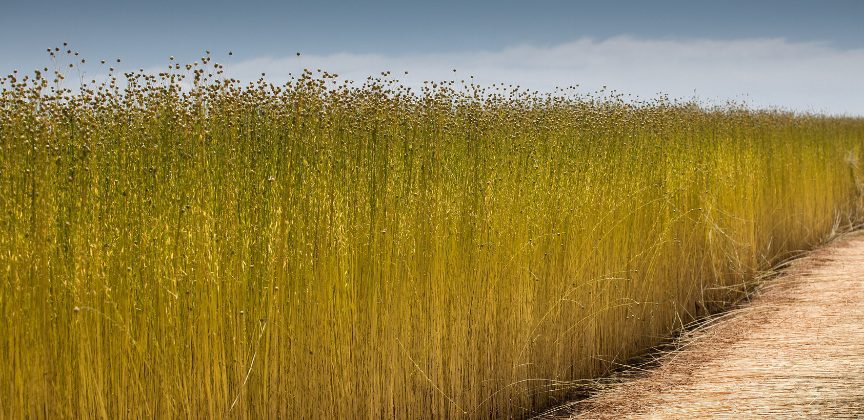
Linum usitatissimum is a slender annual herb, commonly growing around 30–120 cm tall. Its narrow leaves have a blue-green cast, and its delicate sky-blue flowers usually last just one day each. Within our Rabbit Herb Guide, exploring Linum usitatissimum helps us understand how linseed grows before offering it in moderation.
Flax is one of humanity’s oldest cultivated crops. Its long stems supplied fibre for linen, while its small, glossy seeds supplied food and oil. Kew lists the species as native from Türkiye to Iran and describes it as growing primarily in the temperate biome. Cultivation has since carried it far beyond that range.
Field identification checklist:
- Growth habit: An upright, slender annual grown for fibre, seed or both.
- Leaves: Narrow, simple and often blue-green.
- Flowers: Usually sky-blue, with five delicate petals; each flower is short-lived.
- Seed capsules: Small, rounded capsules form after flowering.
- Seeds: Smooth, flat, glossy and usually brown or golden.
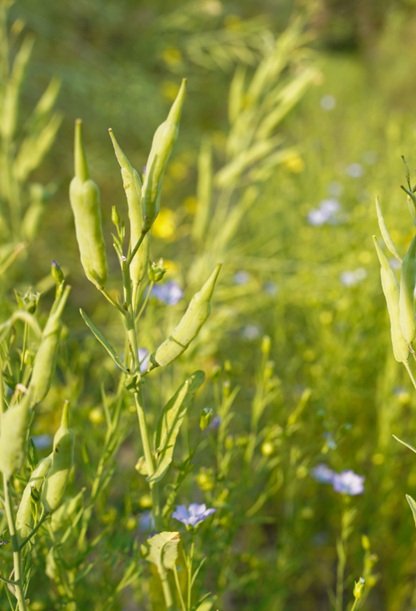
Linum usitatissimum — the flax plant and its oil-rich seeds
Golden vs Brown: Colour Doesn’t Tell the Whole Story
Golden and brown flaxseeds are colour forms of the same species, but colour alone won’t tell you the oil’s fatty-acid profile. Traditional flax oil commonly contains around 50% ALA. Some yellow-seeded Solin-type cultivars, also known as Linola, were bred for low-ALA oil; studied Linola lines contained around 2% ALA. Other yellow cultivars remain high in ALA. If that nutrient is the reason you’re choosing flaxseed for rabbits, check the variety or supplier information rather than judging by the seed coat.
Botanical identification reference: Royal Botanic Gardens, Kew — Plants of the World Online.
Flaxseed vs Black Sesame — A Naming Mix-Up Worth Knowing
This comparison comes from Chinese materia medica history, not modern marketing. Flaxseed (亚麻子, yà má zǐ) and black sesame (黑芝麻, hēi zhī má) are separate medicinal materials, but their historical names can look remarkably alike.
A Hong Kong government identification guide notes that black sesame appeared as 胡麻 in the Shennong Bencao Jing, while flaxseed appeared as 胡麻子 in the Song-dynasty Bo Ji Fang. The guide compares them precisely because those similar names can cause confusion. Both materials appear separately in the Chinese Pharmacopoeia edition cited by the guide. Everything below describes traditional human use and botanical identification, not a treatment claim for rabbits.
| Feature | Flaxseed | Black Sesame |
|---|---|---|
| Scientific name | Linum usitatissimum | Sesamum indicum |
| Plant family | Linaceae | Pedaliaceae |
| Historical name | Recorded as 胡麻子 in the Bo Ji Fang | Recorded as 胡麻 in the Shennong Bencao Jing |
| Shared traditional action | Moistens the intestines | Moistens the intestines |
| Other traditional actions | Nourishes blood and dispels wind | Tonifies liver and kidney and benefits essence and blood |
| Visible seed clue | Brown to reddish-brown and glossy; one end is pointed and slightly slanted | Black, smooth or finely wrinkled; one end is pointed |
| Hilum (seed scar) | Pale brown, elongated and located along a side edge | Brown to dark brown, roughly round and located at the pointed tip |
For this Atlas, the lesson is simple: 胡麻 in an older text needs context. Flaxseed and black sesame are botanically unrelated, even where their historical names and traditional human uses overlap.
When reading an old herbal claim, identify the plant before carrying the claim forward.
Identification reference: Hong Kong Government Chinese Medicines Testing Institute — Flaxseed and Black Sesame.
Nutritional Profile — Flaxseed for Rabbits
Flaxseed packs a surprising amount into a small seed. The figures below describe 100 g of whole flaxseed as a standard nutrition reference, not a suggested serving for a rabbit.
27.3 g
Includes the soluble mucilage associated with the seed coat.
About 22.8 g
A reference value for conventional flaxseed; cultivar matters.
42.2 g
Nutrient-dense, with a very different profile from hay.
| Nutrient per 100 g whole seed | Approximate amount |
|---|---|
| Energy | 534 kcal |
| Protein | 18.3 g |
| Fat | 42.2 g |
| Total carbohydrate, including fibre | 28.9 g |
| Dietary fibre | 27.3 g |
| Calcium | 255 mg |
| Phosphorus | 642 mg |
| Magnesium | 392 mg |
| Alpha-linolenic acid (ALA, omega-3) | About 22.8 g in this reference profile |
A small table-reading detail: The 27.3 g of dietary fibre is already included within the 28.9 g of total carbohydrate; the two figures shouldn’t be added together. ALA also varies by cultivar, especially in low-ALA Solin varieties, so this table isn’t a promise about every golden or brown seed.
What does this mean for rabbits? Fibre and ALA are the headline nutrients, but flaxseed is also an oil-rich food with more phosphorus than calcium. Its place is as a small, occasional extra alongside a hay-based diet; the balance of the whole diet matters more than the ratio in a few seeds.
Composition reference: USDA FoodData Central, “Seeds, flaxseed” (FDC ID 169414). Values are rounded; individual seed lots vary.
Traditional Use & Modern Scientific Understanding of Flaxseed for Rabbits
Traditional herbalism and modern research ask different questions when exploring our Rabbit Herb Guide, and both are worth taking seriously on their own terms. TCM history tells us how linseed has been used and understood for centuries; modern trials tell us what happens under controlled, measurable conditions. Read together within our overview of Linum usitatissimum, they give a fuller picture of this small but rather busy seed.
Traditional / TCM Use
In Traditional Chinese Medicine, flaxseed is 亚麻子 (yà má zǐ), known in pharmaceutical Latin as Lini Semen. It appears in the Chinese Pharmacopoeia as the dried mature seed of Linum usitatissimum. The traditional description is sweet and neutral, entering the Lung, Liver and Large Intestine meridians. Its stated functions are 润燥通便,养血祛风 — moistening dryness to promote bowel movement, nourishing blood and dispelling wind.
The pharmacopoeia also lists traditional human uses involving dry constipation, dry or itchy skin, and hair loss. That’s documented herbal history, and the skin connection is particularly interesting alongside the coat observations we’ve heard from pawrents. It remains a description of human traditional use, rather than evidence that flaxseed for rabbits treats those conditions in pets.
What Has Actually Been Studied in Rabbits?
Linseed has real rabbit research behind it, mostly from studies of formulated diets intended to change the fatty-acid profile of rabbit meat. The growth and digestion results aren’t all alike:
- Up to 10% flaxseed: One feeding trial found no statistically significant difference in final body weight or average daily gain across its diet groups, while feed conversion improved at the highest inclusion level.
- 5% extruded linseed (2025): Another trial found significantly lower average daily gain in the 5% group, although body-weight trajectory and feed intake were not significantly different. The authors discussed mucilage and other seed constituents as possible contributors; their experiment did not establish the cause.
- 4%, 6% and 8% flaxseed (2021): A separate study reported changes in nutrient digestibility, with poorer results at the higher inclusion levels for some measures. These findings concern complete research diets, so they cannot be converted into a tested serving size for loose seeds or a baked treat.
Lignans: A Different Kind of Rabbit Study
Researchers have also given laboratory rabbits isolated secoisolariciresinol diglucoside (SDG), a flaxseed lignan, in experimental cardiovascular studies. At oral doses of 15 or 20 mg/kg body weight daily, studies using Linum usitatissimum extracts reported reductions in blood lipids or atherosclerotic changes under their respective conditions.
These studies did not report an obvious toxicity signal at the tested doses, but they were designed to investigate cardiovascular outcomes, not to establish the safety of whole-seed treats. An isolated compound given to a laboratory rabbit on a cholesterol-enriched diet is a very different exposure from flaxseed for rabbits baked into an oishi bunny cookie.
What Human Research Adds
Human trials and evidence reviews have found modest improvements in cholesterol and blood pressure with some flaxseed preparations and study conditions. Flaxseed lignans are also studied for their hormone-related activity. This helps explain the seed’s wider reputation, while leaving the practical question of coat, skin and digestive outcomes in pet rabbits open for rabbit-specific research.
Putting the layers together: TCM records a longstanding interest in flaxseed for dryness and bowel movement. Modern research confirms its distinctive fibre, oil and lignan chemistry, and rabbit experiments show measurable effects from both formulated linseed diets and isolated SDG. What we still need are studies asking the companion-rabbit question directly: whether small amounts in ordinary foods make a meaningful difference to skin, coat or comfort.
Herb Profile
Rating principle: These assessments describe the quality, depth and relevance of the evidence in each category — not whether flaxseed is “good” or “bad” for rabbits.
| Evidence Category | Assessment | What We Can Say |
|---|---|---|
| Botanical Identification | Strong | Linum usitatissimum is a well-characterised species. Brown and golden seeds can come from different cultivars of the same plant; seed colour alone does not establish their fatty-acid profile. |
| Traditional Herbal History | Well documented | Flaxseed appears as 亚麻子 (yà má zǐ) in the Chinese Pharmacopoeia, with traditional uses relating to dryness and bowel movement. Historical use of the name 胡麻 (hú má) also created documented confusion with black sesame. |
| Edibility / Food Use | Documented, with context | Flaxseed has an extensive human food history and has been incorporated into complete rabbit research diets. It is an oil-rich seed, and those formulated diets do not establish a serving size for loose seeds or home treats. |
| Phytochemical Evidence | Substantial | Its ALA-rich oil, soluble mucilage, fibre and lignans — particularly SDG — are well characterised. Composition is well established; a specific coat or skin benefit from a small treat is a separate question. |
| Rabbit-Specific Evidence | Meaningful, but mixed | Several growing-rabbit studies have tested flaxseed or extruded linseed in complete diets, with differing effects on growth and digestibility. Isolated SDG has also been studied in rabbit cardiovascular models. Direct trials of loose flaxseed treats, coat improvement or a validated home serving size have not been identified. |
Why the Rabbit Research Matters
Flaxseed is more than an interesting nutrient label: rabbits have actually eaten it in controlled feeding studies. Some diets containing flaxseed showed no significant reduction in growth, while others found lower average daily gain or poorer nutrient digestibility under particular study conditions. The results deserve to sit together; choosing only the most flattering trial would give the seed a rather selective biography.
The research establishes that flaxseed can affect rabbit nutrition. It has yet to tell us whether an occasional portion in a companion rabbit’s food improves dry skin, coat shine or digestive comfort — or what home portion would reliably produce those effects.
Growing Flaxseed For Rabbits in Singapore
Kew describes flax as a plant grown primarily in temperate regions. Singapore offers year-round heat, humidity and frequent rain instead. You might coax a plant to grow, but reliable home seed production would be a much harder project. Flax has enough trouble with high temperatures during flowering without asking it to navigate an entire Singapore summer — which is to say, every month.
If You Want to Try Growing It
- Light: Choose a bright spot with direct sun and good airflow.
- Container: Use a pot with drainage holes and a loose, well-draining growing mix.
- Rain: Protect young plants from prolonged waterlogging and heavy downpours.
- Expectations: Treat it as a botanical growing experiment. Flowering and a useful seed harvest are less predictable here than in a temperate growing season.
The Practical Route: Buy the Seed
- Choose: Plain, whole, food-grade flaxseed from a grocery or health-food supplier.
- Golden or brown: Either can work as an ingredient. Freshness and a reliable source matter more than colour.
- Check the label: Seed colour alone does not tell you its ALA content; low-ALA cultivars can also have light-coloured seeds.
Keep It Fresh
- Store whole: Keep the seed airtight, away from heat and light. The fridge or freezer is practical in Singapore’s climate.
- Grind as needed: Grinding exposes more of the seed’s oil to air. If your recipe uses ground flaxseed, mill a small amount close to use.
- Pre-ground meal: It can be convenient, but pay closer attention to packaging, storage and freshness. Discard any that smells or tastes rancid.
The Singapore gardener’s takeaway: Grow flax if you enjoy the plant; buy whole seed if you need a dependable food ingredient. If you experiment with sprouts or other home-grown parts, keep garden hygiene in mind and remember that the seed-feeding discussion in this article does not automatically apply to them. Our Safe Gardening & Biosecurity for Rabbits guide covers the wider growing environment.
The Oishi Bunnies Bottom Line
After caring for rabbits through the easy days and the difficult ones, we have learnt that good care does not always look the same.
For a healthy rabbit, herbs can be part of the simple pleasures of everyday life — different scents to investigate, leaves to forage through, new flavours to taste and a little more botanical variety alongside a hay-based diet. Many of these same plants also carry long histories of traditional medicinal use, with fascinating chemistry that modern science continues to investigate.
We believe there is room to respect both traditional herbal knowledge and modern science without asking either to be something it is not. Traditional use does not automatically prove that a herb will treat disease, while limited scientific evidence does not necessarily mean that generations of observation have nothing useful to teach us. Sometimes research supports an old idea, sometimes it changes our understanding, and sometimes the answer simply remains uncertain.
That uncertainty becomes especially important when caring for a rabbit who is elderly, chronically ill or approaching the end of life. There may come a time when surgery is no longer suitable, treatment options have become limited, or the burden of further intervention may outweigh what it can realistically give the rabbit.
In those moments, care does not stop simply because cure is no longer possible.
The priorities may change towards comfort, pain relief, appetite, hydration, familiar foods, companionship, mobility, rest and the small things that tell us a rabbit is still finding pleasure in their day. Herbal and botanical support may sometimes have a place within that bigger picture. At other times, a particular herb may offer little benefit or may be inappropriate because of the rabbit’s condition or medications. The individual rabbit matters more than the reputation of any herb.
For us, palliative care is not about trying everything simply because something might help. Nor is it about dismissing a supportive option simply because it comes from traditional herbal practice. It is about choosing thoughtfully, watching the rabbit in front of us, working with veterinary care where it is needed, and continually asking whether what we are doing is adding comfort and quality to that rabbit’s life.
Sometimes medicine is about curing. Sometimes it is about managing a condition for years. And sometimes our responsibility is simply to make the days that remain comfortable, familiar, interesting and filled with as many good moments as possible.
Respect the tradition. Understand the plant. Follow the evidence. But above all, look at the rabbit in front of you — because their comfort, dignity and quality of life are what ultimately matter.
Explore Flaxseed with Oishi Bunnies
Curious to see flaxseed in action? Bunnini has the ingredient notes neatly filed. Pee-Casso is more interested in finding the cookies. Explore our freshly ground flaxseed or browse the oat-based cookie range for a little variety in your bun’s treat rotation.
Organic Ground Flaxseed
We store the whole seeds in the freezer and grind each order before it goes out. Use a measured amount as an occasional ingredient or topper, then keep the ground seed airtight and chilled at home.
Oat-Based Cookie Blindbox
Fancy a hand-baked reward instead? Browse our oat-based cookie selection (Skin & Coat) and check the current ingredients for flaxseed-containing options. Coat shine is a lovely observation from pawrents, though no cookie can promise to treat a skin condition.
Our forage philosophy: Variety keeps life interesting for curious rabbits. Rotate suitable botanicals and occasional treats while keeping the foundation solid: unlimited fresh grass hay and clean water.
References & Further Reading
These sources cover flaxseed’s botanical identity, traditional use, composition, processing and rabbit research. Whole seed, extruded linseed, sprouts, oil and isolated SDG answer different questions, so the preparation matters when reading a result.
Rabbit-Specific Research
- Daboussi et al. (2025) — Extruded linseed at 2.5% and 5%: Growth Performance, Carcass Traits and Meat Quality in Rabbits Fed with Two Different Percentages of Extruded Linseed. Foods, 14(10), 1778.
- Ibrahim et al. (2021) — Flaxseed at 4%, 6% and 8%: The Effects of Dietary Inclusion of Different Levels of Flaxseed on the Digestibility, Growth Performance, Blood Parameters and Fatty Acid Profile in Growing New Zealand White Rabbits. Egyptian Journal of Nutrition and Feeds, 24(1), 95–105.
- Omer et al. (2013) — Feeding trial up to 10% flaxseed: Utilization of Flaxseeds in Rabbit Rations. 1. Response of Growing Rabbits to Diets Containing Different Levels of Flaxseeds. Life Science Journal, 10(4), 2638–2646.
- Dal Bosco et al. (2015) — Flax sprouts: The Effect of Dietary Alfalfa and Flax Sprouts on Rabbit Meat Antioxidant Content, Lipid Oxidation and Fatty Acid Composition. Meat Science, 106, 31–37.
- Rabbit breeding does — Extruded flaxseed in formulated diets: Dietary Fish Oil and Flaxseed for Rabbit Does: Fatty Acids Distribution and Δ6-Desaturase Enzyme Expression of Different Tissues.
- Roman et al. (2022) — Coat-related research: The Effect of the Season, the Maintenance System and the Addition of Polyunsaturated Fatty Acids on Selected Biological and Physicochemical Features of Rabbit Fur. Animals, 12(8), 971. Investigated linseed-oil ethyl esters, rather than whole seed or baked treats.
- Prasad (1999) — Isolated SDG: Reduction of Serum Cholesterol and Hypercholesterolemic Atherosclerosis in Rabbits by Secoisolariciresinol Diglucoside Isolated From Flaxseed. Circulation, 99(10), 1355–1362.
- Prasad (2008) — Isolated SDG: Regression of Hypercholesterolemic Atherosclerosis in Rabbits by Secoisolariciresinol Diglucoside Isolated From Flaxseed. Atherosclerosis.
Botany, Nutrition & Seed Chemistry
- Royal Botanic Gardens, Kew: Linum usitatissimum L. — Plants of the World Online. Accepted name, range and growing biome.
- USDA FoodData Central: Seeds, flaxseed (FDC ID 169414). Reference composition per 100 g whole seed.
- Canadian Food Inspection Agency: The Biology of Linum usitatissimum L. (Flax). Crop biology, feed uses and a USDA-derived nutrient table.
- Cell-layer study of flaxseed lignans: Laser Microdissection and Spatiotemporal Gene Expression Assign the Cell Layer-Specific Accumulation of SDG in Flaxseed Coats.
- University of Saskatchewan — Solin cultivars: The Effect of Seed Colour and Linolenic Acid Concentration on Flaxseed Characteristics. Explains the yellow-seeded, low-ALA Solin distinction.
Traditional Chinese Materia Medica
- Hong Kong Government Chinese Medicines Testing Institute: 亞麻子與黑芝麻 — identification and traditional naming comparison. Distinguishes the plants and documents their pharmacopoeial entries.
- Chinese Pharmacopoeia entry: 亚麻子 — 2025 edition transcription. Botanical source, identification, 性味归经 and traditional functions; consult the official printed edition for authoritative wording.
- Historical naming scholarship: “Huma Should Be Linum usitatissimum, Not Sesamum indicum”. Journal of Systematics and Evolution (2007). A scholarly interpretation of the disputed historical name, rather than a modern rule making the two seeds interchangeable.
Processing, Safety & Rabbit Diet Context
- Chen et al. (1994) — Baking and ALA: Oxidative Stability of Flaxseed Lipids During Baking. Journal of the American Oil Chemists’ Society.
- EFSA (2019) — Cyanogenic glycosides: Evaluation of the Health Risks Related to the Presence of Cyanogenic Glycosides in Foods Other Than Raw Apricot Kernels. EFSA Journal. A human food-risk assessment, not a rabbit dosing guide.
- Merck Veterinary Manual: Diet for Rabbits. General companion-rabbit diet context.
How these sources are used: Botanical and food-composition records establish what the plant and seed contain. Traditional sources document human herbal use and naming. Rabbit feeding studies show what happened with particular preparations in complete diets; isolated-SDG experiments ask a different pharmacological question. None of those study percentages translates directly into a tested serving size for a pet rabbit’s treat.
Our Approach to Herbs and Disclaimer
We write the Herbal Atlas because we believe herbal knowledge is worth taking seriously — humans have found value in these plants for centuries, rabbits naturally interact with a remarkably diverse botanical diet, and modern research keeps giving us better ways to understand what these plants contain and what they may do. This section pairs that respect for herbalism with a few practical ground rules.
- Educational use, not a prescription. This profile is for botanical learning and enrichment — it isn’t veterinary advice, a diagnosis, or a treatment protocol. Use it to make an informed feeding decision, not to replace a vet visit.
- Whole herb ≠ medicine. Edible herbs can carry genuinely active phytochemicals and interesting nutritional properties, but feeding a whole herb is a different act from administering a standardised medicinal preparation. Dietary herbs can complement a healthy rabbit’s diet; they don’t substitute for veterinary treatment of a sick one.
- Hay comes first. Unlimited grass hay and clean water are the foundation of a rabbit’s diet. Herbs are a complementary, rotational addition — flavour, variety and enrichment on top of that foundation, not a replacement for it.
- Every rabbit is different. Age, digestive health and medical history all vary. Introduce anything new gradually, in small amounts, and watch appetite, droppings and general behaviour over the next 24–48 hours.
- Concentrates and extracts are their own category. A dried herb and a standardised extract are chemically different exposures, and neither should be confused with essential oils. Never diffuse or administer concentrated aromatic oils to rabbits, orally or topically.
- Extra care for vulnerable rabbits. Kits, frail seniors, pregnant or nursing does, rabbits taking medication, and rabbits with significant chronic disease may tolerate dietary changes differently. Introduce new herbs more cautiously and check with a rabbit-experienced veterinarian when the rabbit’s condition or medication makes food choices clinically relevant.
- Sourcing matters as much as the herb itself. Identify plants correctly, source cleanly, and discard anything spoiled, mouldy or of uncertain origin. No herb is safe if it’s the wrong herb — or a bad batch.
- When in doubt, see a vet. If your rabbit is unwell, professional veterinary care always comes first — no dietary remedy is a substitute for prompt treatment.
Our evidence promise: This Atlas reflects our best current reading of the evidence, and we update it as better research comes along.
Ding Dong