 Pro-Tip: Viewing on a phone? Select desktop mode or rotate to landscape for the best reading experience!
 Estimated Read Time: 8 Mins
Grooming welfare standards: minimum standards and best practices
Singapore’s grooming welfare standards, set out in the pet groomers’ annex, include both minimum standards and best-practice recommendations. We identify the distinction where relevant.
In this guide, “AVS pet grooming guidelines” refers to the pet groomers’ annex. Our rabbit-specific interpretations are practical applications, not additional rules issued by NParks or a claim of NParks endorsement. This article discusses selected points rather than every requirement in the Code.
01 · RABBIT-SPECIFIC GROOMING
Rabbit grooming welfare standards: the service should suit the species

What NParks recommends
C2 best practices cover maintenance advice, bathing precautions and preparing equipment within reach. Minimum standards separately protect whiskers and restrict full wet baths for small mammals.
What this means for rabbits
Bathing guidance should not be read as a recommendation to bathe every species. Rabbits do not need routine baths, and persistent soiling may require veterinary assessment rather than repeated washing.
Applying grooming welfare standards to rabbits means considering coat type, moulting, mobility and tolerance. Tangles should not be pulled through delicate skin simply to achieve a smooth finish.
What Oishi Bunnies does
We do not bathe or blow-dry rabbits. Neither forms part of our grooming service. If your bunny has persistent soiling or needs cleaning related to a health condition, please seek guidance from a rabbit-savvy veterinarian.
We do not cut or trim whiskers, including during face shaping. A tidy outline should leave those sensory hairs intact.
Paw fur is protection, not something to shave away
Rabbits do not have the bare, cushioned paw pads seen in dogs and cats. The fur covering the undersides of their feet plays an important protective role.
We do not shave the weight-bearing undersides of rabbits’ paws for cosmetic purposes or to remove staining. Removing protective fur can leave the skin more vulnerable to pressure and friction, contributing to the risk of sore hocks, or pododermatitis. Flooring, nail length, body weight and underlying health also affect that risk.
Careful shaping around the outer foot is different from removing the cushioning fur underneath. Where trimming is appropriate, that protective covering must be preserved.
Stains may be unsightly, but a whiter-looking foot is not worth sacrificing its protection. Persistent wetness, thinning fur, redness, sores or discomfort deserve attention and veterinary assessment—not simply a closer shave.
02 · HANDLING AND COMFORT
Rabbit grooming welfare: comfort before a perfect finish
What NParks recommends
Within the grooming welfare standards, C3 addresses individual assessment and appropriate handling. Best practices include preliminary checks and veterinary preparedness.
What this means for rabbits
Grooming welfare standards need to work for the individual rabbit. A grooming package describes planned services. It cannot tell us how an individual rabbit will cope on the day.
An older bunny may need different positioning. A nervous rabbit may need shorter periods of work. A familiar customer may arrive with a new sensitivity that changes what is appropriate.
What Oishi Bunnies does
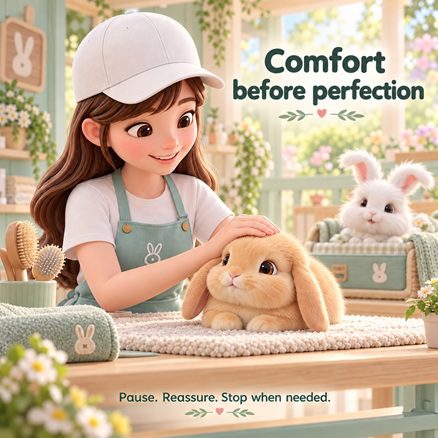
As experienced bunny owners, we pay close attention to each rabbit’s behaviour and watch for signs of fear, stress and discomfort throughout grooming.
We use gentle handling, offer reassurance and take breaks when needed, adapting our approach to the bunny in front of us.
If your bunny becomes very uncomfortable, we will stop grooming rather than push through for a perfect finish. We’ll explain what was completed, what was left unfinished and discuss the next step with you.
A few uneven tufts can wait. Your bunny’s wellbeing comes first.
03 · SECURE FOOTING AND HYGIENE
Grooming welfare standards: secure footing and supported handling
What NParks recommends
The AVS pet grooming guidelines recommend stable, adjustable, non-slip grooming tables under C5. Disinfection between animals is a minimum standard.
What this means for rabbits
Rabbits are ground-dwelling prey animals, and many find being lifted or carried unsettling. A stable surface provides grip and supports their body weight, reducing unnecessary carrying during suitable tasks.
For rabbit grooming welfare, table height is only one consideration. A low table reduces the height of a possible fall, but it does not remove the risk. Appropriate handling and supervision remain essential.
What Oishi Bunnies does
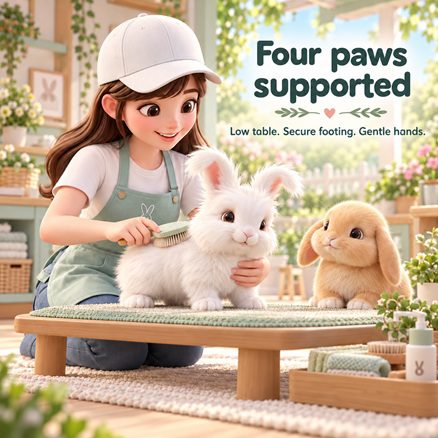
We groom rabbits on a low table fitted with a non-slip mat and a rug for them to sit on.
Whenever the procedure allows, we prefer all four paws to remain supported on the table, rather than keeping the bunny cradled throughout the appointment. We assess each bunny’s response instead of assuming that a rabbit resting quietly in someone’s arms must be comfortable.
Some procedures require brief lifting or repositioning. When needed, we support the chest and hindquarters, keep handling controlled and return the bunny to a stable position as soon as practical.
Four paws on the table does not mean unrestricted movement near an edge. We remain close, provide appropriate support and adapt positioning to the rabbit’s mobility, health and tolerance.
We do not trance rabbits
We do not deliberately place rabbits on their backs to induce “trancing” for grooming. This motionless state, known as tonic immobility, is a fear response—not evidence that a rabbit is relaxed or enjoying the experience.
Brief, supported repositioning for a necessary task should not become prolonged immobilisation for convenience. Our aim is secure, comfortable handling—not making a rabbit remain still at any cost.
Grooming welfare standards include a clean workspace
All our grooming tools, equipment and the tabletop are cleaned and sanitised before every grooming session. We prepare the workspace before beginning, so suitable footing and the necessary equipment are ready.
04 · WAITING AND ACCOMMODATION
Grooming welfare standards for waiting and accommodation
What NParks recommends
C4 covers suitable accommodation, drinking water and supervision. Group holding requires constant physical supervision; best practices also emphasise calm surroundings.
What this means for rabbits
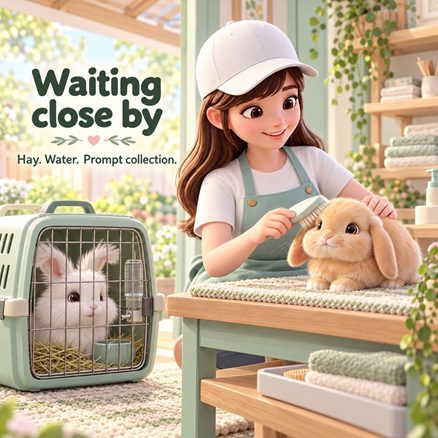
Grooming welfare standards extend to waiting arrangements. A familiar carrier can provide reassurance, but a carrier suitable for transport is not automatically suitable for an extended wait.
Consider space, clean bedding, ventilation, temperature, hay and accessible drinking water. Bonded companions need advance planning; unfamiliar rabbits should not be introduced during an appointment.
How Oishi Bunnies arranges waiting
Cookie Yiyi works alone. Bunnies awaiting grooming or collection stay in a designated area close to the grooming station, rather than in a separate room.
This allows her to check on waiting bunnies between grooming tasks while keeping her attention on the rabbit being handled. Being nearby does not mean uninterrupted observation while she carries out a procedure.
Please tell us beforehand about bonded companions, closer-monitoring needs or possible collection delays. We discuss suitable arrangements in advance, including the supervision needed for shared holding.
If a bunny needs closer observation than can be provided while another is being groomed, we will discuss a different appointment arrangement.
Same-day collection only
Oishi Bunnies is not an AVS-licensed boarding facility, and we do not offer overnight accommodation for grooming customers.
Please arrange to return and collect your bunny promptly once grooming is completed. If you anticipate a delay, contact Cookie Yiyi as early as possible.
Our rescue and fostering work is separate from grooming and does not provide an overnight-stay option for grooming appointments.
What to bring
Bring your bunny in a secure, well-ventilated carrier with clean, non-slip bedding, together with:
- Their usual hay, with enough for the journey and waiting time.
- Drinking water and a familiar water bowl, so water can be made accessible while they wait.
- Relevant veterinary instructions and information about individual needs.
Tell us beforehand if you cannot bring these supplies, so the necessary arrangements can be discussed before the visit.
05 · THE GROOMING ENVIRONMENT
Rabbit grooming welfare begins with the environment
What NParks recommends
The accommodation guidance includes reducing disturbance and avoiding unsuitable environmental conditions.
What this means for rabbits
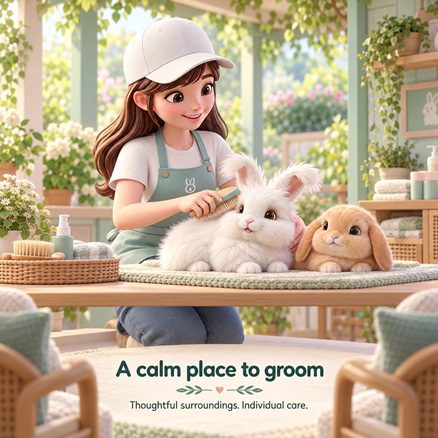
Grooming welfare standards also matter beyond the table. A room may look inviting to a person while feeling unfamiliar to a rabbit. Noise, nearby animals, sudden movement and temperature all deserve attention.
Rabbits are vulnerable to heat stress. A suitable environment depends on actual conditions and how the rabbit responds—not simply how attractive the setting looks.
What Oishi Bunnies does
For alfresco grooming, bunny parents are welcome to stay, observe and ask about grooming or bunny care. Our grooming area has two air coolers to help keep the bunnies and Cookie Yiyi comfortable.
We monitor the conditions and each bunny’s comfort throughout the appointment. If the latest PSI reading exceeds 100, or the latest PM2.5 concentration exceeds 100 µg/m³, we move grooming indoors. We may also move indoors earlier if the alfresco area becomes too warm or a bunny’s individual needs call for it.
Our indoor grooming space is air-conditioned, and appointments operate on a drop-off and pick-up basis.
These are Oishi Bunnies’ own operating arrangements, separate from NParks’ general standards. We confirm the grooming setting and collection arrangements with owners when planning the appointment.
06 · UNDERSTANDING YOUR BUNNY
Rabbit grooming standards start with knowing your bunny

What NParks recommends
C7 covers health-history discussions, expectations and risk communication. Best practices include declarations and species-appropriate preventive-health checks.
What this means for rabbits
Health-history discussions help turn grooming welfare standards into individual care. A form is useful when its contents influence the appointment. Sensitive areas, previous handling experiences and mobility limitations should guide the conversation.
Preventive-health questions should fit the species. Rabbit haemorrhagic disease vaccination is one topic to discuss with your veterinarian, rather than relying on a copied dog-and-cat checklist.
What Oishi Bunnies asks owners to share
- Recent medical history and known health conditions.
- Current medications and relevant veterinary instructions.
- Mobility limitations or sensitive areas.
- Previous reactions to brushing, nail trimming or handling.
- Behaviour, preferences and what helps your bunny settle.
- Bonded companions and difficulties with separation.
- Veterinarian-advised parasite prevention, including the product and date last applied.
For example, if your bunny receives Revolution under veterinary advice, let us know when it was last used.
Even if your bunny has visited before, please share changes since the last appointment. Previous notes provide context; your latest update helps us prepare for the bunny arriving today.
07 · TRAINING AND HOME CARE
Putting grooming welfare standards into practice
What NParks recommends
C6 best practices encourage qualifications, continued education and additional welfare, behaviour and first-aid training.
What this means for rabbits
To understand how a groomer applies grooming welfare standards, owners should be able to ask how their knowledge translates into rabbit-specific practice: What makes you stop? How do you support a struggling rabbit? What work would you refer elsewhere?
At home, build confidence at the rabbit’s pace. Gentle familiarisation and positive experiences can make necessary handling less alarming.
What Oishi Bunnies does
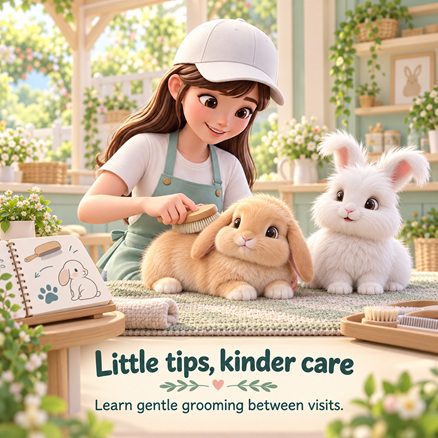
During alfresco appointments, parents are welcome to ask questions while observing. Where appropriate, Cookie Yiyi can share simple grooming and everyday bunny-care tips, demonstrate suitable brushing techniques and explain what to check between visits.
These conversations help owners understand rabbit grooming standards and continue suitable care at home. They follow the needs of the session. Demonstrations and chatting may pause whenever your bunny needs our full attention.
08 · TRANSPARENCY AND UPDATES
Grooming welfare standards: care you can see and understand
What NParks recommends
C7 best practices include condition photographs, written procedures and visual session recording.
What this means for rabbits
Under grooming welfare standards, documentation should serve care and accountability. It should not require stressful poses or turn an appointment into a performance.
Clear consent is part of applying grooming welfare standards thoughtfully. Private care documentation and public promotional content have different purposes. Owners should understand which is being proposed.
What Oishi Bunnies offers
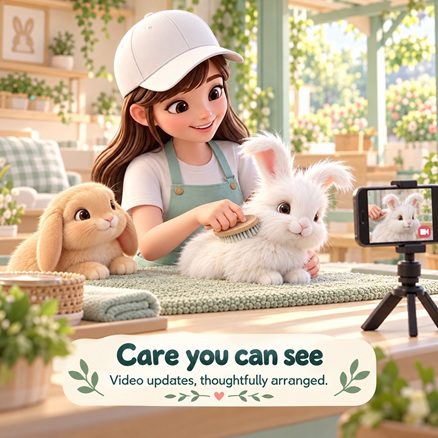
For drop-off and pick-up appointments, we can discuss video updates beforehand. Where practical, we may record clips to share privately after grooming.
An Instagram or Facebook Live session may also be arranged with your prior permission and subject to availability. Because a live broadcast may be visible to other viewers, we will agree on what can be shown. Choosing not to appear on social media will not affect your bunny’s care.
Filming remains secondary to safe handling. We may pause or stop recording whenever your bunny needs our full attention. Video updates do not replace the written grooming report.
09 · OUR LATEST ADDITION
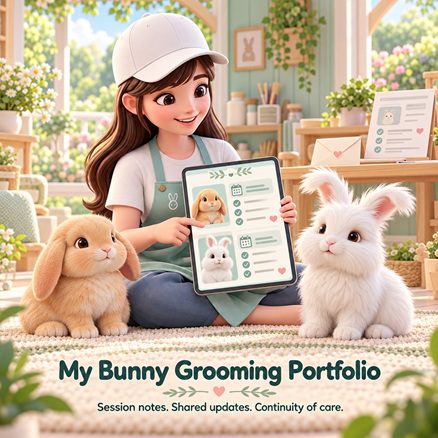
My Bunny Grooming Portfolio
What NParks requires
Relevant records must be retained for at least two years, with backups for electronic records.
What this means for rabbits
Record-keeping is another part of grooming welfare standards. An ongoing record helps the next appointment begin with useful context: sensitive areas, handling approaches that helped, concerns discussed and work deferred.
“Nail trim completed; remaining work deferred after repeated attempts to escape; owner informed” explains far more than a label such as “uncooperative.”
What Oishi Bunnies does
We’ve introduced My Bunny Grooming Portfolio to document each session and give owners a clearer picture of their bunny’s experience over time.
- Services completed and work deferred.
- Behaviour observed and handling approaches that helped.
- Relevant general observations.
- Aftercare information and concerns discussed with the owner.
Keeping rabbit grooming standards consistent between visits depends on useful notes. This supports continuity of care. Each appointment becomes part of an ongoing record, while allowing for changes in your bunny’s needs.
Where relevant, we document observations about the coat, skin, nails, cleanliness, movement and response to handling. We explain concerns and recommend veterinary review when appropriate.
These are grooming observations—not a diagnosis or a substitute for a veterinary examination.
How to view your bunny’s report
Once a report is approved and made available, it is emailed to your registered address. You can also sign in to My Account → My Bunnies and open your bunny’s grooming session.
The portfolio supports communication about grooming welfare standards and your bunny’s care. Having a digital report alone does not establish that every operational requirement has been met.
A NOTE FROM COOKIE YIYI
Where grooming meets compassion
Cookie Yiyi cares deeply for every bunny who comes into our care. Each arrives with their own personality, preferences and vulnerabilities, and we make the time to understand the little individual beneath the coat.
Sometimes care means a gentle brush and a reassuring pause. Sometimes it means leaving a few tufts unfinished, sharing a concern with an owner, or deciding that today is not the right day to continue.
We take our role and responsibility seriously, and we are grateful for the trust you place in us. That trust deserves gentle hands, honest communication and decisions guided by your bunny’s wellbeing. Grooming welfare standards give us a framework; the care lies in how we apply it to each bunny.
For anyone choosing a rabbit groomer in Singapore, we hope this guide makes it easier to ask practical questions about handling, supervision and records. Thank you for letting us be a small part of their care. We want every bunny to leave feeling as secure and comfortable as we can help them be—and every owner to feel heard, informed and supported.
With care,
Cookie Yiyi ♡
Choosing a rabbit groomer in Singapore: further reading
Why we don’t trim rabbit whiskers: understanding vibrissae
Choosing a rabbit groomer in Singapore: Is Your Rabbit Groomer Truly Safe?
AVS pet grooming guidelines and further reading
- AVS: Code of Animal Welfare
- Official pet groomers’ annex
- RWAF: Handling Rabbits
- RWAF: Grooming Rabbits
- RWAF: Bathing Rabbits
- RWAF: Sore Hocks
- RWAF: Transporting Rabbits Safely
- RSPCA: Tonic Immobility in Rabbits
- AVS: Rabbit Haemorrhagic Disease Vaccination Guidelines
This article explains selected grooming welfare standards and recommendations. Rabbit-specific interpretations and Oishi Bunnies’ practices are identified separately from official requirements. It is not a comprehensive compliance assessment or a substitute for veterinary advice. Illustrations are for educational purposes.