 Pro-Tip: Viewing on a phone? Select desktop mode or rotate to landscape for the best reading experience!
 Estimated Read Time: 12 Mins
Oishi Bunnies Herbal Atlas
Mulberry
Morus alba L., Morus nigra L., Morus rubra L.
Welcome to the Oishi Bunnies Herbal Atlas. Here, we explore mulberry leaves for rabbits as food, forage and sensory enrichment—bringing together botanical knowledge, traditional herbal use and rabbit-specific research.
Pee-Casso found the mulberry tree first, naturally. Bunnini arrived with a notebook, a botanical name and several questions about what, exactly, was heading into the forage bowl.
Fair enough. Mulberry gives the Herbal Atlas something useful: rabbits eating leaf-based diets in real trials, a long herbal tradition, and lab studies on particular extracts. Plenty to explore.
Written by Cookie Yiyi, rabbit rescuer and fosterer who has rehomed 18 rabbits, guardian to 4 resident house rabbits, and passionate organic balcony gardener—the Atlas pairs careful research with years of hands-on rabbit care.
Educational Notice: Herbal profiles are provided for botanical learning, responsible forage use and enrichment. This guide focuses on whole mulberry leaves. Fruit, twigs, root bark, concentrated extracts and isolated compounds such as DNJ require separate assessment. Mulberry should never replace professional veterinary diagnosis, treatment, prescription medication or emergency care. If your rabbit is unwell, please seek appropriate veterinary care.
Mulberry for Rabbits: The Verdict
Yes. Correctly identified mulberry leaves (Morus alba) can be offered fresh or properly dried as part of a varied forage selection for healthy rabbits.
As with other herbs for rabbits, introduce mulberry leaves gradually and choose clean material with a known treatment history. Keep unlimited grass hay or suitable fresh grass at the centre of the diet.
What the research supports: rabbit trials support mulberry leaves as a feed ingredient under the conditions tested. They do not establish a universal home serving, a medicinal dose, or long-term suitability for every rabbit. This Herbal Atlas profile explains those findings and their practical limits.
The fruit is a separate decision. Ripe mulberries belong in the treat category, and the sources reviewed provide no rabbit-specific berry count or feeding frequency. Twigs, root bark and concentrated products also require separate assessment from mulberry leaves.
For the universal introduction steps—going slowly, fresh versus dried, the post-introduction watchlist, vulnerable-bun considerations and essential-oil safety—see the Oishi Herb Guide for Buns. This Rabbit Herb Guide covers the feeding principles used throughout the Atlas.
A useful leaf for the forage bowl, with a story worth exploring.
Mulberry at a Glance
| Botanical name covered | Morus alba L. — white mulberry |
| Family | Moraceae — the mulberry family |
| Origin | Native to China; now cultivated widely in temperate and tropical regions |
| Main forms discussed | Fresh leaves, deliberately wilted leaves used in research, and dried leaves or leaf meal |
| Practical role | Dietary variety and forage enrichment |
| Rabbit research | Whole-leaf feeding trials, a DNJ additive study, and experimental leaf-extract studies |
| Evidence gaps | Validated companion-rabbit portions, long-term senior-rabbit feeding, and routine whole-fruit or twig feeding |
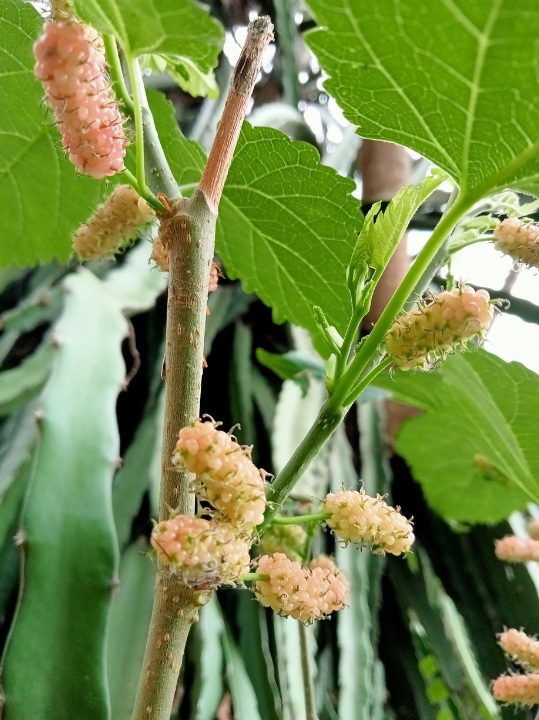
Morus alba L.
White Mulberry
Traditional Use & Modern Scientific Understanding
Traditional history raises research questions. Modern studies then examine constituents, mechanisms, safety and effects in a defined setting. Both layers belong in the picture.
Traditional Herbal History: Sang Ye
In Traditional Chinese Medicine, dried Morus alba leaf is Sang Ye, traditionally described as sweet, bitter and cold and associated with the Lung and Liver channels (HKBU Chinese medicine record).
| Traditional description | Meaning within the traditional framework |
|---|---|
| Disperse wind-heat | Patterns traditionally described as wind-heat |
| Clear lung heat and moisten dryness | Dry cough and dryness affecting the lung system |
| Clear the liver and benefit the eyes | Certain patterns involving red or uncomfortable eyes |
These terms describe a traditional approach to patterns of illness. “Cold” is a traditional property, not a measured cooling effect on a rabbit’s body.
The leaf and fruit both appear in China’s official 2002 list of materials traditionally used as both food and medicine (National Health Commission). That’s a historical human-use classification, not a rabbit safety approval.
One Tree, Several Herbal Identities
| Plant part | Traditional name |
|---|---|
| Leaf | Sang Ye |
| Fruit | Sang Shen |
| Twig | Sang Zhi |
| Root bark | Sang Bai Pi |
Why Offer Mulberry Leaves?
Variety
Mulberry leaves add another flavour and texture to familiar greens, and some rabbits enjoy finding dried pieces among their hay. When choosing herbs for rabbits, individual acceptance matters. Feeding trials show rabbits can eat mulberry-containing diets, but preferences and tolerance vary.
Nutrition
Mulberry leaves supply plant protein, fibre and minerals. Their practical role is as a leafy addition within a varied diet; they aren’t a complete food or a replacement for grass hay.
Foraging
A few familiar pieces of mulberry leaves scattered through hay or a clean forage tray give your rabbit something to search for, investigate and choose. That’s practical enrichment, rather than a measured therapeutic effect from the feeding trials.
A Homegrown Option
Growing mulberry for rabbits gives you a convenient leaf source with a known history. Use an established, correctly identified tree, check any garden treatments and harvest sound leaves.
Mulberry for Rabbits: Edible Anatomy
| Plant Part | How We Treat It Here |
|---|---|
| Mulberry Leaves | The main subject of this Herbal Atlas profile, with direct rabbit feeding research. Offer fresh or properly dried, introduced gradually. |
| Ripe Fruit | A sweet treat. If offered, keep it a small portion within the overall diet. No validated mulberry-specific berry count was identified. |
| Dried Fruit | Easier to overfeed, since water removal packs more fruit solids into a small amount. Avoid added sugar, and don’t equate its portion with fresh fruit. |
| Twigs and Branches | Some rabbit owners offer them for chewing. The studies reviewed don’t establish routine twig-feeding guidance, so verify species-specific advice and treatment history independently. |
| Root Bark and Roots | Outside this leaf guide. Traditional medicinal use doesn’t establish casual feeding suitability. |
| Extracts, Tinctures and Isolated DNJ | Different preparations with different exposures. Experimental findings are covered below and aren’t home prescriptions. |
NParks describes mulberry fruit as edible, and general rabbit-welfare guidance treats fruit as a sugary treat rather than a leafy food. Neither gives a tested mulberry-fruit portion for rabbits.
If you offer fruit to a healthy adult who already tolerates it, use a tiny ripe portion as part of the total treat allowance. Prefer ripe, sound fruit. The sources reviewed did not establish rabbit-feeding guidance for unripe fruit, so it is not recommended here; that evidence gap does not itself prove toxicity.
Practical Use: Introducing Mulberry Leaves
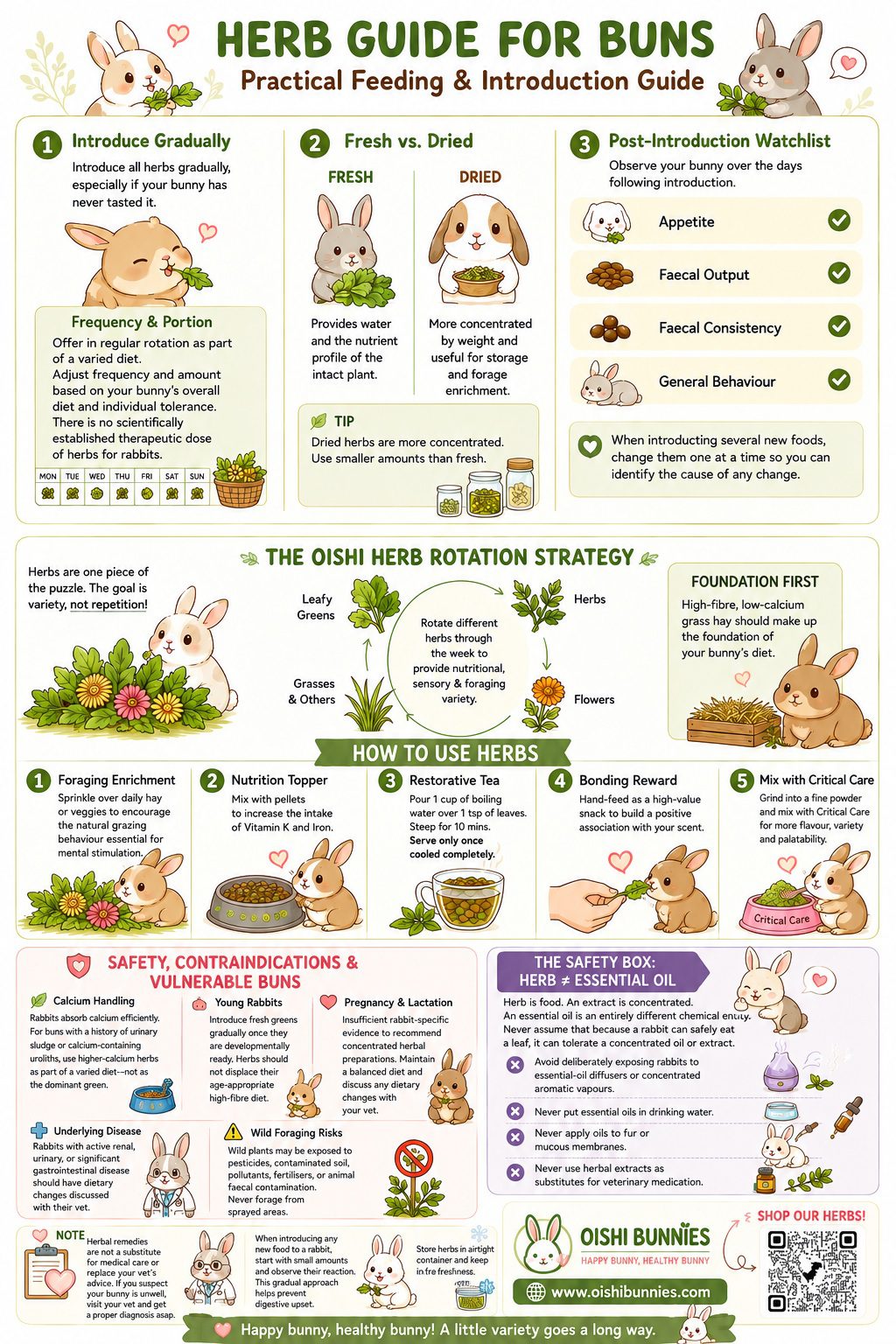
Our Rabbit Herb Guide uses the same introduction routine for mulberry and other herbs for rabbits: one new food at a time, a small first taste, and 24–48 hours of watching appetite, hay intake, droppings and comfort. If your rabbit becomes unwell, seek veterinary advice promptly rather than waiting out the observation period.
Mulberry-Specific Feeding Cautions
- Leaf condition: fresh or properly dried leaves are suitable options. Deliberate wilting was used in research, but spoiled leaves are unsuitable. Discard mouldy, slimy, musty or fermenting material.
- Sourcing: avoid roadside forage, animal-waste contamination and unknown pesticide histories. Follow treatment labels and harvest restrictions; washing cannot make every contaminated leaf safe.
- Tea products and extracts: choose plain Morus alba leaf and remove tea-bag packaging before offering. No home medicinal dose is established for tea, extracts or DNJ supplements. Never put homemade preparations in the eyes.
- Urinary diets: some mulberry material is calcium-rich. Discuss inclusion within a prescribed feeding plan; mulberry is not an established treatment for sludge, stones or kidney disease.
- Vulnerable rabbits: evidence is limited for nursing kits, pregnant or lactating rabbits, and medically fragile or senior companions. Tailor dietary changes to their individual care plan.
If your rabbit becomes unwell: stop the new food and contact a rabbit-savvy vet promptly for reduced appetite, markedly fewer droppings, pain, lethargy or diarrhoea. Don’t wait out the observation period.
Meet the Plant
White mulberry is a perennial tree, familiar as silkworm food and as a fruit tree in Southeast Asian gardens. Its leaves may be lobed or unlobed. Despite the common name, ripe fruit can be white, pink or dark purple depending on the variety.
Fruit colour and leaf shape alone are unreliable for identification. Confirm the species before harvesting.
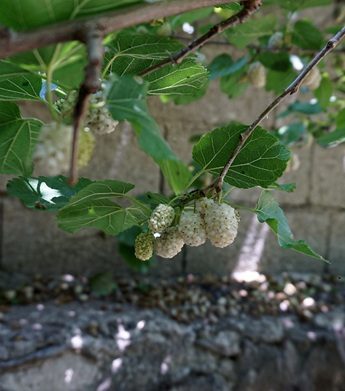
Morus alba L. — White Mulberry
Check the treatment history, too. A nursery label saying “edible” doesn’t tell you whether the plant was recently treated with something unsuitable for immediate harvest.
Botanical references: NParks Flora & Fauna Web and GardeningSG: White Mulberry.
Nutritional Profile
Feedipedia reports these values for mulberry leaf meal. They’re dry-matter figures, not percentages of a fresh leaf as offered.
| Component | Reported Leaf-Meal Value | Context |
|---|---|---|
| Crude protein | Average 18% DM; range 13.6–20.4% | Eight observations |
| Crude fibre | 13.7% DM | Calculated estimate, marked with an asterisk in the database |
| NDF | Average 37% DM; range 26.2–59.5% | Six observations |
| ADF | Average 25.1% DM | Two observations |
| Ash | Average 12.8% DM | Eight observations; total mineral residue |
| Calcium | 42.3 g/kg DM (4.23% DM) | One observation |
| Phosphorus | 4.2 g/kg DM | One observation |
| Potassium | 21.7 g/kg DM | One observation |
| Condensed tannins | 30 g/kg DM, as catechin equivalents | One observation |
A reference snapshot: these figures are not a nutritional label for the leaves in your garden. Cultivar, growing conditions, harvest stage and processing all shift composition, and other forage datasets report different values.
What Does “Dry Matter” Mean?
Dry matter (DM) means the water has been excluded from the calculation. Fresh and dried leaves contain different amounts of water, so comparing them gram for gram can mislead.
Understanding fibre: NDF (neutral detergent fibre), ADF (acid detergent fibre) and crude fibre are different measurements and shouldn’t be added together.
A fibre percentage also doesn’t prove that dried mulberry provides the same chewing pattern or dental benefit as grass hay.
Traditional Use & Modern Scientific Understanding
Traditional history raises research questions. Modern studies examine constituents, mechanisms, safety and effects under defined conditions. Both layers help us understand mulberry.
Traditional Herbal History
In Traditional Chinese Medicine, dried Morus alba leaf is: sweet, bitter and cold, associated with the Lung and Liver channels. Traditional functions include dispersing wind-heat, clearing lung heat and moistening dryness, and clearing the liver and benefiting the eyes.
“Cold” describes a traditional property, not a measured cooling effect on rabbits. Both leaf and fruit appear in China’s official 2002 food-and-medicine list, documenting traditional human use.
Same tree, separate herbal identities: leaf—Sang Ye; fruit—Sang Shen; twig—Sang Zhi; root bark—Sang Bai Pi.
What the Chemistry Shows
A 2022 study of four Kashmiri varieties linked chlorogenic acid to antioxidant activity and DNJ and syringic acid to enzyme-inhibitory activity in laboratory assays.
DNJ—1-deoxynojirimycin—inhibits alpha-glucosidase, an enzyme involved in carbohydrate digestion. This helps explain the research interest in mulberry and blood-glucose regulation.
Human Research in Context
NCCIH describes human clinical evidence as limited: some studies suggest blood-glucose effects, while others found none. It also reports digestive upset and potential interactions with diabetes medicines in people.
These findings provide context, but do not establish rabbit side effects or health benefits from ordinary leaf portions.
Where rabbits enter the picture: researchers have studied mulberry-containing diets, a DNJ additive and leaf extracts in rabbits. The Herb Profile below examines those studies and what each can tell us. Whole leaves, concentrated additives and medicinal extracts represent different exposures.
Herb Profile: Evidence on Mulberry for Rabbits
This Herbal Atlas profile separates botanical identity, traditional use and experimental findings. Each category describes a layer of evidence, rather than an overall safety score or a measure of therapeutic effectiveness.
| Evidence Category | What It Contributes |
|---|---|
| Botanical Identification | Morus alba is well documented. When sourcing mulberry leaves, confirm both the species and plant part. |
| Traditional Herbal History | Sang Ye has established human use in Chinese herbal practice; the fruit, twig and root bark have separate herbal identities. |
| Edibility / Food Use | Leaves and fruit have human food uses. Rabbit feeding trials support mulberry leaves as a dietary ingredient in particular formulations. |
| Phytochemical Evidence | Studies identify phenolic compounds, flavonoids and the alkaloid DNJ, with antioxidant and enzyme-inhibitory activity in laboratory assays. |
| Rabbit-Specific Evidence | Direct feeding studies and experimental extract studies exist. They answer different questions and don’t establish a home treatment or universal serving. |
Mulberry for Rabbits: What Has Actually Been Studied?
Whole Mulberry Leaves and Leaf Meal
- Khan et al., 2020: among 60 young rabbits, replacing 50% of a concentrate diet with wilted mulberry leaves produced the best reported growth and feed conversion. This describes replacement within that feeding system, not a recommendation to replace a companion rabbit’s hay.
- Hou et al., 2020: 80 young males received diets containing 0–20% mulberry material made from leaves and new shoots. The 20% group had poorer feed conversion than all other groups and slower growth than the control, 5% and 10% groups. Growth at 5–15% did not differ significantly from control.
- Le Thi Lan Phuong et al., 2022: increasing leaf meal reduced several digestibility measures. Replacing 50% of fishmeal protein—about 13.6% leaf meal in the pellets—gave the highest numerical daily gain. Final weight and feed conversion did not differ significantly across treatments.
- Hassanien et al., 2026: diets containing 9% or 12% mulberry leaf powder showed no significant growth difference over 63 days. Some digestibility measures declined and feed costs improved. The paper reports different animal numbers in its abstract and methods.
DNJ and Medicinal Extracts
- Li et al., 2024: a 28-day DNJ-additive study in 36 males found favourable changes in some inflammatory and intestinal-barrier markers. Both supplemented groups had shorter intestinal villi, and the higher level reduced daily gain.
- Cheng et al., 2021: a 42-rabbit experiment using an androgen-deficiency dry-eye model reported improved tear secretion and tear-film stability with prepared mulberry leaf-extract eye drops over 14 days.
- Chen et al., 2022: mulberry leaf extract improved reported clinical signs, bacterial load and tissue injury in experimentally induced bacterial conjunctivitis over five days. Only the publisher abstract was reviewed.
The Oishi Bunnies Read
Mulberry has direct rabbit evidence for dietary use and biological activity. Most studies are short and involve young animals or induced disease, leaving companion-rabbit portions and long-term senior feeding less certain.
Our Rabbit Herb Guide applies the same distinction when assessing herbs for rabbits: feeding whole leaves differs from administering a medicinal extract. Extract experiments do not establish home doses, and the eye studies do not justify homemade drops or treating eye disease through forage feeding.
Full study links are collected in the References section.
Growing Mulberry in Singapore
NParks’ GardeningSG guide describes Morus alba as suited to full sun, loamy soil and good drainage. With suitable space and care, it can provide a convenient homegrown source of leaves.
Sun, Soil & Water
Provide at least six hours of sunlight and loamy, well-draining soil. Pots should allow soil at least 30 cm deep. Pair generous watering with free drainage, as mulberry is vulnerable to root rot.
Size & Pruning
The tree can reach about 15 m. NParks suggests maintaining it around 1.5 m for easier harvesting. Regular pruning helps manage its size and encourages fruiting.
Propagation
Stem cuttings are commonly used. Rooted cuttings from a mature tree can sometimes fruit after a month, while seedlings may take around four years. These are possibilities, not a guaranteed timetable.
Pests & Plant Health
Watch for aphids, mealybugs, whiteflies and spider mites. Check both the pests and growing conditions; not every infestation comes from drainage problems. Mechanical measures, such as removing infested growth, can help reduce unnecessary spraying.
For rabbit-safe growing practices, see our Safe Gardening & Biosecurity for Rabbits guide.
Harvest & Fresh Storage
Young leaves can be harvested as needed. Pick sound material and keep it clean during collection. Keep fresh harvests cool, inspect before use and discard anything deteriorating. Storage life varies with handling and conditions.
Drying & Keeping Moisture Out
Use a clean process with enough airflow or controlled dehydration to remove moisture thoroughly. Humid air can prevent reliable drying. Cool the leaves before airtight storage, protect them from moisture and check for mould. Crispness alone does not confirm microbiological safety or shelf life.
The Oishi Bunnies Bottom Line
After caring for rabbits through the easy days and the difficult ones, we have learnt that good care does not always look the same.
For a healthy rabbit, herbs can be part of the simple pleasures of everyday life—different scents to investigate, leaves to forage through, new flavours to taste and a little more botanical variety alongside a hay-based diet. Many of these same plants also carry long histories of traditional medicinal use, with fascinating chemistry that modern science continues to investigate.
We believe there is room to respect both traditional herbal knowledge and modern science without asking either to be something it is not. Traditional use does not automatically prove that a herb will treat disease, while limited scientific evidence does not necessarily mean that generations of observation have nothing useful to teach us. Sometimes research supports an old idea, sometimes it changes our understanding, and sometimes the answer simply remains uncertain.
That uncertainty becomes especially important when caring for a rabbit who is elderly, chronically ill or approaching the end of life. There may come a time when surgery is no longer suitable, treatment options have become limited, or the burden of further intervention may outweigh what it can realistically give the rabbit.
In those moments, care does not stop simply because cure is no longer possible.
The priorities may change towards comfort, pain relief, appetite, hydration, familiar foods, companionship, mobility, rest and the small things that tell us a rabbit is still finding pleasure in their day. Herbal and botanical support may sometimes have a place within a veterinary-guided comfort plan. At other times, a particular herb may offer little benefit or may be inappropriate because of the rabbit’s condition or medications. The individual rabbit matters more than the reputation of any herb.
For us, palliative care is not about trying everything simply because something might help. Nor is it about dismissing a supportive option simply because it comes from traditional herbal practice. It is about choosing thoughtfully, watching the rabbit in front of us, working alongside appropriate veterinary care, and continually asking whether what we are doing is adding comfort and quality to that rabbit’s life.
Sometimes medicine is about curing. Sometimes it is about managing a condition for years. And sometimes our responsibility is simply to make the days that remain comfortable, familiar, interesting and filled with as many good moments as possible.
Respect the tradition. Understand the plant. Follow the evidence. But above all, look at the rabbit in front of you—because their comfort, dignity and quality of life are what ultimately matter.
Explore Mulberry with Oishi Bunnies
1 FOR 1 SPECIAL BUNDLE
Mulberry Leaves
Add a little leafy variety to your bunny’s forage rotation with our 1-for-1 Mulberry Leaves. Once introduced and tolerated, offer small pieces alongside familiar greens or scatter them through hay for a little searching and snuffling.
Our forage philosophy: introduce new botanicals gradually and rotate familiar favourites for variety and enrichment, while keeping unlimited grass hay or suitable fresh grass and clean water at the centre of the diet.
Mulberry FAQ
Can rabbits eat mulberry leaves regularly?
After a successful gradual introduction, they can be one option in a varied leafy rotation for a healthy rabbit. The studies reviewed set no necessary daily amount or long-term maximum for companion rabbits, and daily feeding isn’t required for variety or enrichment.
Can mulberry leaves replace hay?
No. Swapping an ingredient in a formulated pellet is different from removing a companion rabbit’s hay supply.
Are dried leaves better for teeth?
No special dental advantage has been established in the studies reviewed. Dried leaves add variety and foraging opportunities, while hay stays central.
Can rabbits chew mulberry branches?
Owner use and commercial availability aren’t controlled safety evidence. The leaf studies don’t establish branch, bark or sap safety, so get species- and part-specific guidance rather than assuming leaf research covers a branch.
Is mulberry the same as Sang Ye?
Sang Ye is the traditional name for Morus alba leaf. A product can still differ in processing, additives or concentration, so check what’s actually supplied.
Does mulberry treat eye problems?
Experimental rabbit studies of leaf extracts exist. They don’t validate treating a pet rabbit’s eyes with forage, tea or homemade drops. A sore, discharging or closed eye needs veterinary assessment.
Does mulberry lower blood sugar?
DNJ has a relevant enzyme-inhibitory mechanism, and human and animal extract research exists. Ordinary leaf portions aren’t an established treatment for a pet rabbit with abnormal glucose.
What about baby or senior rabbits?
The 20% finding in a young-rabbit growth trial isn’t a kit-feeding instruction. Developmental stage, established diet and medical needs come first. For seniors, individual appetite, dental function and the care plan matter more than age alone.
Where should I buy mulberry leaves?
Look for botanical identification, a plain ingredient list, a credible harvest and handling history, suitable storage and no mould. A “natural” label or a pet-shop listing doesn’t establish quality or a tested serving.
References & Further Reading
These sources support the botanical, nutritional, traditional-use and research sections of this mulberry profile. Rabbit feeding trials, experimental extracts and human herbal use provide different kinds of evidence; their findings should be read within the conditions studied.
Botanical Identification & Singapore Cultivation
- NParks Flora & Fauna Web:
Morus alba L. Botanical description, plant characteristics and edible uses. - NParks GardeningSG:
White mulberry. Singapore growing guidance, including sunlight, drainage, pruning, propagation and pests.
Traditional Herbal & Food Context
- Hong Kong Baptist University:
Chinese medicine record: Sang Ye 桑葉, B00334. Traditional properties and uses of Morus alba leaf. - China Ministry of Health (2002), via the National Health Commission:
List of materials traditionally used as both food and medicine. Includes mulberry leaf and fruit; this is a human-use classification.
Nutrition & Phytochemistry
- Feedipedia:
White mulberry (Morus alba). Feed composition and nutritional context. The article’s nutritional table uses the leaf-meal dataset, expressed on a dry-matter basis. - Laboratory phytochemistry study (2022):
Metabolomic profiling and identification of antioxidant and antidiabetic compounds from leaves of different varieties of Morus alba grown in Kashmir. ACS Omega, 7, 24317–24328. Chemical profiling and laboratory assays.
Rabbit Research: Leaves & Leaf Meal
- Khan et al. (2020):
Mulberry leaves as a concentrate substitute in rabbit diets. Turkish Journal of Veterinary & Animal Sciences, 44, 1136–1141. Wilted-leaf feeding trial. - Hou et al. (2020):
Dietary mulberry leaf, rabbit growth and meat quality. Indian Journal of Animal Research, 54, 317–321. Pelleted diets containing different inclusion levels of mulberry leaves and new shoots. - Le Thi Lan Phuong et al. (2022):
Mulberry leaf meal, digestibility and growth of crossbred rabbits. Livestock Research for Rural Development, 34(3). Replacement of fishmeal protein within pellets, with fresh Para grass also offered. - Hassanien et al. (2026):
Mulberry leaves in growing Flanders rabbits. Tropical Animal Health and Production, 58, 55. Leaf powder replacing part of the clover hay in formulated diets.
Rabbit Research: DNJ & Medicinal Extracts
- Li et al. (2024):
Mulberry leaf DNJ and the intestinal barrier in fattening rabbits. Animal Bioscience, 37, 2101–2112. Concentrated DNJ additive research. - Cheng et al. (2021):
Morus alba leaf extract in a rabbit dry-eye model. Farmacia, 69, 341–346. Experimental treatment using prepared extract eye drops. - Chen et al. (2022):
Mulberry leaf extract and Staphylococcus aureus conjunctivitis in rabbits. Pharmacology, 107, 250–262. Experimental bacterial-conjunctivitis research; the publisher abstract was reviewed.
Reviews & Human Evidence
- Kurniawan & Nasihin (2025):
Mulberry leaves as alternative rabbit forage: a review. Conference review useful for locating literature; includes evidence from rabbits and other species. - National Center for Complementary and Integrative Health:
White mulberry leaf. Overview of human clinical evidence, reported digestive effects and potential medication interactions.
General Rabbit Feeding Guidance
- Rabbit Welfare Association & Fund:
Greens, veg and herbs. General guidance on leafy variety, sourcing and occasional sugary treats.
Reading the evidence: Feeding trials test particular ingredients and diets. Extract studies test particular preparations. Neither establishes a universal household serving or a home treatment for companion rabbits.
Our Approach to Herbs and Disclaimer
We write the Herbal Atlas because we believe herbal knowledge is worth taking seriously — humans have found value in these plants for centuries, rabbits naturally interact with a remarkably diverse botanical diet, and modern research keeps giving us better ways to understand what these plants contain and what they may do. This section pairs that respect for herbalism with a few practical ground rules.
- Educational use, not a prescription. This profile is for botanical learning and enrichment — it isn’t veterinary advice, a diagnosis, or a treatment protocol. Use it to make an informed feeding decision, not to replace a vet visit.
- Whole herb ≠ medicine. Edible herbs can carry genuinely active phytochemicals and interesting nutritional properties, but feeding a whole herb is a different act from administering a standardised medicinal preparation. Dietary herbs can complement a healthy rabbit’s diet; they don’t substitute for veterinary treatment of a sick one.
- Hay comes first. Unlimited grass hay and clean water are the foundation of a rabbit’s diet. Herbs are a complementary, rotational addition — flavour, variety and enrichment on top of that foundation, not a replacement for it.
- Every rabbit is different. Age, digestive health and medical history all vary. Introduce anything new gradually, in small amounts, and watch appetite, droppings and general behaviour over the next 24–48 hours.
- Concentrates and extracts are their own category. A dried herb and a standardised extract are chemically different exposures, and neither should be confused with essential oils. Never diffuse or administer concentrated aromatic oils to rabbits, orally or topically.
- Extra care for vulnerable rabbits. Kits, frail seniors, pregnant or nursing does, rabbits taking medication, and rabbits with significant chronic disease may tolerate dietary changes differently. Introduce new herbs more cautiously and check with a rabbit-experienced veterinarian when the rabbit’s condition or medication makes food choices clinically relevant.
- Sourcing matters as much as the herb itself. Identify plants correctly, source cleanly, and discard anything spoiled, mouldy or of uncertain origin. No herb is safe if it’s the wrong herb — or a bad batch.
- When in doubt, see a vet. If your rabbit is unwell, professional veterinary care always comes first — no dietary remedy is a substitute for prompt treatment.
Our evidence promise: This Atlas reflects our best current reading of the evidence, and we update it as better research comes along.