
Bunny-Proofing Your Home:
The Art of Creating a Safe Sanctuary
“Bunny proofing isn’t about restriction; it’s about creating a ‘yes’ space where your rabbit can explore safely and freely. Your goal is to manage their environment, not their instincts.”
Bunny-proofing is a non-negotiable step toward ethical rabbit guardianship. It is a proactive investment in your rabbit’s health, your peace of mind, and the longevity of your furniture. While rabbits must have unrestricted movement to thrive, we must first ensure that movement does not lead to injury or destructive behaviors.
1. Electrical Cords (Public Enemy #1)
The Danger: We jokingly call cords “Spicy Hay,” but they are a high-risk hazard. A single bite can deliver a fatal electric shock, cause massive mouth burns, or spark a house fire. Rabbits identify cords as intrusive “roots” across their path and are physiologically compelled to clear them.
The Solution: Complete Elimination of Access. Your bunny-proofing strategy must assume your rabbit *will* try to chew any exposed line. Use a combination of these methods:
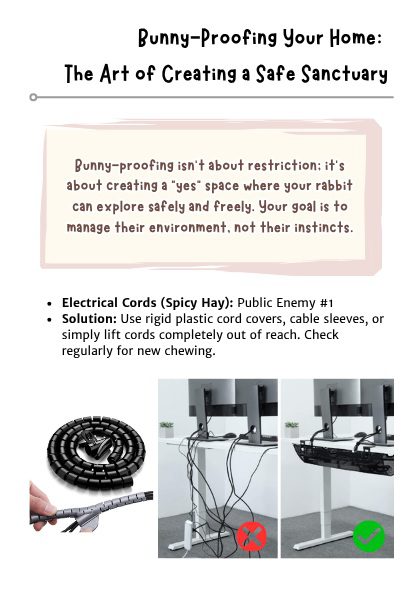
- Rigid Conduit & Cable Sleeves: Encase any low-hanging or ground-level cords in thick, durable plastic. We recommend split loom tubing for flexible areas.
- Organize & Elevate: Use adhesive cord clips or Velcro straps to bundle cords and lift them completely off the floor. Mount power strips vertically on desk or TV stand legs, out of hopping reach.
- Physical Blockades: If elevation isn’t possible, use baby gates or grid panels to fence off entire entertainment centers and computer stations.
2. Boundaries, Flooring & Hideaways
Block Unsafe Hideaways & Rooms
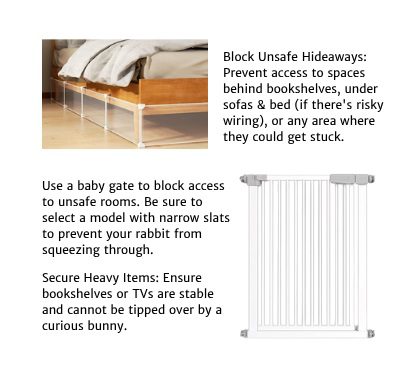
A rabbit’s natural survival instinct is to hide, and they will seek out small, dark cavities (behind bookshelves, under sofas, or behind appliances) where they feel secure. This becomes dangerous if they get stuck or encounter risky wiring or cleaning solutions.
Solutions: Create physical, impassable barriers. We use grid panels (like X-pen panels) or clear plastic grids zip-tied together to block off the perimeter under a bed or behind furniture. Use a stable, tension-mounted baby gate with narrow slats to block off off-limit rooms entirely.
Floor Protection & Traction
Rabbits have four primary needs: foraging, zoomies, binkies, and digging. Hardwood or slippery tile floors are an anatomical hazard (risk of splayed legs or hip issues) and do not provide the traction needed for “natural behaviors.” Rabbits will often dig or mark favorite spots to establish territory.
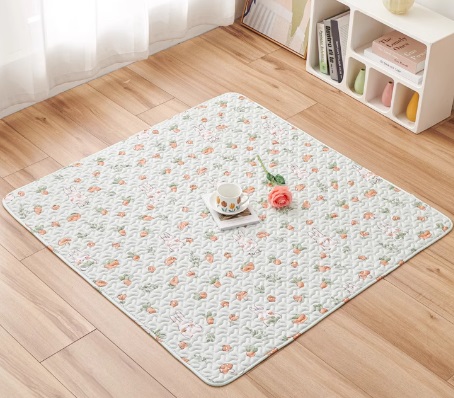
Solutions: We prioritize washable area rugs, foam mats, or grass mats. If your bunny is a dedicated digger, **Redirect, don’t just restrict.** Provide them with a dedicated digging box (filled with shredded paper, hay, or a safe blanket) placed *over* their favorite carpet corner to protect the floor.
3. The Destructive Habits of Furniture & Baseboards
We often blame “naughty” rabbits, but a rabbit who chews furniture is often just a rabbit whose physiological needs (dental wear, mental engagement, territory management) are not being met. Our bunny-proofing strategy must address both physical protection and mental redirection.
Physical Barriers for Wood Surfaces
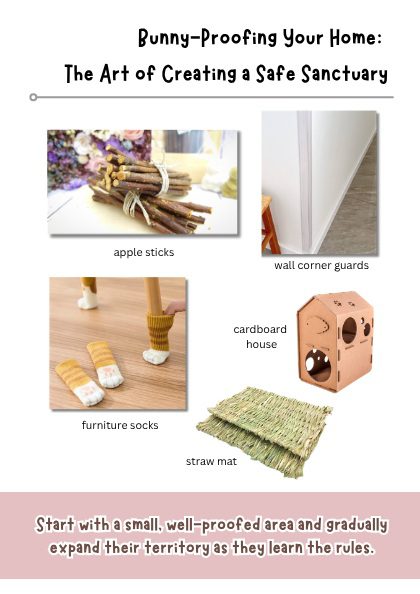
Baseboards and wooden table legs are irresistible “trunks” that rabbits must chew to wear down their open-rooted teeth. The solution is physical shielding. Clear plastic baseboard guards or L-shaped wood moldings (L-trim) can be adhered along the entire wall perimeter. Table legs can be shielded with decorative acrylic or clear guards. In a pinch, “furniture socks” can prevent minor nicks on smaller legs.
 The Redirection Rule: Address the *Need*

You cannot stop a rabbit’s biological need to chew. You must simply ensure the **approved items** are more appealing than your sofa leg. Our approach is to saturate their “yes” space with diverse, safe chewing options.
4. Household Toxins & Plants
Rabbits, being lagomorphs, have uniquely delicate digestive systems. They process toxins differently than dogs or cats, and items we consider “normal” can be fatal. This section requires zero-tolerance management.
- Cleaning Supplies: Common floor cleaners, disinfectants, and even laundry detergent can cause severe toxicity if ingested or even if residues irritate their skin. Store all chemicals in high, secure, inaccessible cabinets, or lockable containers. Transition your cleaning protocol to utilize **rabbit-safe alternatives** like a simple white vinegar/water solution. If you use stronger agents, ensure the area is *completely* dry and ventilated before granting bunny access.
- Houseplants (The No-Guess Rule): The only safe plant rule is the **”No-Guess Rule.”** Unless a plant is explicitly on a verified, medically sound rabbit-safe list (like Ashitaba or Dandelion), it must be *completely off-limits*. Rabbits cannot distinguish between toxic and safe plants. Place them on high shelves (away from all potential jump points) or keep them in an off-limits room.

Critical Warning: If you suspect your rabbit has ingested a plant or chemical, time is the enemy. Contact your nearest emergency clinic immediately. A rabbit’s condition can degrade rapidly.
Toxic Substances & Houseplants
Rabbits are natural foragers, but many common decorative plants are biological landmines. Because rabbits cannot vomit, ingestion is a non-negotiable medical emergency.
In the Modern Art of Rabbit Care, we assume all houseplants are toxic until proven otherwise. Before bringing a new plant into your home, you must audit it against our medically sound safety directory.
 View the Full “Yucks” Directory
 Common “Yucks” to Avoid:
- Lilies: Even pollen ingestion is fatal.
- Monstera / Philodendron: Causes oral micro-trauma.
- Aloe Vera: Causes severe diarrhea.
- Snake Plants: Causes nausea and lethargy.

Ingestion Emergency? Contact your nearest rabbit-savvy vet immediately.