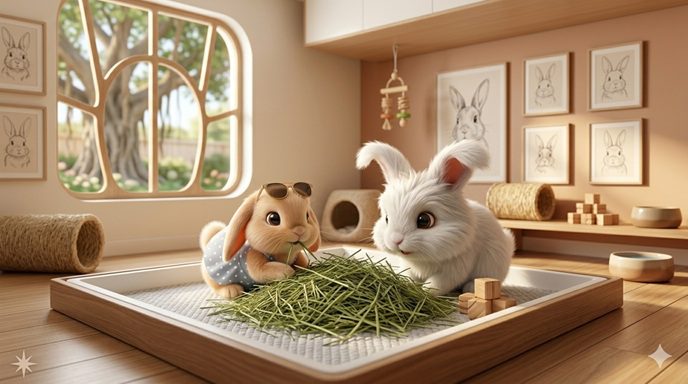
🐰 Pro Tips for Bonded Rabbits & Rabbits During Bonding
Litter training becomes slightly different when two rabbits share the same space. During bonding, rabbits are still establishing a shared territory and communicating through scent, so it is completely normal to see more territorial droppings or occasional urine marking than you would with a single rabbit. Even after a pair is fully bonded, changes such as moving to a new home, expanding their roaming space, or rearranging furniture can temporarily affect their litter habits.
Fortunately, a few simple adjustments can make the transition much smoother.
 1. Upgrade to a “Mega” Litter Box
 1. Upgrade to a “Mega” Litter Box
Bonded rabbits love doing almost everything together—including eating hay, relaxing, and using the toilet. A litter tray that comfortably fits one rabbit is often too cramped for two.
Choose the largest litter box your space allows, such as a large cat litter pan, a shallow under-bed storage tub, or a cement mixing tray. Both rabbits should be able to sit inside comfortably, turn around independently, and enjoy their hay without pushing each other out of the tray.
2. Feed Hay from Both Ends of the Litter Box
 2. Feed Hay from Both Ends of the Litter Box
Because rabbits naturally eat and eliminate at the same time, the litter box should also function as their dining area.
For bonded pairs, placing hay in only one corner can unintentionally cause one rabbit to occupy the preferred feeding position, encouraging the other rabbit to leave the litter box while eating.
Instead, distribute fresh hay along both ends of the litter box or install two hay racks above the tray. This allows both rabbits to eat comfortably side-by-side while reinforcing good litter habits.
3. Provide Multiple Litter Boxes During Bonding
 3. Provide Multiple Litter Boxes During Bonding
While rabbits are learning to trust one another, don’t expect them to share a single litter box immediately.
Place several litter boxes throughout the bonding pen or around their preferred toilet areas. This gives each rabbit easy access to a litter tray without feeling pressured to use the exact same one.
Many bonded pairs naturally begin sharing a litter box over time. Allow this to happen at their own pace rather than forcing it.
4. Collect Stray Territorial Droppings Promptly
 4. Collect Stray Territorial Droppings Promptly
During bonding or after moving into a new environment, both rabbits may leave scattered territorial droppings outside the litter tray. This behaviour is a normal part of establishing a shared scent map and usually improves as the rabbits become more comfortable with one another.
Rather than throwing these droppings away immediately, collect them and place them inside the litter box.
5. Reset Their Territory if Litter Habits Slip
 5. Reset Their Territory if Litter Habits Slip
If a bonded pair suddenly begins having accidents after moving into a larger room or gaining more free-roam space, they may simply feel the need to redefine their territory.
Instead of allowing unrestricted roaming, temporarily reduce their space using an exercise pen (x-pen) or a smaller rabbit-proofed area.
Keep them there until they consistently use the litter box for several consecutive days before gradually expanding their territory again. If accidents return, simply reduce the space once more and repeat the process.
6. Completely Neutralize Accident Spots
 6. Completely Neutralize Accident Spots
Because rabbits rely heavily on scent to navigate and define territory, urine accidents that are not thoroughly cleaned can encourage repeated marking in the same location.
After every accident, clean the area using white vinegar (or a 50/50 vinegar-water solution for routine cleaning) or a rabbit-safe enzymatic cleaner to break down urine residues and remove lingering odours.
If your rabbits repeatedly target the same corner, consider temporarily placing a litter box, hide, ceramic bowl, or another desirable resource over that spot to interrupt the behaviour while they establish better habits.
7. Reduce Competition Around Shared Resources
 7. Reduce Competition Around Shared Resources
Even well-bonded rabbits experience subtle changes in social dynamics, particularly after illness, veterinary visits, aging, or moving to a new environment.
If one rabbit suddenly begins toileting just outside the litter box, consider whether access has become uncomfortable rather than assuming they are being “naughty.” Avoid structural bottlenecks by providing:
8. Remove Extra Litter Boxes Gradually
 8. Remove Extra Litter Boxes Gradually
Many owners provide several litter boxes during bonding—which is an excellent strategy—but then remove the extras too quickly once the rabbits appear bonded.
Instead, reduce the number of litter boxes gradually.
Remove one tray at a time and observe their habits for a week or two before removing another. If accidents increase, simply return the extra litter box and try again later.
 Oishi Bunnies Tip
Don’t judge litter training by the occasional stray dropping.
Bonded rabbits communicate through scent, especially during bonding and after changes to their environment. Focus on the overall pattern rather than expecting perfection overnight. With a well-designed environment, plenty of hay, appropriately sized litter boxes, and patience, most bonded pairs naturally develop excellent litter habits over time.
Troubleshooting Guide: Sudden Lapses & Spraying
If a previously flawless adult rabbit suddenly stops using their tray or starts backing up against vertical surfaces to shoot a fine mist of urine. Before assuming your rabbit is being stubborn, remember this: it is a biological cry for help.
 Symptom Symptom |  Potential Root Cause Potential Root Cause |  The Immediate Fix The Immediate Fix |
|---|---|---|
| Sudden puddles right outside or near the lip of the box. | Medical Issue: Urinary Tract Infections (UTIs), bladder sludge (calcium crystals), kidney disease, or arthritis making it painful to jump. | Consult a rabbit-savvy veterinarian immediately for a urinalysis or X-ray. Swap to a senior low-entry box. |
| Peeing exclusively on soft surfaces (beds, couches, mats). | Textural Attraction: Soft fabrics mimic premium absorbent wild latrines, or they are marking your “nest.” | Deny physical access to the bed/couch entirely for 2 weeks using baby gates or x-pen panels. |
| Fine mist of urine sprayed up walls and furniture. | Hormonal Surge: Sexual maturity has hit, or an environmental change (new pet/visitor) triggered extreme territorial marking. | Spaying or neutering is the absolute cure. It reduces territorial and hormonal marking by up to 90% once hormones settle. |
| Complete rejection of a historically perfect box. | Hygiene Particulars: The tray has become too wet, deep, or smelly. Rabbits have incredibly sensitive respiratory systems. | Increase your cleaning frequency. Avoid strongly scented litters or heavily perfumed area cleaners. |
| Consistently leaking or urinating just over the edge of the box. | Structural Mismatch / Edge Placement: The rabbit backs up to finish and inadvertently sits over the rim, or dislikes the floor texture outside. | The Linoleum Hack: Place a rigid linoleum tile or slick plastic floor mat directly underneath the box, extending 15–20 cm out. The slick texture discourages standing outside, forcing them to hop completely inside. |
| Sudden scatter-pooping or regression during bondings. | Territorial Anxiety: Introducing new companions or shifting group dynamics spikes the biological drive to mark borders. | The Mirroring Setup: Place two identical litter boxes side-by-side or touching. Rabbits are social eliminators; communal, adjacent tray designs leverage mimicry instincts rather than combat. |
| High-tail sprayers soaking wall plaster behind the setup. | High Velocity Urination: Some rabbits lift their posteriors unusually high during urination, overshooting standard rims. | The Puppy Pad Shield: Use a tall storage tub container with an entrance door cut out. Clip a puppy pad securely to the inside back wall like a curtain to catch and drop vertical streams safely down into the primary litter substrate. |

Ready for a Stress-Free, Bunny-Friendly Home?
Litter training doesn’t have to be a guessing game. Explore our curated selection of premium, healthy rabbit munchies and lifestyle essentials designed to support your bunny’s natural habits.
Follow our rescue and rehabilitation journey for more expert care tips:
Instagram |TikTok |Facebook