Why Most Rabbits Thrive with a Bonded Companion: Understanding the Emotional Architecture, Wild Instincts, and Core Rules of Rabbit Companionship

rabbit companionship

📱 Pro-Tip: Viewing on a mobile device? Switch your browser to Desktop Mode or rotate to Landscape Layout for the ultimate masterclass reading layout!

Understanding the Emotional Architecture, Wild Instincts, and Core Rules of Rabbit Companionship

To a human, a solitary domestic rabbit lounging peacefully on a rug may appear perfectly content. To an ethologist—and to the rabbit’s own nervous system—that same rabbit may be living in a constant state of low-grade vigilance.

Domestic rabbits (Oryctolagus cuniculus) retain the vast majority of the behavioural and physiological traits of their wild European rabbit ancestors. Thousands of years of domestication have changed their appearance and, to some extent, their temperament, but not the fundamental biological programming that governs how they perceive safety and social relationships. They remain highly social animals whose survival strategy evolved around living within a colony.

While a single rabbit can receive excellent care and enjoy a good quality of life, decades of behavioural research and modern rabbit welfare guidelines consistently show that most rabbits benefit greatly from living with a compatible, bonded companion. Understanding why begins with looking at how rabbits evolved to survive.

Rabbits Are Hardwired to Live Together

Wild European rabbits naturally live in colonies known as warrens, where multiple family groups share tunnels, sleeping chambers, and feeding areas.

Their daily routine revolves around:

  • Sleeping together
  • Grooming one another
  • Eating as a group
  • Exploring together
  • Raising young collectively
  • Watching for predators as a team

Bonded rabbits routine

For a wild rabbit, solitude is unusual. Every rabbit contributes to the group’s collective awareness, allowing others to relax knowing multiple pairs of eyes and ears are monitoring the environment.

Our house rabbits no longer face foxes or hawks, but their brains still rely on many of these ancient survival instincts.

The Wild Instinct: Shared Vigilance

Rabbits are classic prey animals, positioned low on the food chain. Unlike predators that actively hunt, rabbits survive by detecting danger before danger detects them.

A solitary rabbit carries the full responsibility for monitoring potential threats. Even inside a quiet home, its nervous system remains ready to notice unfamiliar sounds, movements, or vibrations.

A bonded companion changes this dramatically.

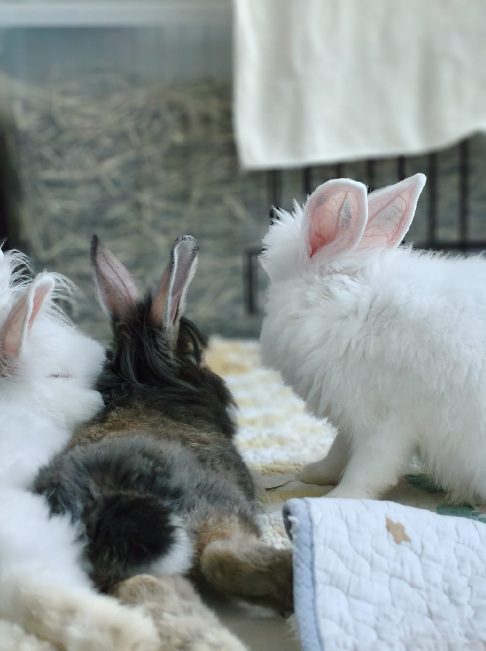
When two rabbits live together, they naturally divide the role of “sentinel.” Owners often notice one rabbit sleeping in a deep, fully relaxed flop while the other rests nearby in a loaf or sphinx position, quietly observing the surroundings. They instinctively take turns remaining alert.

The Neurological Shift

The presence of a trusted companion provides what behavioural scientists call social buffering—the natural reduction of stress through the presence of a familiar social partner.

When rabbits feel secure with a bonded companion, their bodies can maintain a lower baseline level of stress, allowing them to relax more fully. Lower chronic stress supports:

  • Better immune function
  • Healthier digestion
  • Improved sleep quality
  • Greater confidence when exploring
  • Increased emotional resilience

Bonded rabbits relaxing together

Although occasional stress is a normal part of life, prolonged stress can negatively affect both physical and psychological wellbeing.

The Emotional Architecture of Rabbits

Dogs evolved alongside humans over thousands of years and naturally look to people for much of their social fulfilment. Rabbits evolved differently.

Their strongest social relationships are naturally designed to form with other rabbits.

Humans provide affection, food, safety, enrichment, and companionship, but we cannot replace rabbit-to-rabbit communication.

A bonded partner provides:

  • Continuous companionship
  • Shared sleeping
  • Mutual grooming
  • Silent communication
  • Emotional reassurance
  • Confidence in unfamiliar situations
  • Comfort during stressful experiences

Rabbits communication and companionship

Even owners who spend every day with their rabbits cannot communicate using the subtle language rabbits instinctively understand.

📱 Pro-Tip: Viewing on a mobile device? Switch your browser to Desktop Mode or rotate to Landscape Layout for the ultimate masterclass reading layout!

Rabbits Speak a Silent Language

Much of rabbit communication happens without sound.

Bonded rabbits constantly exchange information through:

  • Nose nudges
  • Ear positioning
  • Eye contact
  • Body posture
  • Gentle leaning

  • Shared resting positions
  • Scent exchange
  • Slow blinking
  • Tooth purring
  • Grooming invitations

These tiny interactions occur throughout the day, continually reinforcing trust and social stability.

Grooming Is More Than Cleaning

One of the strongest signs of a healthy bond is allogrooming—mutual grooming between rabbits. This rabbit behaviour is far more than hygiene.

The forehead, around the eyes, and behind the ears are sensitive areas that rabbits struggle to groom thoroughly themselves. A bonded partner reaches these areas with gentle licking, helping maintain cleanliness while reinforcing emotional security.

Allogrooming serves several important purposes:

Builds Trust

Allowing another rabbit near the face represents complete confidence.

Reinforces the Social Bond

Grooming is the social currency of rabbit relationships. Daily grooming continually strengthens attachment between bonded partners.

Encourages Relaxation

Grooming is associated with relaxation, lowered heart rate, and the release of natural feel-good chemicals within the brain, helping rabbits feel calm and secure.

Maintains Peaceful Hierarchies

Established bonded pairs often use grooming to reinforce their social relationship without aggression.

The “Cuddle Puddle”

Bonded rabbits rarely choose to rest apart.

Instead, they often:

  • Sleep pressed against each other
  • Share hideouts
  • Rest nose-to-tail
  • Mirror one another’s posture
  • Eat side by side
  • Use the litter tray together

Bonded rabbits resting together in a puddle

This close physical contact helps rabbits regulate body temperature while also providing continuous reassurance.

When startled by thunder, fireworks, visitors, or unfamiliar environments, bonded rabbits frequently seek one another before investigating the situation.

Humans Cannot Fully Replace Rabbit Companionship

“My rabbit follows me everywhere.”

Many owners share this sentiment, and it certainly reflects incredible trust and affection.

However, even the most dedicated humans cannot:

  • Remain with rabbits 24 hours a day
  • Groom their faces using rabbit behaviour
  • Sleep beside them throughout the night

  • Communicate through rabbit body language
  • Share silent social interactions every few minutes

Even the most devoted owner cannot completely substitute another rabbit.

Bonded Rabbits Often Become More Confident

Experienced rabbit rescues and rabbit-savvy veterinarians frequently observe behavioural improvements after successful bonding.

Owners commonly report:

  • More frequent binkies
  • Increased curiosity
  • Better appetite
  • Less hiding

  • Greater confidence exploring new spaces
  • More relaxed body posture
  • Increased playfulness

Rabbits naturally borrow confidence from one another. If one rabbit investigates something new, the other often follows.

The Core Rules of Rabbit Companionship

Although rabbits are highly social, they are also territorial. Successful bonding follows a careful behavioural process rather than simply placing two rabbits together.

Rule 1: Desexing Is Essential

Attempting to bond undesexed rabbits often leads to hormonal aggression, territorial disputes, pseudopregnancy, and unwanted litters. Both rabbits should be desexed and fully recovered, with hormone levels allowed to settle—typically around four to six weeks after surgery—before introductions begin.

Rule 2: Rabbits Must Establish Their Social Hierarchy

Every bonded pair develops a social structure. During bonding, it is normal to observe:

Chasing

Short periods of chasing help rabbits establish personal boundaries.

Mounting

Usually a display of dominance rather than sexual behaviour. Brief mounting is normal, though mounting the head should be interrupted to prevent facial bites.

The Grooming Standoff

Both rabbits may lower their heads, each asking the other for grooming. The rabbit that eventually begins allogrooming first is usually accepting the more submissive role.

These rabbit behaviours are part of normal communication unless they escalate into fighting.

Rule 3: Bond Only on Neutral Territory

Rabbits instinctively defend areas they consider their own. Introducing a new rabbit into an existing rabbit’s territory often triggers territorial aggression. Bonding sessions should therefore take place in a completely neutral space that neither rabbit associates with home, such as a bathroom, hallway, or exercise pen in an unfamiliar room.

📱 Pro-Tip: Viewing on a mobile device? Switch your browser to Desktop Mode or rotate to Landscape Layout for the ultimate masterclass reading layout!

Signs of a Healthy Bond

Bonded rabbits displays deep behavioral harmony. These behaviours reflect genuine trust rather than simple tolerance.

A well-bonded pair commonly:

  • Groom one another regularly
  • Sleep touching
  • Eat together
  • Explore together
  • Relax completely in each other’s presence
  • Seek one another after frightening experiences
  • Share resources peacefully

When Bonded Rabbits Lose Their Partner

One of the strongest indicators of the depth of rabbit relationships is how some rabbits respond when a bonded companion passes away. Although every rabbit grieves differently, some may temporarily exhibit distinct changes.

  • Eat less than usual
  • Become quieter or less active
  • Search for their missing companion
  • Spend time in places they previously shared
  • Show reduced interest in toys or exploration

Maintaining familiar routines, monitoring appetite closely, and providing extra comfort can help during this period. Owners considering another companion should allow the surviving rabbit time to adjust before beginning a careful bonding process with a new partner.

When a Rabbit Lives Alone

Not every rabbit can immediately have a companion. Some live alone because their bonded partner has passed away, medical conditions prevent bonding, they are waiting for a suitable match, or behavioural rehabilitation is still ongoing.

A single rabbit can still enjoy an excellent quality of life when provided with:

  • Daily interaction
  • Plenty of enrichment
  • Space to exercise
  • Predictable routines
  • Mental stimulation
  • Opportunities to bond in the future

Many rabbit rescues offer supervised “speed dating” sessions to help owners find compatible partners safely.

A Welfare and Health Perspective

Rabbit Companionship is not simply about preventing loneliness—it can influence overall welfare and health.

Chronic stress may contribute to reduced appetite, lower activity levels, behavioural problems, and can be one of several factors associated with gastrointestinal disorders. Because rabbits have delicate digestive systems, maintaining normal eating habits, exercise, and positive social interactions is especially important.

Bonded rabbits often:

  • Exercise more naturally
  • Eat more consistently
  • Groom each other

  • Recover confidence more quickly after stressful experiences
  • Maintain healthier daily routines

When one rabbit becomes ill or undergoes surgery, the familiar presence of a bonded partner may provide reassurance during recovery.

Rabbit-savvy veterinarians sometimes recommend keeping bonded rabbits together whenever medically appropriate to minimise unnecessary stress.

Common Myths About Rabbit Companionship

MythReality
Rabbits prefer living alone.Rabbits are naturally social animals that evolved to live in colonies.
Humans replace rabbit companions.Humans provide love and care, but cannot replace rabbit communication or constant companionship.
Any two rabbits will automatically get along.Successful bonding requires patience, compatibility, and careful introductions.
Opposite-sex rabbits always bond best.Personality and temperament are usually more important than gender once both rabbits are desexed.
Older rabbits don’t need companions.Many senior rabbits thrive with a gentle, compatible partner.

Final Thoughts

For most rabbits, a compatible bonded companion provides something that toys, larger enclosures, and even the most devoted human cannot fully replace. Shared vigilance, mutual grooming, silent communication, and resting side by side are behaviours deeply rooted in rabbit biology.

Not every rabbit can be paired immediately, and some will live happy, well-supported lives as singles. However, when circumstances allow, providing a carefully chosen companion is widely regarded as best practice for rabbit welfare. A successful bond often brings greater confidence, emotional security, and a richer quality of life.

rabbit companionship is more than friendship.

It is one of the foundations of how they naturally experience safety, comfort, and belonging.

🩺 Scientific Transparency & Care Disclaimer

Educative Intent: The data provided within The Modern Art of Rabbit Care masterclass and the Oishi Bunnies platform is grounded in extensive rescue, rehabilitation, and behavioral observation. While we prioritize strict medical, physiological, and scientific accuracy regarding rabbit social dynamics, this content is engineered for educational purposes only and does not constitute official veterinary advice, clinical diagnosis, or prescribed medical treatment.

Sanctuary Safety & Socializing: Companion bonding guidelines—including neutral territory staging, chronic stress metrics, and hierarchy introductions—are highly dependent on your specific household environment and the individual profiles, histories, and medical temperaments of your animals. Always monitor your rabbit’s clinical and behavioral responses closely during any integration or transition phase.

Anatomy-Aware Handling & Ethics: Always consult an experienced, rabbit-savvy veterinary professional before modifying current care protocols, validating recovery behaviors post-surgery, or executing dynamic environmental shifts. Oishi Bunnies advocates for transparency and empirical knowledge; however, we cannot assume liability for actions executed without professional veterinary oversight.

As a rescue and rehabilitation hub, we value transparent data over flawless reviews. We are constantly expanding our clinical gallery of knowledge—if you are an evidence-based writer or creator passionate about rabbit welfare and behavioral science, we invite you to contact us to contribute your voice to our database. Let’s build a safer sanctuary together.