
 Pro-Tip: Viewing on a mobile phone? Switch to desktop mode or rotate to landscape for the ultimate reading experience!
 Estimated Read Time: 10 Mins

 CAN YOU BOND THREE RABBITS?
 CAN YOU BOND THREE RABBITS?
Yes—but rabbit group bonding requires extra care.
Three, four, or even more rabbits can potentially form a stable group. However, success depends heavily on the individual rabbits, their personalities, previous experiences and compatibility.
The source bonding guide recommends additional care when attempting multiple-rabbit bonding, including scent and habitat swapping before dates, professional supervision where possible, and shorter initial dates that gradually increase as the rabbits become more familiar.
A trio can be created in several ways:
- Introducing three rabbits who are all unbonded
- Adding a third rabbit to an established pair
- Expanding an existing bonded group
Of these, adding a third rabbit to an established pair can be particularly delicate because the original pair already has an established relationship, routine and territory.
The newcomer is not simply joining a friendship. They are entering an existing social structure.
ADDING A THIRD RABBIT
 Rabbit B ➔ Introduce Rabbit C
Rabbit C needs to develop a comfortable relationship with both A and B.
At first, you may see:
- Chasing
- Mounting
- Nipping
- Grooming requests
- Following
- Ignoring
- Testing boundaries
- Changes in social behaviour
Some of these behaviours can occur while rabbits establish their relationship, but they must always be monitored.
The original pair may also behave differently after the newcomer arrives. They may:
- Accept the newcomer
- Become curious
- Become more territorial
- Compete for access to space or resources
- Experience temporary tension with each other
This is why adding a third rabbit should never be treated as simply “adding one more bunny.”
You are creating a new social group.

👑
UNDERSTANDING GROUP SOCIAL STRUCTURE
A multi-rabbit household may develop preferred social roles and relationships, but these do not necessarily form a simple linear ranking such as “first, second, and third.”
Rabbits may use behaviours such as mounting, following, chasing, grooming requests and yielding space while establishing their social relationships. RSPCA guidance also recognises that rabbits form complicated social structures and a pecking order.
THE CRITICAL DISTINCTION:
ADVANCED MULTI-RABBIT BONDING: FOUR RABBITS & LARGER GROUPS

STEP 1 — DUPLEX LIVING & SWAPPING
When rabbits are not yet bonded, separate living areas allow them to become familiar with one another while preventing direct physical contact.
The source guide describes a “duplex” arrangement where rabbits can see, hear and smell each other while remaining safely separated. Daily or regular swapping can then help reduce territorial ownership and increase scent familiarity.
Adapt setup depending on your group:
- Three individual rabbits
- An established pair plus one rabbit
- Two existing pairs
- A larger group
There is no single setup that works for every household.
STEP 2 — NEUTRAL GROUP DATES
Begin interactions in neutral territory. For multiple rabbits, start conservatively and increase duration as the group becomes more comfortable.
The source guide specifically recommends shorter dates that gradually increase in duration for multiple bondings. Do not feel pressured to move quickly toward permanent housing.
A peaceful 15-minute session does not automatically mean the group is ready to live together permanently.
STEP 3 — POSITIVE ASSOCIATIONS
Food can help create positive associations around another rabbit. Hay, leafy greens and suitable treats can encourage rabbits to remain calmly in one another’s presence.
The bonding guide recommends having food involved during dates because eating around another rabbit can be an encouraging sign that the rabbit is sufficiently relaxed.
For groups, distribute food across the area rather than creating one intensely guarded feeding point.
The objective: “Everyone has enough,” NOT “Everyone must compete for one bowl.”
BUNNY MAGIC: FALSE GROOMING
One technique described in the bonding guide is “Bunny Magic.” When rabbits sit beside one another but neither initiates grooming, the human gently pets both rabbits.
This is sometimes used as a form of false grooming, allowing rabbits to experience calm tactile interaction while their scents become mixed. Because we cannot know exactly how a rabbit interprets this experience, it is best viewed as a bonding technique rather than a scientifically proven mechanism for making rabbits feel as though they have been groomed by another rabbit.
 MOST IMPORTANTLY:
Never use Bunny Magic to force rabbits to remain together when either rabbit is showing significant fear, distress or aggression.
The rabbit’s ability to move away and regain emotional safety comes first.
BONDING FOUR RABBITS & LARGER GROUPS
A quad or larger group follows many of the same principles as pair and trio bonding—but there are more individual relationships to monitor.
Group Dynamics You May Observe
Grooming & Bonds
Different grooming partnerships and two rabbits becoming particularly close.
Personality Mix
One rabbit appearing more confident while another remains more reserved.
Evolving Roles
Temporary changes in social roles and varied relationships developing within the group.
This does not automatically mean the group is failing. Rabbits do not need to have identical relationships with every member of the group. What matters is whether the overall group remains safe, stable and socially functional.
 An Advanced Bonding Project
Larger groups are possible, but they should generally be approached as an advanced bonding project rather than something every household should attempt. RSPCA guidance notes that experienced owners may be able to bond larger groups, while also highlighting their greater risk of bonding failure.
READING GROUP BEHAVIOUR
Understanding rabbit body language becomes particularly important when several rabbits are interacting.
Affiliative & Comfortable Behaviours
 Affiliative & Comfortable Behaviours
Mirroring
Rabbits independently perform similar behaviours:
- Eating
- Grooming
- Resting
- Exploring
An encouraging sign of growing comfort.
Grooming
Key social indicator. Look for:
- One rabbit grooming another
- Mutual grooming
- Head-down grooming requests
- Side-by-side self-grooming
Mutual grooming shows strong bonding evidence.
Relaxed Resting
Rabbits displaying deep relaxation around each other:
- Flopping completely
- Lying down horizontally
- Resting close together
High trust and emotional safety.
Social Negotiation
 Social Negotiation
Chasing
Short periods can occur naturally while establishing social relationships.
Mounting
Part of social/dominance hierarchy. May continue even after neutering.
Nipping
Quick nips occur during negotiation; distinctly different from a sustained attack.
Note: Monitor carefully if one rabbit is repeatedly targeted or appears visibly distressed.
Reverse Mounting Warning
If a rabbit attempts to mount from the front or ends up positioned dangerously around another rabbit’s face or underside, intervene carefully and gently redirect. A rabbit can be severely injured if the other reacts defensively to front mounting.
When Negotiation Becomes a Fight
 When Negotiation Becomes a Fight
Not every chase is a fight, but certain warning signs require immediate action:
Tail Popping
A raised tail combined with tense body language signals escalating aggression.
Tight Circular Chasing
Chasing each other’s tails in a rapidly tightening circle quickly escalates into a tornado.
CRITICAL SAFETY: THE BUNNY TORNADO
 CRITICAL SAFETY: THE BUNNY TORNADO
A bunny tornado is one of the most dangerous behaviours during bonding. Break it up immediately!
NEVER put bare hands between fighting rabbits.
Always use a safe physical barrier to separate them: a towel, thick cardboard, a dustpan, or a broom.
If a serious fight occurs, follow this protocol:
- Separate safely using a physical barrier.
- Check every rabbit thoroughly for wounds or bite punctures.
- Contact a rabbit-savvy vet immediately if injuries or punctures are found.
- Allow cooling off time for emotional safety and reset.
- Continue swapping habitat and scent items if advised.
- Reassess strategy before attempting another introduction in a larger/different neutral space.
*Note: Suggested cool-off periods (e.g., two weeks) should be treated as a specific bonding protocol, not an absolute universal rule.
 NOT EVERY RABBIT IS COMPATIBLE
 Significant fear
 Persistent aggression
 Repeated serious fights
 Physical injuries
 Ongoing exclusion
 Chronic stress
 RSPCA guidance explicitly warns that incompatible introductions can result in severe stress and physical injury, strongly recommending qualified behavioral support when bonding issues persist.
LONG-TERM GROUP HOUSING
 LONG-TERM GROUP HOUSING
Once the group is genuinely bonded, the next challenge is maintaining that relationship within their permanent home.
Moving from neutral territory into an established rabbit’s territory can trigger renewed territorial behaviour.
Pre-Move-In Preparation Checklist:
- Thoroughly clean the entire living area
- Wash all bowls and bedding
- Deep clean litter areas
- Rearrange the environment layout
Think of it as creating:
 A NEW HOME FOR THE WHOLE GROUP
(Not: “Rabbit A’s home + Rabbit B + Rabbit C”)
ELIMINATE RESOURCE BOTTLENECKS
 ELIMINATE RESOURCE BOTTLENECKS
In a multi-rabbit household, avoid making essential resources unnecessarily scarce. RSPCA guidance recommends providing sufficient resources—including shelter, food, water, and hiding places—so rabbits can escape from one another if needed.
 Multiple feeding areas Allows eating without competing for a single location.
 Multiple water sources Provides choices and reduces resource guarding.
 Multiple litter boxes Prevents hotspot disputes. Add extra boxes if guarding occurs.
 Resting & hiding areas (Dual Exits) Provide at least 1 hiding place per rabbit (+1 extra), ideally with 2 exits so no rabbit gets trapped inside.
 Multiple enrichment options Spread toys, tunnels, and activity areas throughout the setup.
 The Objective: No rabbit should ever have to compete for access to essential resources or safety.
MAINTAINING THE MULTI-RABBIT GROUP
 MAINTAINING THE MULTI-RABBIT GROUP
A successful group bond is not something to take completely for granted.
KEY BEHAVIOURS TO CONTINUE OBSERVING
 Changes in grooming
 Sudden chasing Resource guarding
 Persistent exclusion
 Changes in eating
 Changes in resting patterns
 Increased territorial marking
 Repeated arguments
 Important Medical Reminder:
A sudden change in group behaviour can indicate environmental stress, illness, or underlying pain. If a previously peaceful group suddenly becomes aggressive, do not automatically assume it is simply a “hierarchy issue”—investigate why the relationship has changed. RSPCA guidance notes that behavioural changes can be associated with stress, fear, illness, or injury, and recommends seeking veterinary or qualified behavioural advice when concerns arise.
WHAT DOES A SUCCESSFUL MULTI-RABBIT HOUSEHOLD LOOK LIKE?
It does not necessarily mean four rabbits permanently cuddled together. A healthy group may display varied, individual friendships:
One rabbit may groom another more frequently. Two rabbits may nap together while a third explores.
 Another rabbit may be more confident and naturally take the lead.
Harmony does not mean identical relationships.
It means: Every rabbit has a secure place within the group.
Look for the Bigger Picture Checklist:
- ✔ Rabbits can relax together
- ✔ Rabbits can eat without fear
- ✔ Rabbits can rest without being repeatedly displaced
- ✔ Grooming occurs naturally
- ✔ Rabbits voluntarily remain near one another
- ✔ No rabbit is persistently bullied or excluded
- ✔ Conflicts do not escalate into dangerous fights
- ✔ The group can share its environment peacefully
- ✔ Every rabbit has access to essential resources and safe retreat spaces
 FINAL THOUGHTs on GROUP BONDING
The beauty of a multi-rabbit household is not that every rabbit becomes best friends with every other rabbit.
It is watching a completely unique little society develop.
The Confident Leaders
There may be rabbits who are naturally more confident in new situations.
 The Gentle Followers
There may be rabbits who prefer to follow the lead of others.
 Special Friendships
There may be particularly close, devoted individual partnerships.
 Personal Space Lovers
There may be rabbits who simply prefer a little more independent space.
These differences are part of living with social animals.
 Your Role as a Caregiver:
Your role is not to dictate the hierarchy. Your role is to provide the space, safety, and patience that allow the rabbits to develop their relationships without being placed in danger.
When the social puzzle finally comes together, the result can be something truly special:
A little rabbit community that has learned to live together, on their own terms.
FREE MULTI-RABBIT BONDING INFOGRAPHICS
 FREE MULTI-RABBIT BONDING INFOGRAPHICS
Save, print, or keep these essential high-resolution A4 guides handy during your group bonding dates. Designed to give you quick visual reference when monitoring complex rabbit interactions.
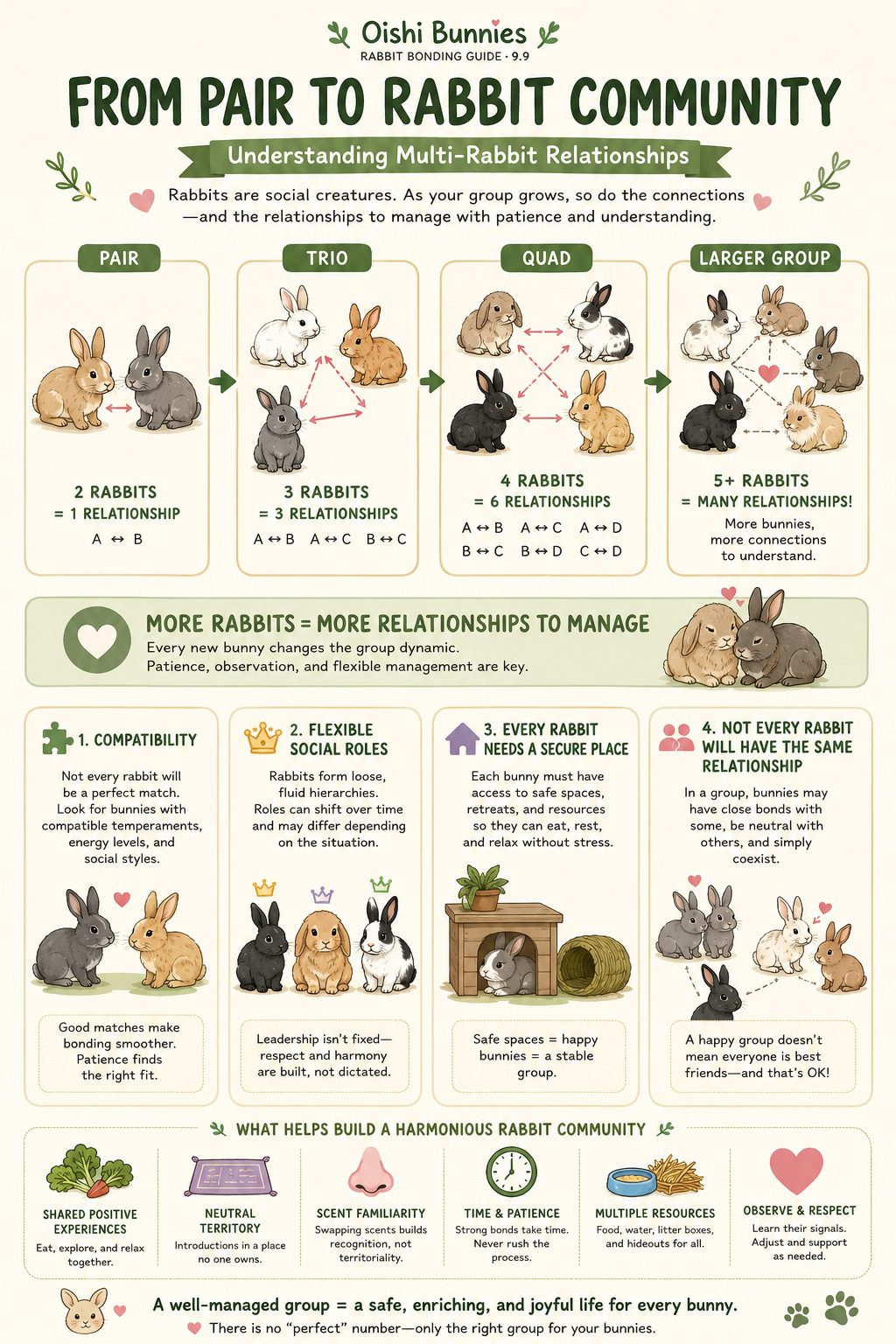
1. From Pair to Rabbit Community
A visual overview mapping the progression from a simple bond to a flourishing multi-rabbit group structure.
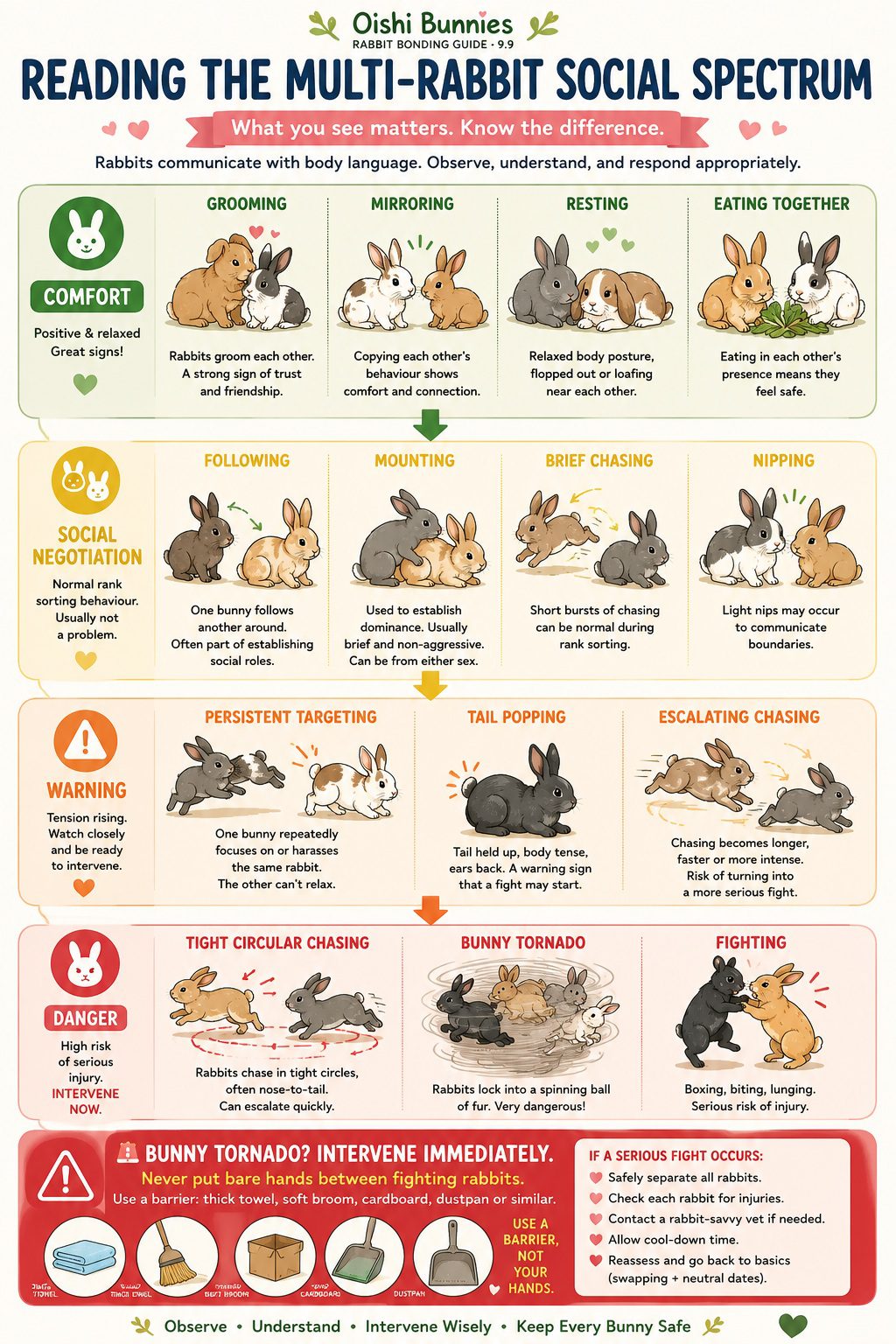
2. Reading the Multi-Rabbit Social Spectrum
Identify subtle group body language—from relaxed group grooming to warning signs requiring intervention.
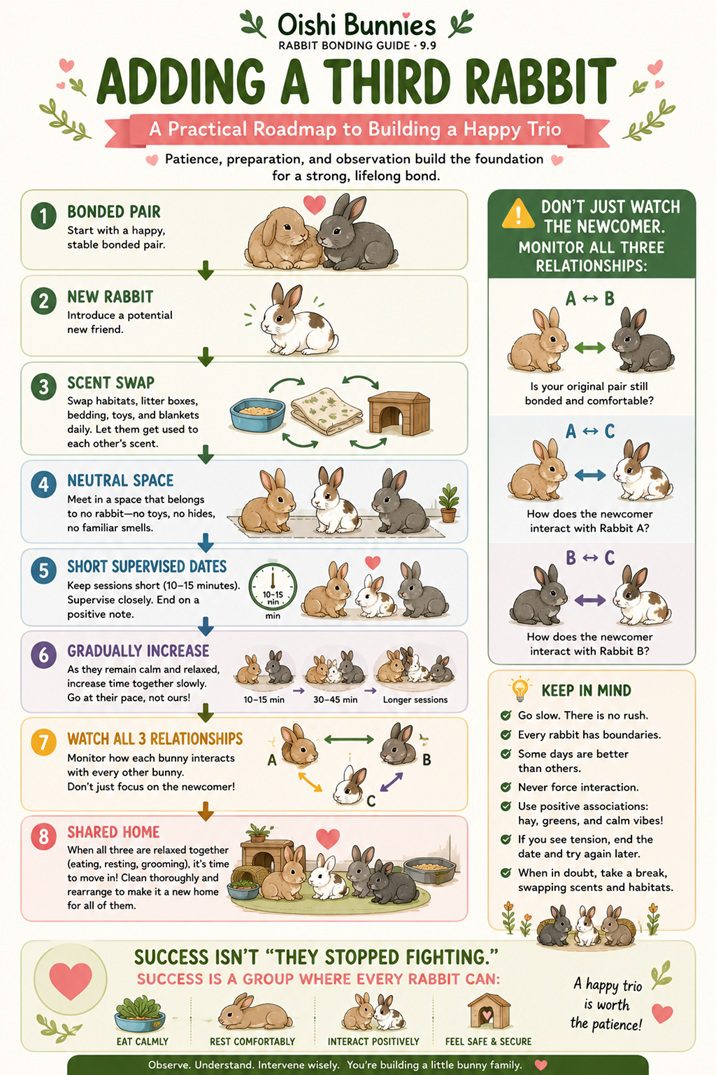
3. Adding a Third Rabbit
Step-by-step guidance on safely introducing a newcomer to an established pair without disrupting their existing bond.