
Understanding Behavior Signals

rabbit Behavior Signals

📱 Pro-Tip: Viewing on a phone? Select desktop mode or rotate to landscape for the best reading experience!

📖 Estimated Read Time: 5 Mins

🐾 Section 9.6

Understanding Rabbit Behavior Signals

Decoding Lagomorph Body Language, Social Dynamics, and Immediate Warning Flags

Rabbits are prey animals whose survival depends on subtle, highly sophisticated communication. Rather than relying on vocalizations, they express their emotional state, intentions, territorial boundaries, and social relationships through body posture, facial expressions, scent marking, movement, and touch.

During bonding, every interaction tells a story. A brief chase may simply be part of social negotiation, while a gentle nudge could be either a friendly greeting or a request for grooming. Likewise, grooming can express affection, reinforce social relationships, or help resolve minor tension.

💡 Key Takeaway

Understanding these behavioural signals is one of the most valuable skills for anyone bonding rabbits. It allows you to distinguish normal social negotiation from genuine aggression, reducing unnecessary intervention while protecting both rabbits from injury.

No single behaviour should be interpreted in isolation. Instead, consider the rabbit’s overall body language, the context of the interaction, and whether the relationship is becoming progressively calmer over multiple bonding sessions.

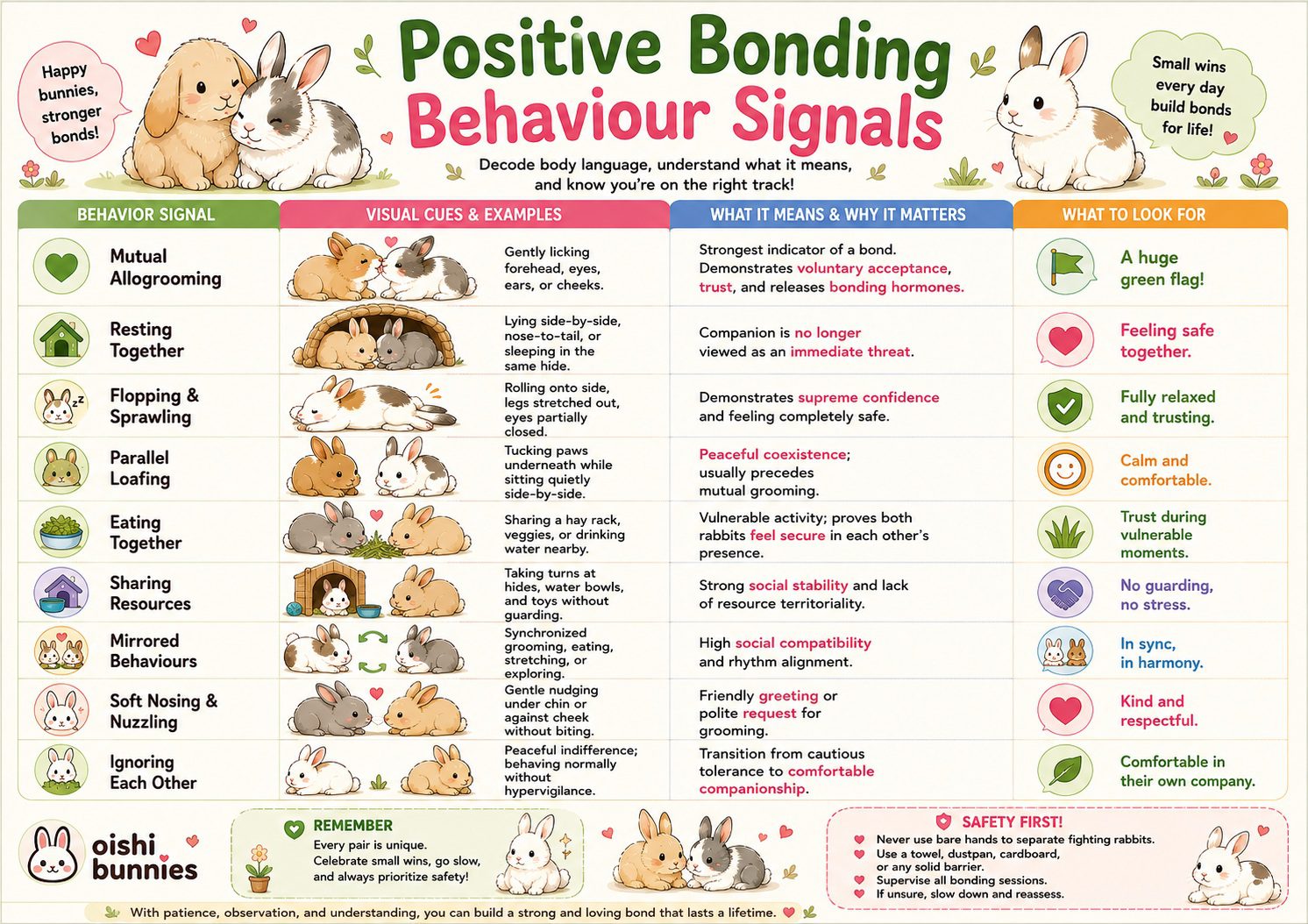
1. Positive Bonding Rabbit Behaviors to Celebrate

These green-light signals indicate that fear and territorial defensiveness are giving way to trust, mutual comfort, and social connection.

✨ Mutual Allogrooming

Licking the forehead, eyes, ears, or cheeks. Social grooming releases oxytocin, reduces tension, and cements pair bonds.
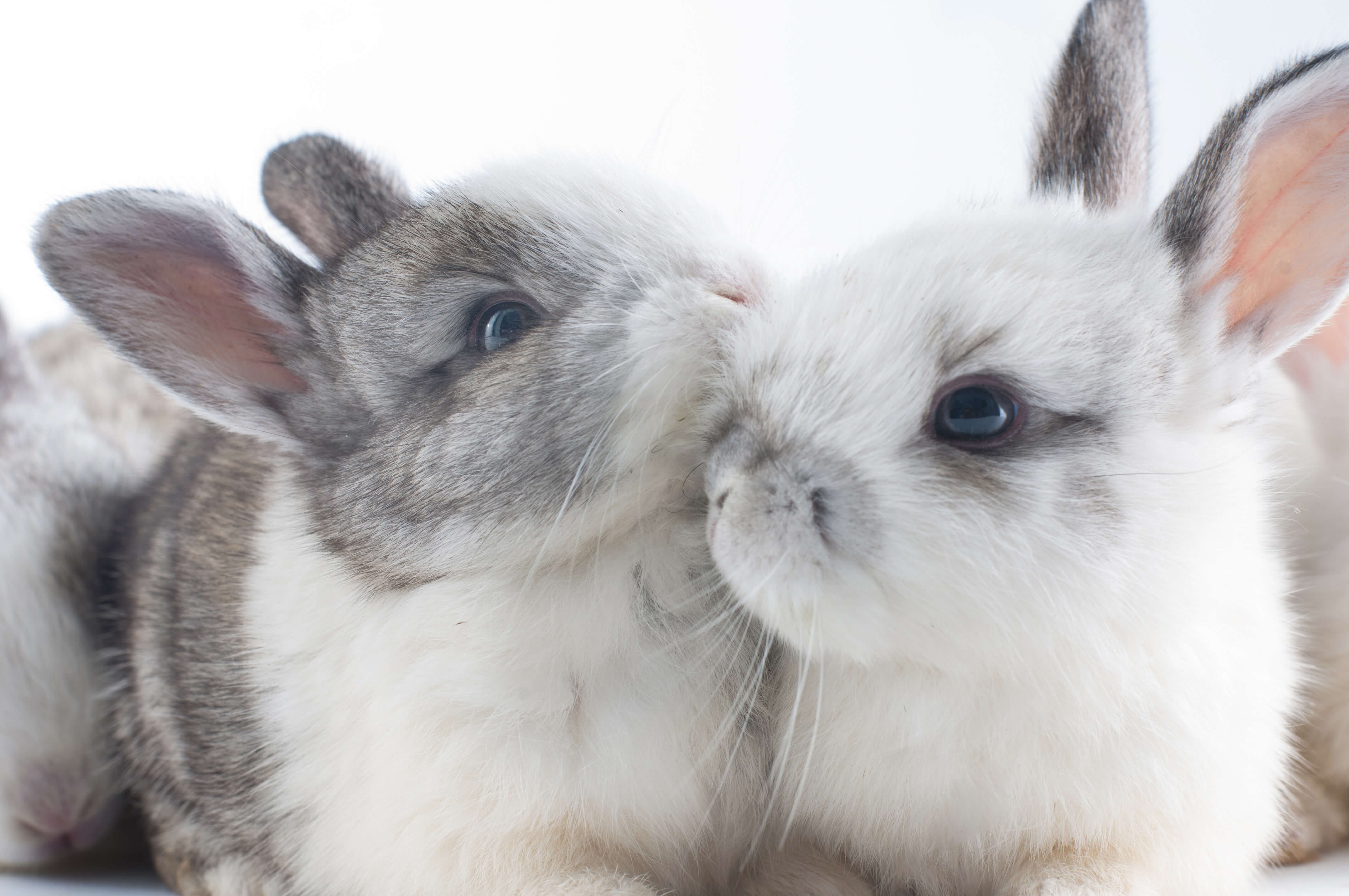
Two rabbits gently grooming each other
💡 Demonstrates acceptance, trust, and social comfort.

✨ Resting Together

Lying side-by-side, resting nose-to-tail, sharing a hide, or sleeping close to one another voluntarily.
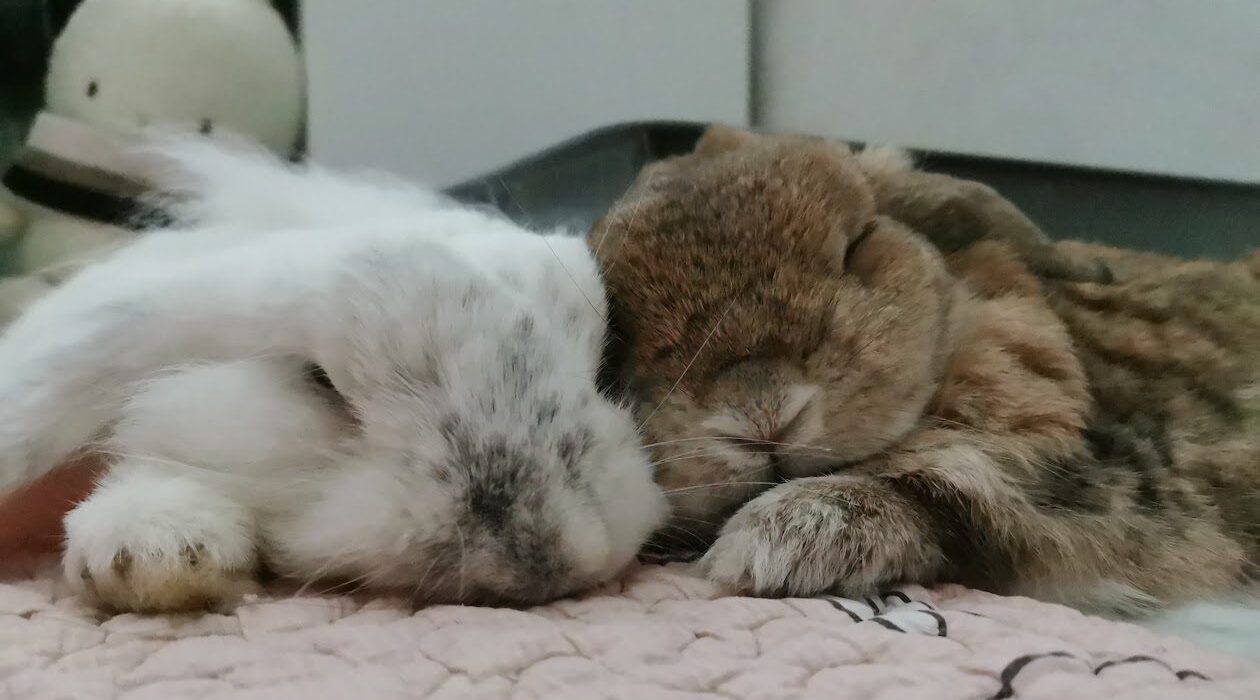
Two rabbits resting side by side
💡 Proves companion is no longer seen as a threat.

✨ Flopping & Sprawling

Rolling onto the side, fully extending hind legs, or resting with partially closed eyes in close proximity.

Rabbit completely flopped onto its side
💡 Clear signal of complete relaxation and security.

✨ Parallel Loafing

Tucking legs neatly beneath the body while sitting side-by-side quietly without avoidance or tension.

Two rabbits loafing in parallel
💡 Peaceful coexistence; often precedes grooming.

✨ Eating Together

Sharing hay piles, munching greens and treats calmly together, or drinking side-by-side without guard postures.
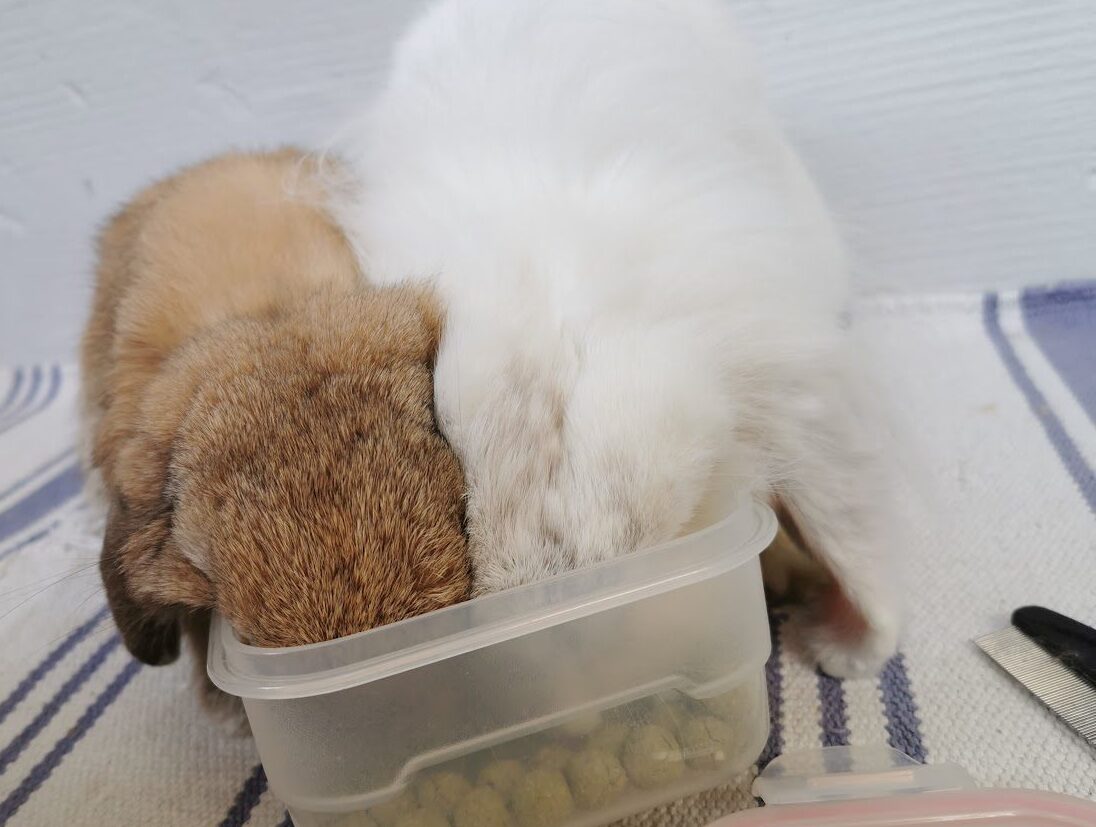
Two rabbits sharing food
💡 High security; rabbits are vulnerable while feeding.

✨ Sharing Resources

Using the same hay racks, water bowls, hides, and toys without resource guarding or displacement.
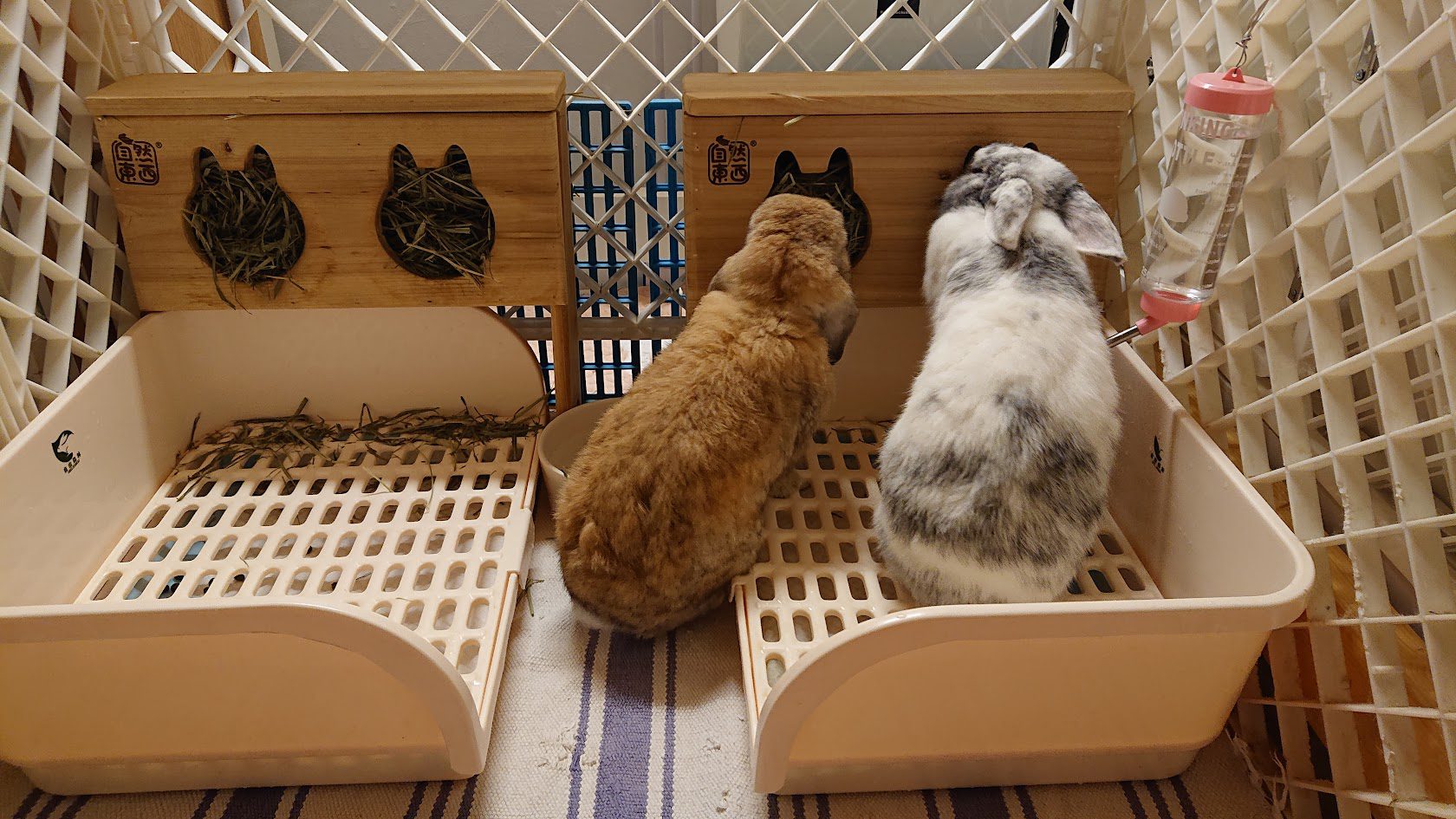
Rabbits sharing a hay rack
💡 Strong indicator of growing social stability.

✨ Mirrored Behaviours

Synchronizing routines—grooming themselves, stretching, eating, or exploring at the exact same time.
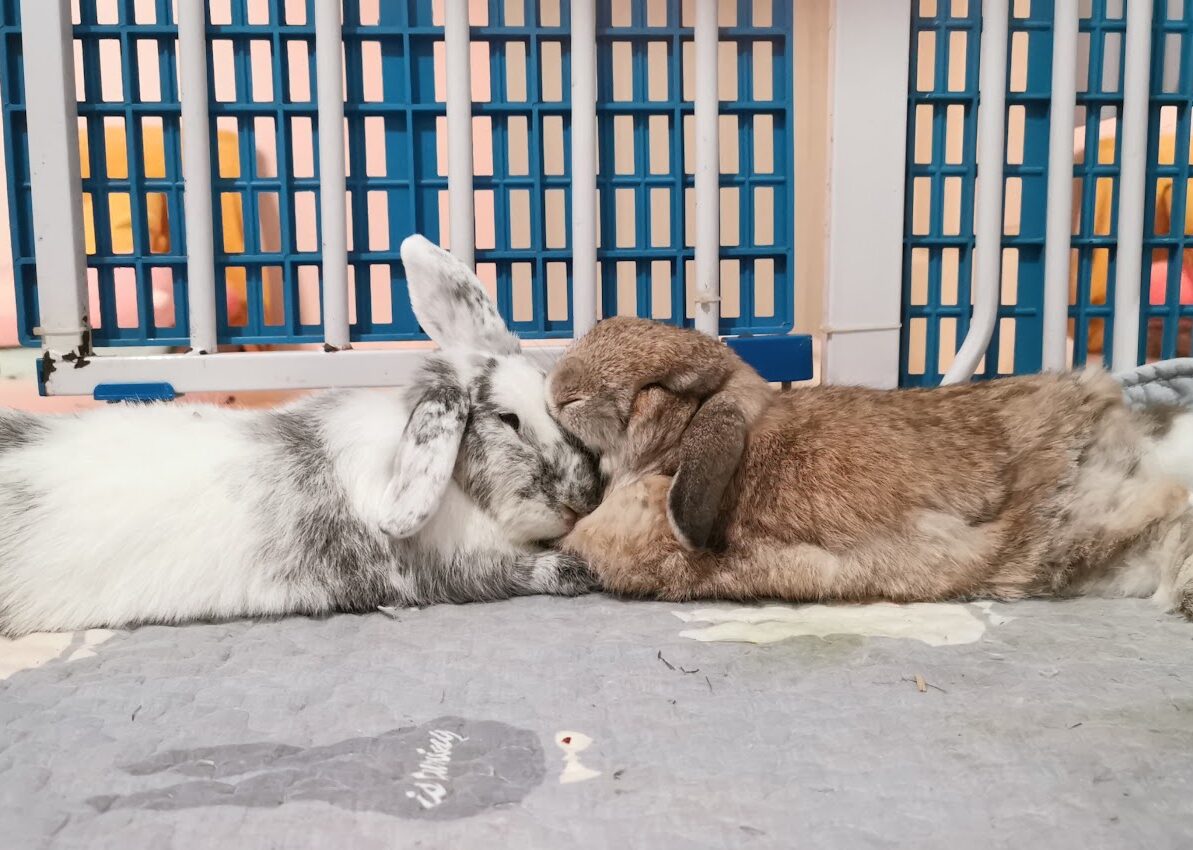
Rabbits grooming simultaneously
💡 Reflects deep rhythm alignment & compatibility.

✨ Soft Nosing & Nuzzling

Gentle nudging beneath the chin or cheek without biting. Used for greetings, curiosity, or asking to be groomed.
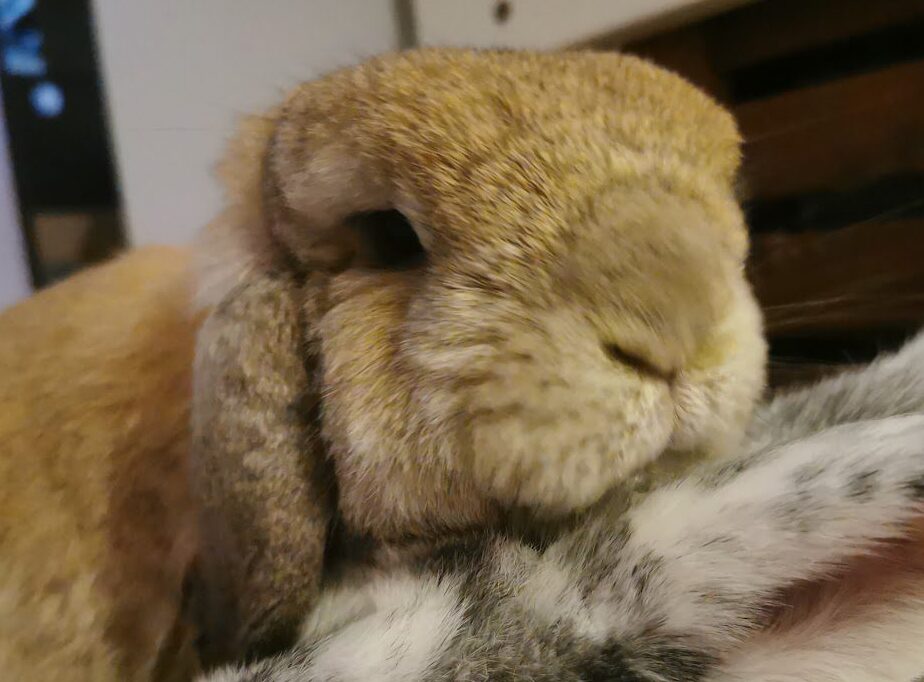
Rabbit soft nosing under chin
💡 Calm communication accompanied by loose posture.

✨ Ignoring Each Other

Transitioning from constant vigilance to behaving completely normally within the shared space.

Rabbits peacefully ignoring each other
💡 The Milestone: Shift from cautious tolerance to lifelong companionship.
2. Social Negotiation & Establishing Relationships

Domestic rabbits retain many of the social instincts of their wild ancestor, the European rabbit (Oryctolagus cuniculus), which naturally lives in structured groups with recognised social relationships.

When unfamiliar rabbits first meet, they gradually negotiate key social boundaries:

❓ Who moves away first?
❓ Who receives grooming?
❓ Who occupies preferred resting spots?
❓ Who yields during minor disagreements?

Some bonded pairs develop clear dominant and subordinate roles, while others share responsibilities more evenly. These relationships can also change over time depending on age, health, individual personality, and environmental circumstances.

The goal of bonding is not to eliminate these behaviours, but to allow rabbits to establish a stable social relationship without fear or injury.

Head Sliding (Grooming Requests)

A rabbit lowers its head beneath another’s chin, requesting—or demanding—grooming. Common during hierarchy negotiations.

Action: Allow. Most resolve naturally. Monitor only if prolonged standoffs escalate into nipping or distress.

Mounting (Forward)

A display of social status rather than sexual behaviour. Both males and females may mount, even after spay/neuter.

👀 Action: Monitor. Brief mounting is normal. Interrupt if it exceeds 10–15s, causes panic, or leads to chasing.

⚠️ Face (Reverse) Mounting

The mounting rabbit positions itself directly over the other rabbit’s head. Carries significant risk of defensive bites.

🛑 Action: Interrupt Immediately. High risk of severe bites to the eyes, face, ears, or genitals.

Short Chasing

Brief chases that help negotiate personal space and social boundaries.

Action: Allow brief chases that stop in a few seconds. Intervene if relentless, repetitive, or trapping occurs.

Chin Rubbing (Chinning)

Deposits scent from specialised chin glands onto objects or occasionally another rabbit.

Action: Normal & Harmless. Completely safe form of territorial and social communication.

Mild Nipping

A quick, low-force nip communicating “move,” “that’s my space,” or “please groom me.”

👀 Action: Observe. Acceptable if brief and does not break skin or escalate into repeated biting.

Mild Fur Pulling

Small tufts of loose fur may occasionally be removed during active social negotiation.

👀 Action: Monitor. End session if fur pulling becomes repeated, causes distress, or results in skin injury.

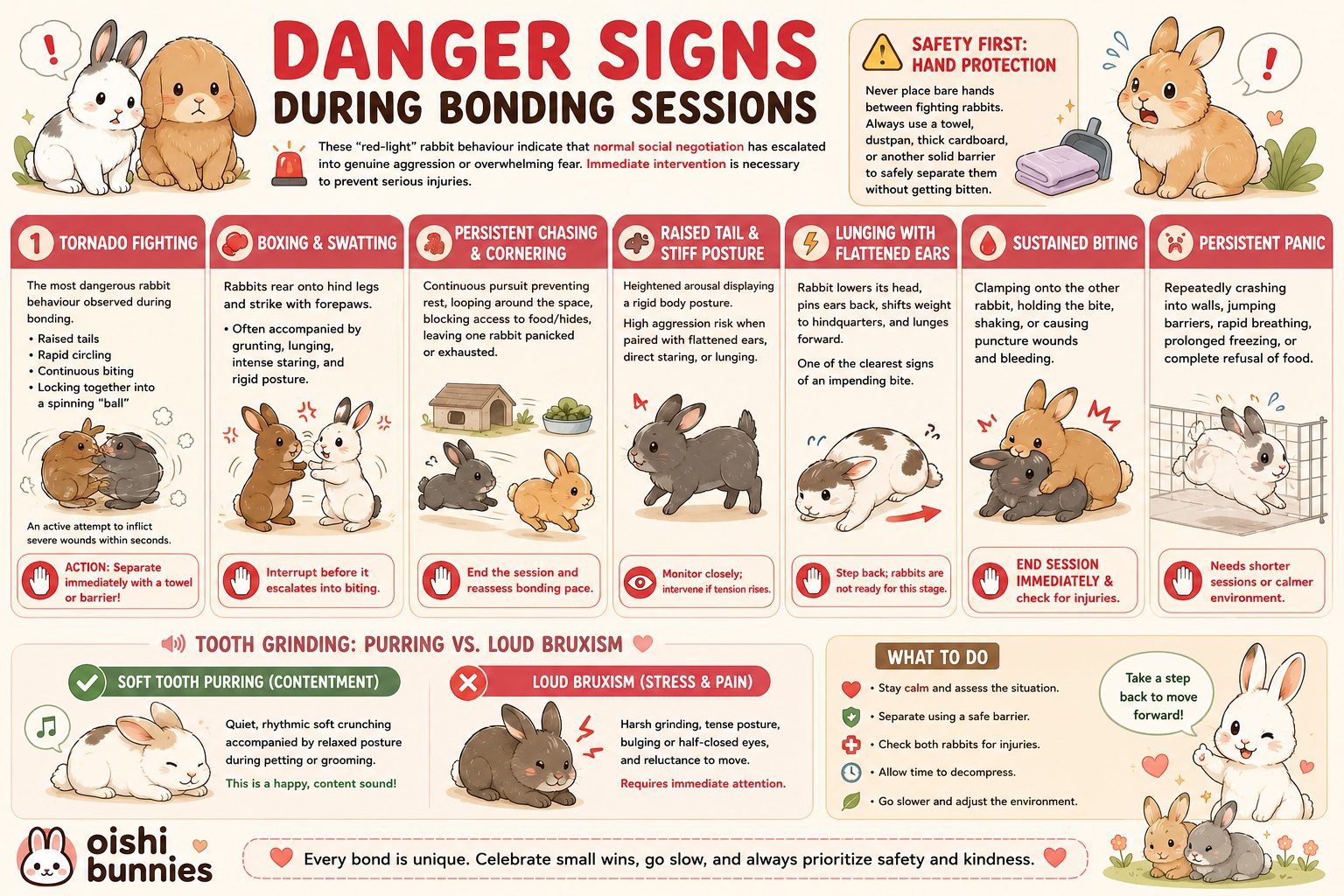
3. Danger Signs During Bonding Sessions

These “red-light” rabbit behaviour indicate that normal social negotiation has escalated into genuine aggression or overwhelming fear. Immediate intervention is necessary to prevent serious injuries.

⚠️ SAFETY FIRST: HAND PROTECTION

Never place bare hands between fighting rabbits. Always use a towel, dustpan, thick cardboard, or another solid barrier to safely separate them without getting bitten.

🚨 Tornado Fighting

The most dangerous rabbit behaviour observed during bonding. Characteristics include raised tails, rapid circling, continuous biting, and locking together into a spinning “ball.” An active attempt to inflict severe wounds within seconds.

🛑 ACTION: Separate immediately with a towel or barrier!

🥊 Boxing & Swatting

Rabbits rear onto hind legs and strike with forepaws. Often accompanied by grunting, lunging, intense staring, and rigid posture.

🛑 Interrupt before it escalates into biting.

🏃 Persistent Chasing & Cornering

Continuous pursuit preventing rest, looping around the space, blocking access to food/hides, leaving one rabbit panicked or exhausted.

🛑 End the session and reassess bonding pace.

🦡 Raised Tail & Stiff Posture

Heightened arousal displaying a rigid body posture. High aggression risk when paired with flattened ears, direct staring, or lunging.

👀 Monitor closely; intervene if tension rises.

💥 Lunging with Flattened Ears

Rabbit lowers its head, pins ears back, shifts weight to hindquarters, and lunges forward. One of the clearest signs of an impending bite.

🛑 Step back; rabbits are not ready for this stage.

🩸 Sustained Biting

Clamping onto the other rabbit, holding the bite, shaking, or causing puncture wounds and bleeding.

🛑 END SESSION IMMEDIATELY & check for injuries.

😨 Persistent Panic

Repeatedly crashing into walls, jumping barriers, rapid breathing, prolonged freezing, or complete refusal of food.

🛑 Needs shorter sessions or calmer environment.

🔊 Tooth Grinding: Purring vs. Loud Bruxism

Soft Tooth Purring (Contentment)

Quiet, rhythmic soft crunching accompanied by relaxed posture during petting or grooming.

Loud Bruxism (Stress & Pain)

Harsh grinding, tense posture, bulging or half-closed eyes, and reluctance to move. Requires immediate attention.

Quick Reference: When Should You Intervene?

A complete rabbit behavioral reference matrix for managing rabbit bonding sessions safely.

Observed Behavior Status Recommended Action
Sniffing, Parallel Loafing, Eating Together, Sharing Resources, Chinning, Peacefully Ignoring Each Other ✅ Usually Allow Allow naturally. Excellent positive signs of comfort and mutual tolerance.
Head-sliding (Grooming Requests), Brief Forward Mounting, Short Chasing, Mild Nipping, Small Loose Fur Pulling ✅ Usually Allow Allow active hierarchy negotiation. Hands off unless escalation occurs.
Repeated Mounting, Prolonged Chasing, Long Grooming Standoffs (“Nose-offs”) ⚠️ Monitor Closely Stay alert with a barrier ready. Interrupt gently if panic or exhaustion sets in.
Persistent Avoidance, Repeated Fur Pulling, Increasing Stress Rather Than Gradual Relaxation ⚠️ Monitor Closely Keep sessions brief. Reassess the bonding space and slow down progression.
Tornado Fighting, Face (Reverse) Mounting, Boxing Followed by Biting 🛑 Stop Immediately INTERVENE NOW using a cardboard/towel barrier to avoid injuries.
Sustained Biting or Clamping, Bleeding or Skin Wounds, Continuous Cornering, Repeated Lunging 🛑 Stop Immediately End session immediately. Check both rabbits for hidden wounds.
Persistent Panic (Wall-Crashing / Freezing), Loud Distress Vocalisations 🛑 Stop Immediately Separate right away. Return to calm, neutral individual spaces to recover.

Conclusion: The Big Picture of Rabbit Bonding

No single behaviour determines whether a rabbit bond will succeed. Instead, evaluate the overall trend across multiple bonding sessions.

🌱 Healthy progress is characterised by:

• Less chasing over time
• More relaxed body language
• More voluntary proximity
• Eating together comfortably
• Sharing resources peacefully
• Resting beside one another
• Increasing grooming
• Faster recovery after minor disagreements

Successful rabbit bonding is rarely completely conflict-free. Small disagreements, brief social negotiations, and occasional dominance-related behaviours are a normal part of rabbits learning to live together. The goal is not to eliminate these interactions, but to ensure they remain controlled, predictable, and become less frequent as trust develops.

By observing the whole rabbit—not just individual behaviours—you can better recognise when rabbits are building a healthy relationship and when intervention is needed to protect their welfare. Patience, careful observation, and respect for natural rabbit behaviour remain the foundations of safe, humane, and successful bonding.

Got More Questions About Rabbit Bonding?

Navigating initial meetings, neutral spaces, and hormonal hurdles can raise plenty of extra questions. Explore our complete, in-depth guide for more expert tips and troubleshooting advice!