
 Pro-Tip: Viewing on a mobile phone? Turn on desktop mode or rotate to landscape for the best reading experience!
 Estimated Read Time: 5 Mins
BONDING SERIES
Bonding Rabbit with Other Pets – Inter-Species Companionship
Introducing a rabbit to a household with other animals can be rewarding, but it requires a very different approach from bonding two rabbits.
Rabbits are prey animals. Dogs and cats may retain hunting, chasing, stalking, or pouncing behaviours even when they are friendly, well-socialised pets. An interaction that looks playful or curious to a human can become dangerous within seconds.
At the same time, not every dog or cat will pose the same level of risk. Individual temperament, previous experience, prey drive, training, environment, and the rabbit’s personality all matter.
 The Primary Objective
 The Primary Objective
The goal is not to force every pet to become friends.
The goal is to create a household where every animal feels safe.
 A Note on Companionship: A dog, cat, or other animal should also never be considered a substitute for a compatible rabbit companion. Rabbits are social animals, and inter-species companionship does not necessarily meet the same social needs as companionship from another compatible rabbit.
Core Behavior
The Biological Reality: Understanding the Predator–Prey Dynamic
Inter-species relationships must be viewed through the lens of both instinct and individual behaviour.
Potential Predator

 Potential Predator
- Dogs and cats may retain chase, stalk, grab, or pounce behaviours.
- Fast movement can trigger arousal or pursuit.
- Excitement and arousal can escalate rapidly.
- Friendly intent does not guarantee safe behaviour.
PREY ANIMAL

- Rabbits are highly sensitive to potential threats.
- Bolting can trigger further pursuit.
- Fear can trigger freezing, flight, or panic-kicking.
- A rabbit can be seriously injured even without intentional aggression.
A Calm Animal Is Not Necessarily a Safe Animal
A dog that calmly ignores a stationary rabbit may behave very differently if the rabbit suddenly runs.
Likewise, a cat casually sharing a room is very different from one that stalks, crouches, or repeatedly approaches from concealment.
Learning to recognise this difference is essential.
Canine Dynamics
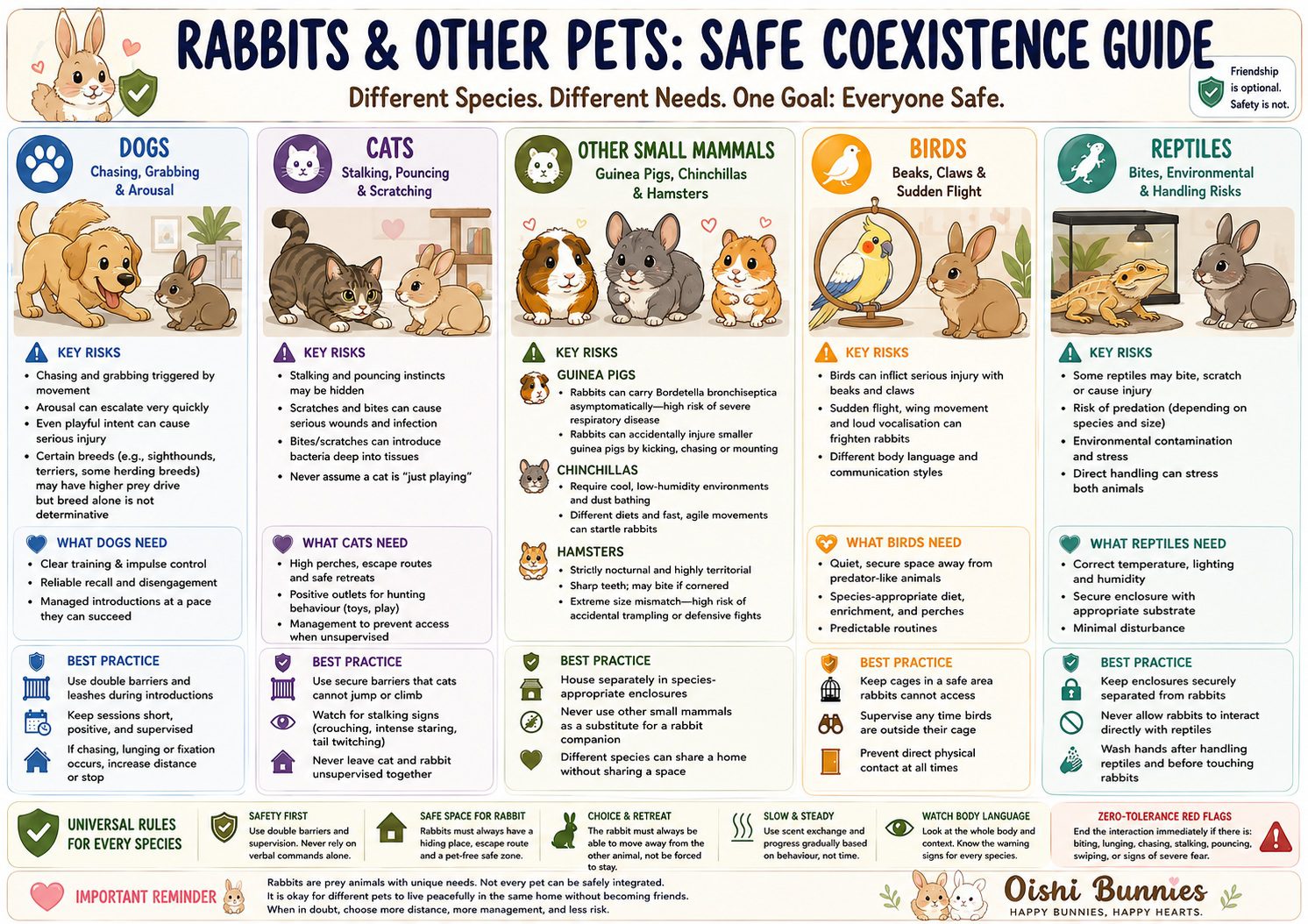
Dogs: Chasing, Grabbing & Arousal
Dogs vary enormously in their predatory behaviour. Some dogs can calmly coexist with rabbits, while others have a strong tendency to chase or grab small, fast-moving animals.
Certain breed groups — including sighthounds and some terriers — may warrant particular caution because individuals within these groups may have been selected for chasing or hunting small animals. Some herding breeds may also react strongly to rapid movement. However, breed alone cannot determine whether an individual dog is safe around a rabbit. Individual behaviour, temperament, training, and prey drive matter more than the breed label alone.
The Biggest Danger: Movement
 The Biggest Danger: Movement
A dog may appear completely relaxed while the rabbit is sitting still, then become highly aroused the moment the rabbit moves.
Watch for Predator Arousal:
- Intense staring or unblinking fixation
- Stiffening of the body or rigid posture
- Stalking or creeping forward
- Whining or trembling with excitement
- Inability to disengage or redirect attention
- Lunging or sudden chasing
- Attempts to mouth, grab, pin, or pursue the rabbit
 A dog that wants to chase the rabbit is not ready for direct interaction, regardless of how friendly they normally are. Even a brief grab or bite can cause severe injury to a rabbit.
Feline Instincts
Cats: Stalking, Pouncing & Scratching
Cats are obligate carnivores, and their hunting behaviour can be deceptively subtle. A cat may appear relaxed while quietly tracking a rabbit’s movements.
Watch for Feline Hunting Signals:
- Intense, fixed staring & dilated pupils
- Crouched, low-profile stalking posture
- Twitching or rapidly lashing tail
- Flattened or rotated ears
- Creeping toward the rabbit or approaching from concealment
- Sudden pouncing, swatting, or chasing
Never assume a cat is simply “playing” because it is small or because the rabbit is large.
Why Scratches and Bites Are Medical Emergencies
 Why Scratches and Bites Are Medical Emergencies
Any bite or scratch from a cat should be taken seriously in a rabbit. Cat bites and scratches can introduce bacteria deep into tissues, and puncture wounds may look deceptively minor on the surface. Serious infection and abscess formation can develop quickly.
If a rabbit is bitten or scratched by a cat, contact a rabbit-savvy veterinarian promptly rather than waiting to see whether the wound becomes infected. Do not rely on the wound looking small or clean.
Behavioral Observation
Reading Inter-Species Body Language
Body language must always be interpreted in full context. A single signal does not tell the whole story—look for subtle behavioral shifts across the entire animal.
One Important Distinction
- A wagging tail does not automatically mean a dog is safe or friendly.
- Likewise, a cat looking at a rabbit does not automatically mean it is hunting.
Always evaluate the whole body, context, intensity, and ability to disengage.
Other Small Mammals
Guinea Pigs, Chinchillas & Hamsters
While small mammals may all seem like natural friends, similar size does not mean compatible social or welfare needs.
Rabbits, guinea pigs, chinchillas, and hamsters have different diets, communication styles, activity patterns, housing requirements, and social structures. Direct mixing can therefore create unnecessary medical, physiological, and behavioural risks.
Another small mammal should also never be used as a substitute for a compatible rabbit companion.
Guinea Pigs
 Guinea Pigs
Rabbits and guinea pigs should not be housed together.
Respiratory Disease Risk Rabbits can carry Bordetella bronchiseptica in their upper respiratory tract without showing obvious illness. Guinea pigs are susceptible to serious respiratory disease caused by this bacterium. This is one reason veterinary and rabbit-welfare organisations advise against keeping the two species together.
Different Social & Dietary Needs Guinea pigs have their own species-specific social needs and require dietary vitamin C. Rabbits cannot provide the same type of companionship or communicate in the same way as another guinea pig.
Physical Injury Rabbits are considerably stronger than guinea pigs. A rabbit can accidentally injure a guinea pig through kicking, mounting, chasing, jumping, or sudden territorial behaviour. The smaller animal may also have limited ability to escape.
Chinchillas
 Chinchillas
Chinchillas have very different environmental and behavioural requirements from rabbits.
Different Environmental Needs Chinchillas require a cool, dry environment and appropriate dust bathing as part of their normal care. Their enclosure, substrate, ventilation, temperature, and hygiene requirements should be designed specifically for chinchillas rather than adapted around a rabbit. This does not mean rabbits and chinchillas cannot live in the same household; it means they should have separate, species-appropriate environments.
Different Behaviour & Physical Risk Chinchillas are agile, fast-moving animals that can make sudden movements. A rabbit may become startled by this activity, while a rabbit’s larger size and powerful hind legs can also pose a risk to a chinchilla during unwanted physical interaction. There is little welfare benefit in deliberately making them share an enclosure or exercise space.
Hamsters
Hamsters are another species that should be kept separately from rabbits.
Different Social & Activity Patterns Hamsters have species-specific behavioural needs and many are naturally solitary. Their activity often increases during the evening and night, although patterns vary by species and individual. A rabbit cannot substitute for another hamster, and a hamster cannot substitute for a rabbit companion.
Territorial & Defensive Behaviour A hamster that feels threatened or cornered may defend itself with its teeth. A rabbit may also unintentionally frighten or injure a hamster through stepping on them, kicking, chasing, nudging, or attempting to investigate them. Because of the extreme size difference, even a seemingly harmless interaction can result in injury.
The Golden Boundary
Different species can share a home without having to share a space.
 No
NoThe purpose of separation is not to suggest that these animals are inherently dangerous or incompatible as household members. It is about respecting species-specific welfare needs.
Your rabbit can happily live in a home with guinea pigs, chinchillas, or hamsters without ever sharing their enclosure or having direct physical contact with them.
If every animal has:
- Appropriate companionship
- Appropriate housing & food
- Species-appropriate enrichment
- Freedom from unnecessary fear
- A secure place to retreat
 Peaceful separation can be an excellent welfare outcome. They don’t need to become friends to be part of the same family.
Specialty Pets
Other Species: Birds & Reptiles
Non-mammalian pets operate on completely different social, behavioural, and physiological dynamics. Safe cohabitation requires strict boundaries to prevent severe physical injury or chronic stress.
Birds
 Birds
BirdsLarge parrots and other avian pets can inflict serious, painful injuries with their powerful beaks and talons.
Rabbits are ground-dwelling prey animals that may become easily frightened by sudden flying, unpredictable wing movements, or loud vocalisations above them.
Birds and rabbits possess fundamentally different body language and communication styles. Apparent curiosity or approach from either pet should never automatically be interpreted as an invitation for direct physical interaction.
Reptiles
 Reptiles
Cohabitation risks vary enormously depending on the specific reptile species, size, and predatory drive.
Primary Safety Concerns:
- Predation & Feeding Instincts: Larger species may view small rabbits as prey.
- Bites & Scratches: Defensive actions can easily break delicate rabbit skin.
- Environmental Contamination: Risk of bacterial transfer (e.g., Salmonella).
- Inappropriate Physical Contact: Clashing habitat needs (heat lamps, humidity levels).
A reptile enclosure should always remain securely latched and completely separated from a rabbit’s living and free-roam areas. Never allow a rabbit to interact directly with a reptile simply because the reptile appears calm or stationary.
Prey Animal Physiology
The Rabbit’s Side of the Equation
Rabbits do not need to be physically attacked to become frightened.
The presence of a predator-like animal, persistent staring, stalking, barking, or chasing can be highly stressful for a rabbit.
Frightened Rabbit Indicators
 Freezing completely
 Pressing flat to the floor
 Repeated thumping
 Rapid breathing
 Bolting / Frantic escape
 Becoming unusually withdrawn
 Hiding constantly
 Refusing food
A frightened rabbit may also kick violently when trying to escape restraint or pursuit. Powerful panic-kicking can result in serious musculoskeletal or spinal injuries.

CRITICAL MEDICAL ALERT: Gut Stasis Risk
Stress directly disrupts normal appetite and gut function. If a rabbit stops eating or produces significantly fewer droppings after a frightening interaction, do not assume it is simply “temporary stress.”
Reduced appetite and faecal output can be signs of a potentially life-threatening medical emergency. Contact a rabbit-savvy veterinarian promptly.
Foundational SAFETY Protocol
Non-Negotiable Pet Safety Rules
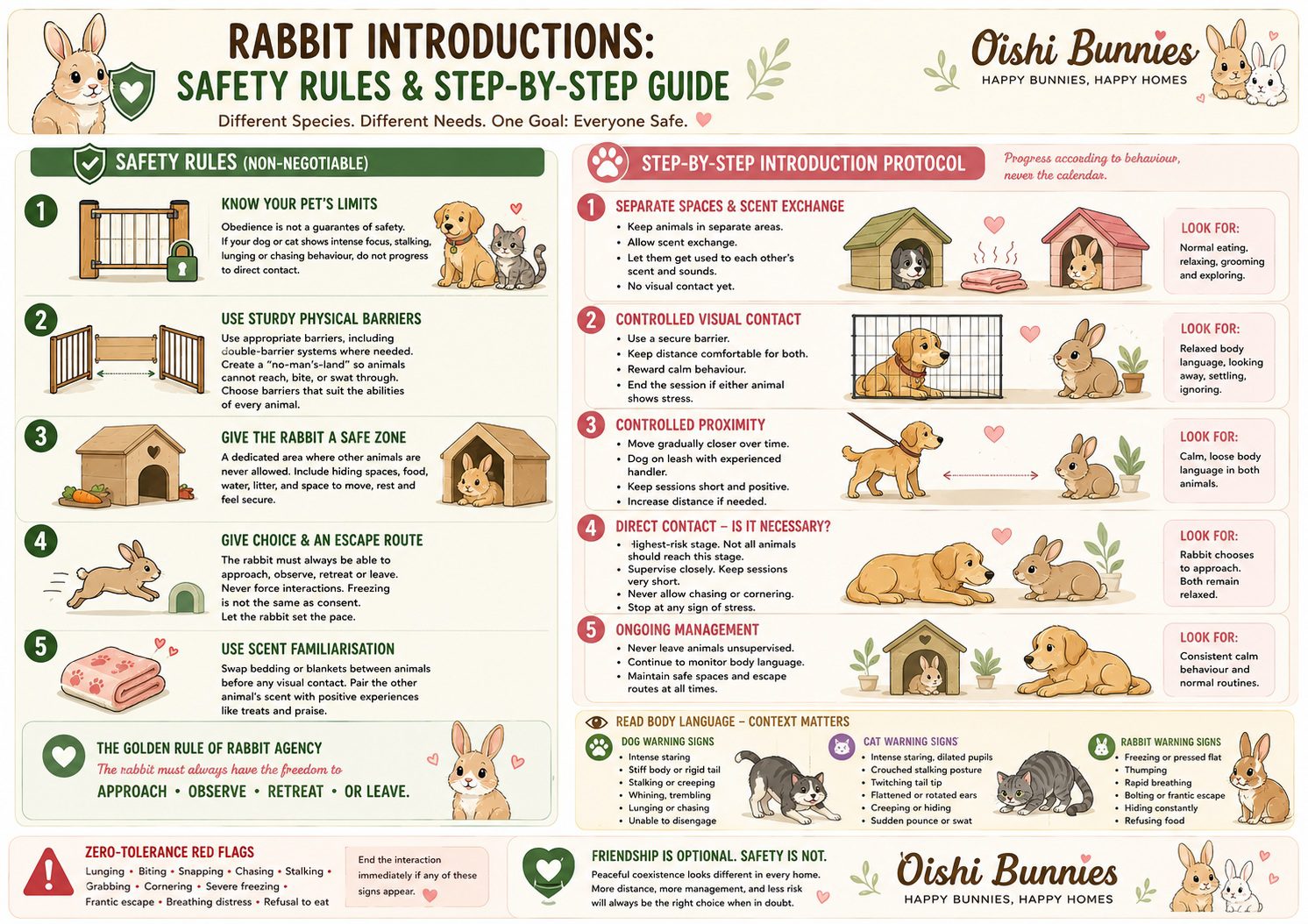
Before attempting any introduction, establish your safety system first.
1. Know Your Dog’s/Cat’s Limits
A dog should reliably respond to core cues such as: sit, stay, leave it, come, and disengage.
Important: Obedience is not a guarantee of safety. If your dog becomes intensely focused, lunges, or cannot disengage, do NOT progress to direct contact. Training reduces risk—it does not justify taking unnecessary chances.2. Use Sturdy Physical Barriers
Never depend entirely on verbal commands. Use heavy-duty exercise pens, solid doors, or secure gates chosen according to the abilities of every animal involved (e.g., cats can jump over standard gates; large dogs can knock over lightweight pens).
 What Is a Double Barrier?
A double barrier uses two separate barriers with a buffer zone (“no-man’s-land”) between them so neither animal can swipe, bite, lean over, or reach across. The goal is complete physical isolation—not a specific number of inches.
3. Give the Rabbit a Safe Zone
A dedicated, permanent area strictly off-limits to other pets. Must include non-slip flooring, hiding spots with safe exits, food, water, litter, and freedom from persistent visual pressure.
4. Choice & Escape Routes
Never force proximity. The rabbit must control distance at all times. Note: Freezing is a fear response, not acceptance or comfort.
The Golden Rule of Rabbit Agency
Approach. Observe. Retreat. Leave.
A safe introduction is one where the rabbit maintains total control over its own distance.
5. Scent Familiarisation First
Swap blankets, bedding, or brushes before visual contact. Pair the new scent with positive treats to build calm associations. Never rush this stage.
Step-By-Step Guide
Phase-by-Phase Safe Introduction Protocol
There is no universal timeline for introducing animals. Some households may progress over days, others may require weeks, and some may never reach a stage where direct interaction is appropriate.
 Core Principle: Progress according to behaviour, never the calendar.
PHASE 1 Separate Spaces & Scent Exchange
Start with complete physical separation. Allow each animal to smell the other animal’s scent, hear normal household sounds, and gradually become accustomed to the other’s presence while continuing normal eating, resting, grooming, and daily activities.
 Do not move forward simply because a certain number of days has passed.
PHASE 2 Controlled Visual Contact
Use a secure physical barrier and allow the animals to see one another from a comfortable distance.
Reward calm behaviour in the dog or cat when they:
- Look away, relax, or settle
- Respond promptly to their handler
- Completely ignore the rabbit
If the other animal hyper-focuses, stalks, barks, lunges, or reaches, increase distance or end the session immediately. The rabbit must always be allowed to retreat.PHASE 3 Controlled Proximity
Only consider moving closer when both animals consistently remain relaxed around the barrier.
- Dogs: Use a secure leash handled by an experienced person.
- Cats: Continue using barriers rather than physically restraining a frightened cat.
Keep sessions short. There is no prize for progressing quickly. A successful session may simply involve the dog lying calmly several metres away while the rabbit eats hay. That is progress.
PHASE 4 Direct Contact — Is It Really Necessary?
Direct physical contact should be considered the highest-risk stage, not the inevitable final step. Some animals should never reach this stage.
If direct contact is attempted, strictly follow these rules:
- Have experienced handlers present.
- Keep sessions extremely short and maintain an immediate method of separation.
- NEVER allow chasing, cornering, or forcing the rabbit toward the other animal.
- NEVER leave the animals unattended or test whether an animal can “catch” the rabbit.
- Stop immediately if either animal becomes distressed or shows predatory behaviour.
Note for dogs: A leash provides an additional layer of control, but it is never a substitute for appropriate barriers and good judgment. The rabbit must always retain a safe escape route.
Critical Safety Protocol
Rabbit Multi Pet Safety: Separation & Risk Assessment
When Rabbit Multi Pet Safety Requires Permanent Separation
When Pets Should Stay Strictly Separated
Permanent separation may be the safest long-term option when:
- A dog repeatedly attempts to chase, grab, or attack.
- A cat repeatedly stalks or pounces on the rabbit.
- An animal cannot disengage despite consistent training.
- Barriers are repeatedly challenged or breached.
- The rabbit remains chronically frightened.
- Rabbit’s eating, toileting, or resting habits alter.
- There has been a past attack, bite, or injury.
- The pet has a known history of harming small animals.
 Permanent separation is not a failure—it is responsible animal care.
Zero-Tolerance Red Flags
Stop the interaction IMMEDIATELY if you observe:
Predator Signals:
- Lunging, snapping, biting, or chasing
- Predatory pouncing, grabbing, or pinning
- Repeated stalking or inability to disengage
Rabbit Distress Signals:
- Frantic escape attempts or severe freezing
- Repeated thumping or breathing distress
- Sudden refusal to eat after session
Create distance first. Evaluate later.
Management Solutions: Some households achieve peaceful coexistence through carefully managed shared spaces, while others thrive with separate rooms or rotational free-roam schedules. The correct solution is whichever allows every animal to live safely and behave normally.
Closing Perspective
Friendship Is Optional. Safety Is Not.
The internet is full of photos of rabbits cuddling cats and dogs. While genuine, they shouldn’t set unrealistic expectations.
Three Equally Successful Outcomes:
- Some rabbits and dogs become wonderful companions.
- Some rabbits happily ignore the family cat.
- Some animals are safest living on opposite sides of a secure barrier.
Your rabbit does not need an inter-species best friend to have a happy life.
If your rabbit eats normally, explores, rests, plays, grooms, and behaves naturally while safely separated, you have achieved the true goal: peaceful coexistence without fear.
Final Takeaway: The Three Golden Rules When Bonding Rabbit with Other Pets
1. Respect the Rabbit
Rabbits are prey animals with a distinct perception of danger. Always give them total agency to retreat, make choices, and return to a secure space.
2. Respect Instinct

 2. Respect Instinct
Even the most loving, well-trained dog or cat possesses ingrained predatory behaviors that can be instantly triggered by sudden movement.
3. Respect the Boundary
Barriers, supervision, separation, and slow introductions are not signs of failure—they are what make responsible coexistence possible.
When in doubt, choose more distance, more management, and less risk.
Because with rabbits, preventing one dangerous moment is always better than trying to recover from it.