 Pro-Tip: Viewing on a mobile phone? Turn on desktop mode or rotate to landscape for the best reading experience!
 Estimated Read Time: 4 Mins
 Rabbit Care & Welfare
Is My Bunny Lonely? Deciding If You Should Get a Buddy for Your Bunny
Rabbits are fundamentally social animals. Wild European rabbits (Oryctolagus cuniculus) live in social groups associated with interconnected burrow systems, using a rich range of behaviors to communicate, rest, groom, and interact.
So if your rabbit lives alone, you may eventually find yourself wondering:
“Is my bunny lonely?”
It’s an important question—but there isn’t a single behavior that can tell you definitively whether your rabbit needs a companion. A rabbit who seems quiet may simply be relaxed. A rabbit who follows you everywhere may be highly social. A rabbit who suddenly becomes withdrawn may not be lonely at all—they may be unwell.
And getting a second rabbit isn’t as simple as bringing home another bunny and hoping they become best friends.
A compatible companion can provide something humans cannot fully replicate: true rabbit-to-rabbit companionship. But choosing a companion requires preparation, patience, space, financial commitment, and a willingness to let the rabbits develop their own relationship.
 Before Looking for Bunny #2
Before you start looking for a second rabbit, it is vital to evaluate the bigger picture: ruling out medical causes, assessing behavioral cues, and evaluating your home environment.
Is My Bunny Lonely?
Rabbits rarely make their emotional state obvious. Unlike dogs, they don’t usually bark or whine when they want company. Their signals can be subtle, and behaviors that look like “loneliness” can have many different explanations.
Possible Clues Your Solo Rabbit Needs More Stimulation:
- Destructive behavior: Repeatedly chewing carpets, baseboards, or enclosure bars despite having appropriate chew items.
- Restlessness: Repeatedly pacing, digging compulsively at corners, or persistently seeking interaction.
- Withdrawal: Spending unusually long periods hiding or showing little interest in their surroundings.
- Excessive attention-seeking: Persistently nudging, following, or demanding head rubs whenever you are nearby.
- Changes in grooming: Excessive grooming, pulling fur, or repeatedly grooming inanimate objects.
- Reduced engagement: Showing little interest in toys, exploration, or enrichment that previously interested them.
 The Key Takeaway
Think of these behaviors as clues that something needs attention—not an automatic diagnosis of loneliness. Boredom, frustration, fear, stress, environmental changes, or pain can all cause similar behavioral shifts.
Always Rule Out Health Problems First
This is critical because prey animals naturally mask illness until they can no longer hide it. A rabbit that suddenly becomes quiet, withdrawn, or inactive may not be asking for a friend—they may be in medical distress.
Red Flag Symptoms to Watch For:
- Reduced appetite or selectivity with food
- Fewer, smaller, or abnormally shaped droppings
- Unusual lethargy or sitting in a tight, “hunched” posture
- Loud teeth grinding (a sign of severe pain, distinct from soft tooth purring)
- Drooling, wet chin, or difficulty chewing
- Sudden weight loss or breathing difficulties
 Veterinary Caution
Pain and illness, including gastrointestinal or dental problems, can cause a rabbit to become quiet, withdrawn, or inactive. If your rabbit’s behavior changes suddenly, always consult a rabbit-savvy veterinarian before assuming the issue is purely emotional.
Why Rabbit Companionship Matters
Why do rabbit welfare organizations emphasize pairs so heavily? Because another compatible rabbit provides a unique social bond that humans simply cannot replicate.
 What a Bonded Pair Shares
 Mutual Grooming
 Rest & Security “Rabbit Language” Shared Activity
 Critical Caveat
Organizations like the Rabbit Welfare Association & Fund (RWAF) consider appropriate rabbit companionship vital for emotional wellbeing. However, rabbits benefit from companionship, but that does not mean any two rabbits will automatically get along.
A Second Rabbit Is Not Automatically a Friend
 The Biggest Misconception in Pet Care
Lonely Rabbit + New Rabbit = Instant Best Friends
Rabbits are naturally territorial. Bringing home an unannounced stranger often leads to a territorial reaction: “Excuse me, who is this in my house?”
A poor or rushed introduction can trigger aggressive chasing, biting, extreme stress, and severe injuries.
Successful companionship requires:
- Compatible, individual personalities
- Adequate space for separate transition housing
- Spaying/Neutering (essential for stabilizing hormones)
- Gradual introductions on neutral territory
- Careful supervision and infinite patience
Are YOU Ready for a Second Rabbit?
Before adopting, evaluate your household environment objectively:
 1. Space Requirements
You need enough room for their permanent bonded lifestyle plus a completely separate housing setup during the bonding phase (which can take weeks or months).
 RWAF standard reference: Minimum permanent space of 3m × 2m × 1m (10ft × 6.5ft × 3.5ft) for a pair. 2. Financial & Veterinary Commitment
Two rabbits mean doubling your ongoing expenses:
- Double the annual health checks and vaccinations
- Twice the budget for dental care, emergent GI stasis treatment, and medications
- Increased supply costs (hay, greens, litter)
 3. Spay / Neuter Status
Both rabbits must be neutered/spayed before attempting physical introductions. This reduces territorial aggression, prevents unwanted litters, eliminates reproductive cancers (especially uterine cancer in females), and helps stabilize mood swings.
The Reality of Rabbit Bonding
Bonding is a structured process—not a first date with a guaranteed happy ending.
 Step-by-Step Bonding Roadmap
 Emergency Note
Genuine fighting (rapid circling, lunging, biting, or “tornado fights”) is an emergency. Separate them immediately using a barrier (like a piece of cardboard or towel)—never put bare hands between fighting rabbits.
Consider Rescue Matchmaking or Experienced Support
 Consider Rescue Matchmaking or Experienced Support
If you decide to proceed, consider working with a reputable rabbit rescue or experienced bonding service that offers structured matchmaking or supervised compatibility assessment.
Some services may use “bunny dating” as part of their process, but methods vary. Look for a welfare-focused service that allows rabbits to be introduced safely rather than forcing interaction.
 Pro Tip: Choosing a potential partner based on temperament and compatibility is generally more meaningful than choosing purely on appearance.
What If You Can’t Get Another Rabbit?
If space, budget, or life circumstances mean a second rabbit isn’t feasible right now, don’t feel guilty. You can still provide an amazingly rich, fulfilling life for your solo bunny:
 Spend Ground-Level Quality Time Enhance Foraging Opportunities
 Rotate Enrichment Regularly
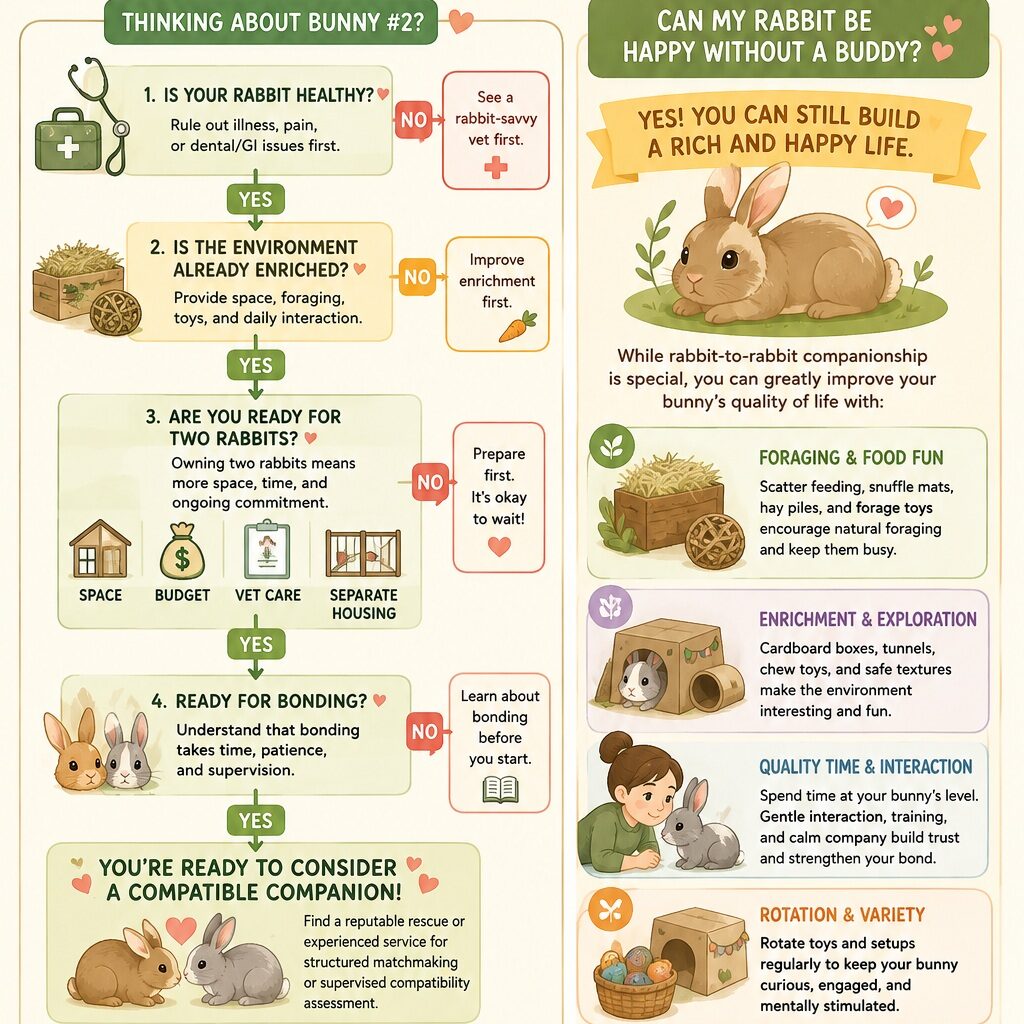
 Decision Framework: Does Your Rabbit Need a Buddy?
 Decision Framework: Does Your Rabbit Need a Buddy?
 PROCEED IF:
- Both rabbits are healthy and desexed.
- You have ample neutral space for step-by-step bonding.
- You are financially prepared for doubled vet and supply costs.
 PAUSE IF:
- The behavioral change was sudden (rule out pain/illness first).
- You haven’t optimized environmental foraging and enrichment yet.
 STOP IF:
- You lack space to keep them housed separately during bonding.
- Either rabbit is unneutered/unspayed.
- You expect instant friendship without a managed bonding process.
 The Bottom Line
Rabbits are social animals, and a compatible rabbit companion can provide a level of comfort, security, and joy that humans cannot completely replace.
However, a second rabbit shouldn’t be brought home out of guilt. It should be a deliberate, well-prepared decision to give two individual animals the chance to form a safe, voluntary, and lifelong partnership.
When that bond takes hold? There is nothing quite as rewarding as watching two bunnies choose each other.
Oishi Bunnies
At Oishi Bunnies, we believe good rabbit care isn’t about following one-size-fits-all rules. It’s about understanding the unique individual in front of you.
If you’re considering expanding your bunny family, take your time, do your research, and make every decision with your rabbit’s health, welfare, and long-term happiness at heart!
Discover how we rescue, rehabilitate, and rehome buns across borders to give every rabbit a second chance at a loving home.