
Step 1: Identify Your Rabbit’s Coat Type
Before selecting grooming tools, look at your rabbit’s actual coat: its length, density, texture and any areas that tangle easily. Breed can offer useful clues, but individual rabbits and crossbreeds vary. Use these practical coat groups as a starting point, then adapt your approach to your rabbit’s needs.
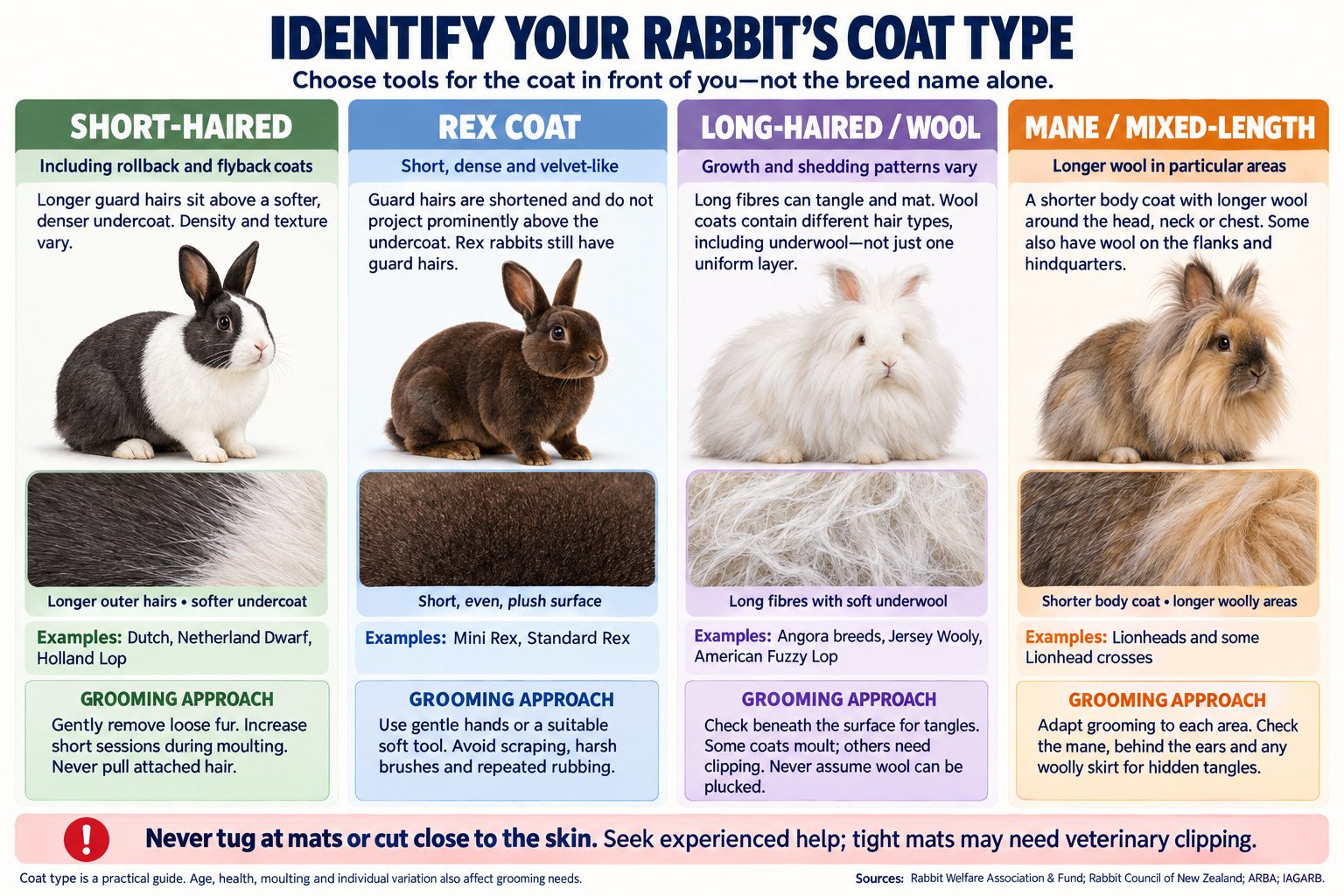
- Short-Haired (Including Rollback and Flyback Coats):
Usually has longer guard hairs above a softer, denser undercoat. Coat density and texture vary considerably. “Rollback” and “flyback” describe how the coat returns to position after being stroked against its natural direction; they do not determine how much brushing pressure a rabbit can tolerate.
Examples include: Dutch, Netherland Dwarf, Holland Lop, Mini Lop, French Lop and English Spot. - Rex Coat:
A short, dense, plush coat with a distinctive velvet feel. The guard hairs are shortened and do not project prominently above the undercoat, creating a relatively even coat surface. Rex rabbits still have guard hairs; describing them as having no protective coat layer is misleading. Groom gently and avoid repeated rubbing or tools that scrape the skin.
Examples include: Mini Rex and Standard Rex. - Long-Haired / Wool Coat:
Has long fibres that can tangle and form dense mats, particularly where the coat rubs together or becomes damp. Growth, shedding patterns and maintenance needs differ between breeds and individual rabbits. Some wool coats release during a moult, while others require regular clipping; do not assume that every long-haired rabbit sheds in the same way or that attached wool can be safely plucked.
Examples include: English Angora, French Angora, Jersey Wooly and American Fuzzy Lop. - Mane / Mixed-Length Coat:
Combines a shorter body coat with longer wool around the head, cheeks, neck or chest. Some rabbits also have longer wool around the flanks and hindquarters. Groom each area according to its texture and tendency to tangle, rather than applying one technique across the whole body. This is a practical grooming category, not a separate anatomical “hybrid” coat type.
Examples include: single-maned and double-maned Lionheads, and some Lionhead crosses.
Step 2: Assess the Stage of the Rabbit Moult
Understanding the rabbit moult helps you adapt rabbit coat care to the amount of loose fur, the condition of the skin and your rabbit’s comfort. For practical rabbit grooming, you can describe a moult as beginning, actively shedding or settling down. These are observation stages—not precise biological hair-cycle phases. Different areas may shed at different times, and some indoor rabbits have prolonged or irregular moulting patterns.
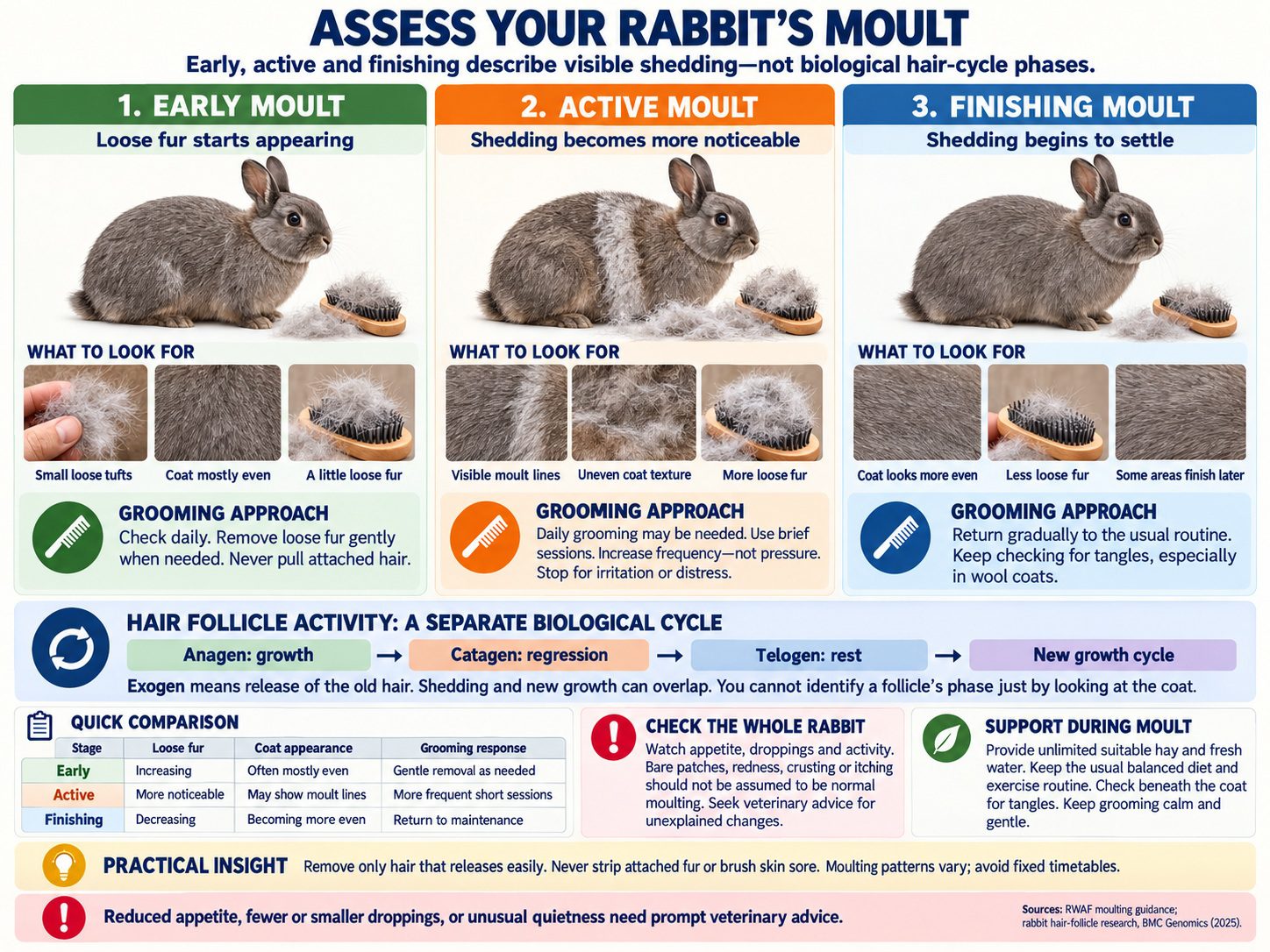
- Early Rabbit Moult: Loose Fur Starts Appearing
You may notice more hair on your hands, bedding or grooming tools, with small tufts beginning to loosen. Much of the coat may still look unchanged. Check gently for loose hair and developing tangles without pulling at fur that remains attached.
Grooming approach: Check daily and use short, gentle sessions when loose fur needs removing. There is no need to force a larger amount out. - Active Moult: More Noticeable Rabbit Shedding
More loose fur may collect during grooming, and visible moult lines or differences between old and new coat can appear. These changes may move across the body or occur in separate areas. Part the coat gently to check beneath the surface, especially in dense or woolly areas where loose hair can become trapped.
Grooming approach: Daily rabbit grooming may be needed, sometimes divided into several brief sessions. Increase frequency rather than pressure. Stop if the skin becomes irritated or your rabbit shows distress. - Finishing Moult: Shedding Settles Down
Less loose fur comes away and the coat may gradually look more even. Some areas can finish before others, so continue checking for remaining tufts and hidden tangles. Do not keep brushing an area simply to make every part of the coat look identical.
Grooming approach: Return gradually to your rabbit’s usual maintenance routine. Long-haired and wool-coated rabbits still need regular checks for matting, even when rabbit shedding decreases.
Understanding the Hair Cycle: Individual follicles cycle through growth (anagen), regression (catagen) and rest (telogen). Exogen refers to the release of an old hair. Shedding and new growth can overlap, so these biological processes do not map neatly onto the three visible rabbit moult stages above. Hair follicles remain in the skin; it is the hair that is released.
How to Groom a Rabbit During a Moult: Remove hair that releases easily with gentle handling. Never tug, strip attached fur or repeatedly work the same patch. Good rabbit coat care leaves the skin comfortable—not red, scratched or sore. New coat growth does not require you to pull out healthy, attached hair.
When to Seek Help: Do not assume that exposed skin, persistent bald patches, redness, crusting or itching are simply part of a normal moult. Arrange veterinary advice for unexplained coat or skin changes. If appetite decreases, droppings become smaller or fewer, or your rabbit becomes subdued, contact a rabbit-savvy vet promptly. Our Rabbit Triage Guide explains warning signs and urgency levels; do not delay contacting your vet to finish reading it.
Further reading: The Rabbit Welfare Association & Fund provides guidance on supporting rabbits through a moult and gentle rabbit grooming.
Rabbit Coat Care: Short-Haired Rabbits
Coat Anatomy & Challenges
Short-haired rabbits, including those with rollback and flyback coats, usually have longer guard hairs above a softer undercoat. During rabbit shedding, loose hair can remain caught in the coat. Good rabbit coat care removes it gently, without stripping attached fur or scraping the skin.
Grooming reduces loose fur available to swallow, but GI stasis is not simply caused by a coat full of hair. Hair can accumulate after gut movement slows. Keep monitoring appetite and droppings rather than judging health by how much fur you remove.
Tools for Short-Haired Rabbit Grooming
- A soft brush or gentle rubber grooming tool.
- A smooth-toothed comb suitable for the coat; a flea comb may help during moulting if it passes without dragging.
- Clean hands or a barely damp soft cloth for gathering loose surface hairs.
💡 Short-Coat Hygiene Tip: Include the chin, dewlap and hindquarters in your checks. Dampness, stuck droppings or persistent staining deserve attention to the cause—not just another brush-through.
How to Groom a Rabbit with a Short Coat
- Settle and check: Work on a secure, nonslip surface, preferably at floor level. Look for tangles or irritated skin before starting.
- Brush gently: Use light strokes with the direction of hair growth. Pause regularly to check comfort.
- Gather released fur: Lift away only hair that releases easily. Use a comb carefully where needed; if it catches, stop rather than pulling through.
- Finish and reassess: Gather remaining surface hairs with your hands or a barely damp cloth. Leave the coat dry and stop before the skin becomes irritated.
⚠️ Common Mistake to Avoid: Trying to finish a moult in one sitting. Short-haired rabbit grooming should never involve forcing a comb through resistance or pulling out attached tufts. Tight mats need experienced help and may require veterinary clipping.
Rabbit Coat Care: Rex Rabbits

Coat Anatomy & Challenges
Rex rabbits have a short, dense, plush coat. Their shortened guard hairs do not project prominently above the undercoat, producing the distinctive velvet-like surface. They still have guard hairs; the coat is not an exposed layer of underfur without protection.
For Rex rabbits, rabbit coat care should focus on comfortable maintenance rather than vigorous polishing. Adapt grooming to the amount of loose hair present. Like other rabbits, Rex rabbits can develop sore skin from excessive rubbing or unsuitable tools.
Tools for Rex Rabbit Grooming
- Clean hands for gentle stroking and gathering released fur.
- An ultra-soft brush, if your rabbit tolerates it comfortably.
- A soft cloth or gentle rubber tool, used lightly only if needed.
⛔ Tool Warning: Avoid sharp-ended slickers, cutting deshedding blades and aggressive raking. Any tool that scratches, drags or repeatedly rubs the skin is unsuitable, regardless of its label.
Rex Rabbit Grooming: Step by Step
- Inspect first: Check for redness, flakes, tenderness or unexplained hair loss before working over the coat.
- Start with light strokes: Gently stroke with the direction of hair growth, gathering loose hairs without pinching or tugging.
- Add a soft tool only if needed: Use a few light passes, then reassess. Avoid firm pressure or repeatedly working one area.
- Finish with a comfort check: Check the body and feet gently. Seek veterinary advice for sore hocks, broken skin or persistent coat changes.
⚠️ Common Mistake to Avoid: Mistaking friction for effective grooming. A silky finish is not worth irritated skin. Stop when little loose hair remains or your rabbit needs a break.
Rabbit Coat Care: Long-Haired & Wool-Coated Rabbits

Coat Anatomy & Challenges
Long wool needs regular attention beneath the surface. Fine fibres can tangle, especially where the coat rubs together or becomes damp. Dense mats can pull on the skin, restrict movement and hide irritation or soiling.
Growth and shedding vary between wool breeds and individual rabbits. Some coats release during a rabbit moult; others need regular clipping. Never assume attached wool can be plucked. Effective rabbit coat care follows the coat’s actual condition rather than a single rule for every Angora.
How to Groom a Rabbit with Long Wool: Section by Section
- Part a small section gently so you can check beneath the surface.
- Loosen easy tangles at the tips first, without pulling on the skin.
- Once the section is clear, check through its depth with a suitable comb, keeping the teeth away from the skin.
- Work through small sections with breaks. Stop at tight mats, pain or resistance.
Tools for Gentle Rabbit Grooming
- A smooth, wide-toothed comb appropriate for the coat.
- A suitable soft brush for finishing, alongside checks beneath the surface.
- A secure nonslip mat and good lighting.
- Professional clipping help when the coat cannot be maintained comfortably at home.
Do not treat scissors, cutting mat splitters or detangling rakes as beginner tools. Rabbit skin can be caught within a mat. Tight or extensive matting, sore skin and medically fragile rabbits should be assessed by a rabbit-savvy veterinary team.
Step-by-Step Long-Coat Maintenance
- Check daily: Look gently through the coat, including behind the ears, under the chin, around the tail and other areas prone to tangling. Avoid forcing a position to reach a difficult area.
- Separate easy tangles: Use your fingers lightly. If the skin moves with the tangle or your rabbit reacts, stop.
- Comb small sections: Clear the ends before checking closer to the roots. Avoid repeated passes over the same patch.
- Adapt during rabbit shedding: Gather released fur without tugging. More loose hair may call for more frequent brief sessions, rather than stronger brushing.
- Review coat length: If daily maintenance is becoming uncomfortable or unmanageable, discuss a suitable trim or clip before severe matting develops.
Common Mistake to Avoid: Judging a wool coat by its fluffy surface. Check beneath it for tangles, dampness and irritated skin. Never pull a comb through a tight mat or cut close to skin you cannot clearly identify.
Lionhead Rabbit Grooming: Adapt to Each Area
Lionheads often combine a shorter body coat with longer wool around the head, neck and chest. Some also have woolly areas on the flanks and hindquarters. Groom each region according to its texture and tendency to tangle.
- The body: Use gentle short-coat methods where appropriate, removing only loose hair.
- The mane and woolly areas: Check small sections carefully, particularly behind the ears and beneath the chin. Avoid tugging near the eyes, mouth or ear edges.
Rabbit Coat Care in Tropical Climates
In a warm, humid home, coat management and environmental care need to work together. A manageable coat can make maintenance easier, but a haircut cannot make an overheated room safe.
What to Monitor
- Heat and comfort: Check conditions where your rabbit rests. Provide a cool environment, shade, ventilation and fresh water; cooling needs vary with the rabbit and the room.
- Damp or soiled wool: Check for urine, stuck droppings and persistent moisture. Repeated soiling needs investigation of its cause.
- Eating and droppings: Do not blame reduced appetite or output on rabbit shedding. Grooming cannot diagnose or treat GI stasis or obstruction.
Trimming vs. Clipping: What Matters?
The terms “trim”, “clip” and “shave” are not used consistently. Ask what will actually be done: which areas, how much coat will remain, which tools will be used and how your rabbit’s comfort will be managed.
Maintenance Trim or Clip
Shortens a manageable coat or tidies selected areas to support everyday care.
Key consideration: Choose a method and remaining length suited to the individual. Both scissors and clippers can injure delicate skin if used incorrectly.
Removal of Tight Mats or Pelting
May require veterinary clipping, particularly where the skin is sore or the matting is extensive.
Key consideration: A fixed minimum of 1 cm cannot always be retained beneath a tight mat. The safe approach depends on the coat and skin; some rabbits need veterinary sedation to avoid prolonged distress.
Clipping is not automatically harmful to follicles, and scissors are not automatically safer. The priority is preventing cuts, excessive heat from equipment, skin irritation and stressful handling. Plan aftercare if substantial coat has been removed.
Why a Shorter Wool Coat May Help
- Easier maintenance: A manageable length can make it easier to find tangles and inspect the skin.
- Hygiene support: Targeted shortening may help keep areas prone to soiling cleaner, alongside care for the underlying problem.
- Comfort in warm conditions: An appropriate trim may help some long-haired rabbits, alongside environmental cooling.
- A more workable routine: Shortening can reduce grooming demands for some rabbits. It does not eliminate matting risk or guarantee protection against GI stasis.
When Keeping a Full Coat Is Suitable
At Oishi Bunnies, we assess rabbit coat care around the individual. Keeping a full coat requires a suitable environment, consistent maintenance and a rabbit who can tolerate the necessary handling. Review that choice if tangles recur or grooming becomes uncomfortable.
1. A Consistently Comfortable Environment
Air-conditioning can help manage tropical heat, but switching it on does not guarantee suitable conditions. Monitor temperature, humidity, airflow and your rabbit’s comfort. No single temperature range makes every full wool coat safe in every situation.
2. Daily Checks Without a Fixed Timer
Check the coat daily and address easy tangles promptly. Ten minutes is not a guarantee against matting: the time needed varies with coat length, texture and condition. Use brief, comfortable sessions rather than rushing to finish.
3. An Individual Grooming Schedule
Arrange professional support at intervals suited to your rabbit. Some wool coats benefit from appointments around every four to six weeks, while others need a different schedule. Daily care remains important between visits, and developing mats should not wait for the next booking.
The Sanitary Clip Option
A targeted sanitary clip can shorten fur that repeatedly becomes soiled while retaining more length elsewhere. It should follow your rabbit’s needs rather than automatically clipping every sensitive area.
- Discuss areas around the tail and bottom that collect urine or droppings.
- Check inner-thigh wool where moisture or tangles recur.
- Preserve protective fur on the feet; clipping the hocks is not routine sanitary care.
Persistent wetness, urine scalding, pain or difficulty keeping clean needs veterinary assessment. A sanitary clip can assist care, but it does not resolve the underlying cause.
Keep the whole rabbit in view: During a rabbit moult or routine grooming, watch eating, droppings and behaviour. If your rabbit becomes unwell, contact a rabbit-savvy vet. Our Rabbit Triage Guide explains urgency levels; do not delay care to finish reading it.
Further reading: RWAF’s rabbit grooming guidance, RSPCA’s coat-care advice and PDSA’s heatstroke guidance.